Showing posts with label online business. Show all posts

Monday, 26 January 2015

9 Ways You Can Become An Affiliate All-Star

Affiliate marketing has become a trending topic in the digital marketing community, and for good reason! This low-risk, high-reward opportunity is great for those who want to monetize their love of a product.

Despite some claims, affiliate marketing won’t make you an overnight millionaire. But that doesn’t mean you can’t make a serious profit. Successful affiliates are advocates for the products they’re referring – and they’re reaping the rewards!

Keep reading to find out if affiliate marketing is right for you – and tips on how you can become an affiliate all-star.

What Is Affiliate Marketing?
Think of affiliate marketers as the middlemen between clients and brands. Is there a product or service you don’t hesitate to recommend to family or friends? Partnering with these brands is a great way to get rewarded for your endorsement.

Affiliate marketers earn commission by referring traffic and sales to a retailer’s website through their own promotional efforts. Prospective affiliates can join a program through a merchandiser directly or a network that manages multiple affiliate programs.

What Are The Benefits Of Affiliate Marketing?

  • Low-Risk, High Reward: Becoming an affiliate usually doesn’t requires no start-up fees or investment.
  • Advanced Tracking Tools: A good affiliate program provides you with the tools to measure your campaign’s effectiveness.
  • No “Selling” Experience Required: It’s as simple as creating good content.
  • Not Your Average Job: Create a steady flow of income by promoting a company’s products and services.

Choosing A Niche
When choosing an affiliate marketing program, first ask yourself a few questions:

  • Are you knowledgeable in the topic?
  • Is the content something people are searching for?
  • What problem are you trying to solve?
  • Is there room for growth? Can you add value to the content
Your answers will help you identify if a niche is right for you.

How Do You Drive Traffic?
When you sign up, you’ll receive a unique affiliate commissions code. This is used to track the visitors and sales that were directed from your efforts. But how do you drive traffic to a merchandiser’s website in the first place?

Some common affiliate promotional strategies include:


  • Blogging
  • Building up an email list
  • Social Media
  • Videos + Podcasting
  • Writing reviews
  • Word-of-mouth
  • Paid advertising
  • Banners
  • Email Marketing
  • Social media ads
  • Contests

Don’t be afraid to get creative in your approach! Blogs like Affiliate Tip, AM Navigator, ShareASale and ABestWeb are great resources for campaign inspiration.

How Do You Build An Audience?
There are a number of tracking tools that give you the power to track the reach of your campaigns. Some frequently used services include:


  • Google Analytics is a free service that lets you measure your advertising ROI, track your social reach and manage your applications. With its suite of features, you can analyze visitor traffic and ensure you’re getting the most out of your marketing efforts.
  • Page Insights provides information about user activity on your Facebook page. You can view metrics, identify your most engaging posts and gather information on your audience.
  • YouTube Analytics lets you monitor the performance of your channel, with up-to-date metrics and reports.


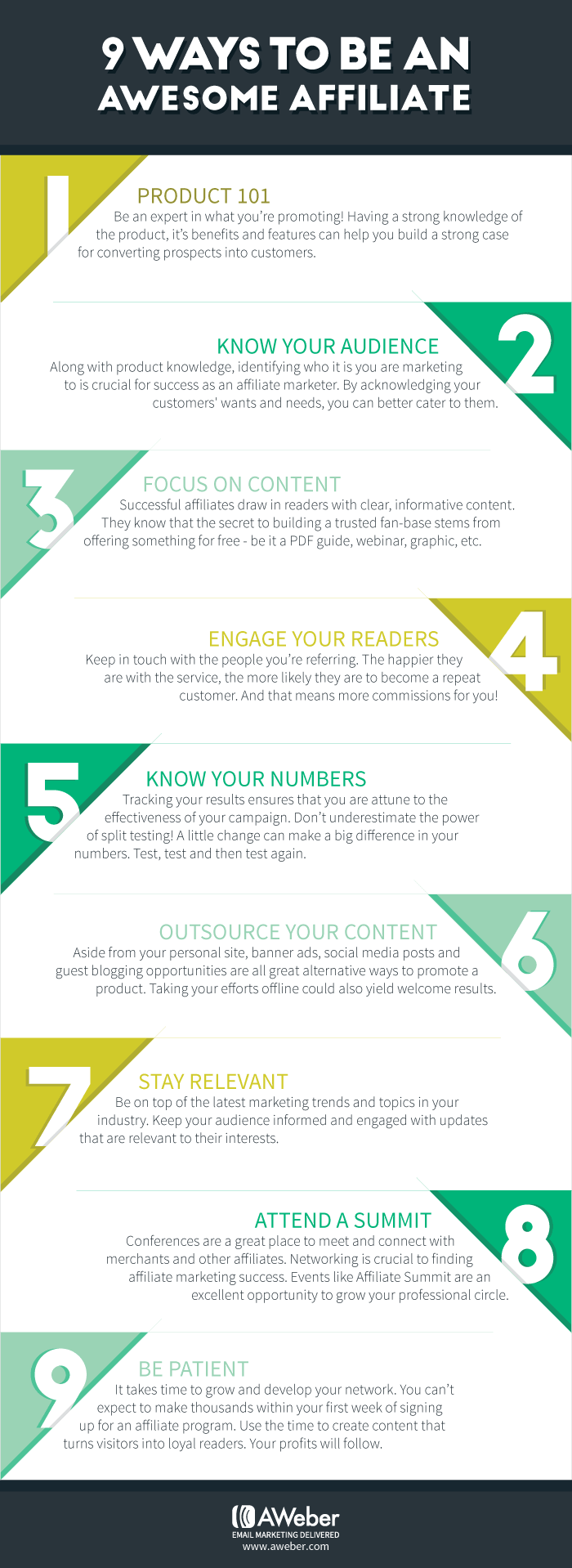
9 Ways To Be An Awesome Affiliate

9-ways-to-be-an-awesome-affiliate


What’s Next?
Have a passion for email marketing? Consider using AWeber as your autoresponder to boost your affiliate marketing!.


Monday, 8 December 2014

My top 11 blogging tips

Alright, so I’m taking a slightly different direction today. I was going through some emails this weekend, poring through questions from the best readers on the Internet (this would be you). I have quite the back log of fantastic reader questions and post suggestions, and I hope to tackle a number of them this fall.

Quite a few repeated themselves about the same subject — blogging. Apparently, some of you think I know how to blog daily while keeping a dust-free home and perfectly groomed children who love each other and never fight.

I have absolutely no idea how one does that. I’ll keep my eye out for the answer, but in the meantime, I I’ll compromise and answer the overarching blogging question, which basically asks, “How do I blog well?”

I don’t know everything about blogging. But I do know some things. Here are my best tips about blogging while still miraculously getting dinner on the table.


1. Decide your reasons.

Think through your purpose in blogging. Blogging for fun looks a bit different than blogging to promote your Etsy site, which also looks different than blogging to practice your writing skills and maybe land a book contract, which – guess what?, looks different than blogging to make a little side income with ad revenue.

You can have more than one reason, of course, so long as they don’t conflict. But if you’re blogging simply to share photos for the grandparents (a great reason, by the way), don’t be disappointed when the ad networks don’t come flooding your email inbox.

Likewise, if you’re blogging to earn revenue (and you therefore want to build an audience), don’t be frustrated when your readers move on when they haven’t heard from you in six weeks.

Blog consistently with your main purpose in doing so.


2. Flow with the seasons.

There are some seasons in life that are more conducive to more in-depth blogging. Enjoy those, and reap their benefits by reading and writing all you can about the topic. For me, I started Simple Mom when my second was a newborn. I nursed all day long, so during those long periods of sitting, I read and read and read some more about blogging.

I started with ProBlogger and went from there, in case you’re wondering.

It wasn’t long before Reed was walking all over the place and scooting the step stool up to the kitchen counter holding the knife block, so needless to say, I was up on my toes much more then. I didn’t read much on the subject of blogging any more.

Go with the season you’re in. Don’t fight it. Another season is probably just around the corner.


3. Marry and keep an amazing man.

Joking. Well, sort of. Honestly, one of the reasons I started Simple Mom — and why I can continue to keep it up — is because my husband Kyle is my most loyal reader and fan. He is a big reason I can write regularly throughout the week, and he sees himself just as much a part of the blog because he helps with the laundry and dishes and carpooling.

I am blessed in that we both work from home. We tag-team our approach to work and parenting, and every Sunday evening we dig up the weekly calendar to decide who works when.

I know not everyone can do this. But I add this to the list because I want you to know that he helps an enormous amount, so I definitely don’t “do it all.” Not by a long stretch.


4. Be you…

Don’t try to be Heather Armstrong, or Ree Drummond, or Ann Voskamp, or Amanda Soule, or Alli Worthington. Be you. Write like you. It’s way more fun. You’ll definitely stick with it longer, and people will enjoy reading you more.


5. …But keep your readers in mind.

This is particularly true if you’re writing with the purpose of generating a community or earning revenue in some form. Yes, in some way you’ll still write for you, but if you’ve created a place where people feel like they belong, like they’re in a community — it’s almost like they have part ownership.

That doesn’t mean you worry yourself to sleep making sure everyone likes you. You still write for you, and the things that interest you. But keep the readers in mind who are blessing you with their time and their eyes.

If they’ve expressed an interest in a topic, go with it.

And also — you can’t say thank you enough. Thank your readers all the time. I slacked off showing my gratitude the first half of this year, and it showed in my writing. Plus, I missed saying thank you, and it made blogging less fun.

Thank you, by the way.


6. Get to know people, and ask good questions.

I’ve rarely met an unfriendly blogger. I’ve met extremely busy bloggers, but I can’t imagine any blogger I’ve met who knows a thing or two honestly wants to withhold major blogging secrets or not reach out and say hello.

Don’t think of bloggers with big audiences as anyone different than you. If you have a good question, just ask. Get to the point, and don’t expect an answer right away, but don’t let intimidation or cynicism stop you from initiating a conversation.

Also, make friends. Blogging is much more fun when you make blogging friends. Email or tweet a blogger, and see if you hit it off.

A hint on this last tip: Reach out to a blogger that seems to have about the same size audience, or who writes about the same topic as you. That way, you can share ideas and experiences as you journey together.  (But you never know, really — Alli and I are fantastic friends, yet our blogs could not be more different.)


7. Drink water, get exercise, and sleep.

Blogging is a sedentary activity, and if you’re not careful, you’ll spend hours and hours of your day not moving much. Move a little every day. Drink water constantly, and keep a cupful right by your laptop. And go to sleep. Shut off that computer and enjoy the three-dimensional world before hitting the pillow.


8. Organize yourself.

If you want to create a blog that posts regularly, has a specific niche, and fosters a community, then you’ve got to plan a bit in advance. Pencil in regular writing, editing, and networking times throughout your week.

Write an editorial calendar. Right now my posts for Simple Mom are more-or-less planned for the next two months, and I keep track of them on a separate calendar within my Google calendars.

Oh, and don’t leave your email client, Facebook, or Twitter open while you write and edit. You’ll never stay focused.


9. Use “use” instead of “utilize.”

Edit, edit, and then edit some more. For every hour I spend writing, I spend about three editing. Choose your words carefully. Spell correctly. Use adverbs where there should be adverbs; adjectives where there should be adjectives.

Get to the point — I’m regularly surprised how much deleting I do before I publish a post. I’ve already deleted paragraphs from this post, in fact.

Don’t use too many exclamation points, and don’t use emoticons — unless you’re blogging for yourself, or for fun. Or if this is your genuine style of writing (see point number four). Then go nuts.

And almost every time, “use” is more appropriate and more pleasant to the ears and eyes than “utilize.” I’m just saying.


10. Don’t forget about the kids.

Remember your priorities. What good is an enormously successful blog if your family is left in the dust? It’s a blessing if you can contribute to your family’s income through your blog, but not to the detriment of your relationships, well-being, and unity.

Close the laptop regularly, and give your kids quality face time. Go on dates with your spouse. Continually kindle your three-dimensional friends.


11. Keep it fun.

This last point is definitely not the least important. Because at the end of the day, if you don’t have a ball running your blog, then you’ll fizzle out, and it’ll show in your writing.

If you’ve noticed you’re no longer having fun, change it up. Take a little break (if your blog is more than just a hobby, re-run posts at least a year old, or find some guest posters). Try vlogging, or taking more photos.

Listen to music while you blog. I do. It makes it a lot more fun.

I could say a bit more about blogging, but I’ll stop for now. There’s already so much out there about the subject — if you’d like to learn more, I’d start with ProBlogger, Blog Coach, and Blogging Basics 101.

Really, at the end of the day, you’ve just got to be you. Your blog, your family, and your self will be all the better because of it.


Alright, fellow bloggers, now it’s your turn. What’s your best blogging tip?


Source
By: TSH

I love this post and it has been such an inspiration for me, thanks TSH!

Friday, 21 November 2014

7 Google Tools For Any Marketer

We all know that Google is a powerful marketing tool and a phenomenal search engine. Any marketer worth his salt will tell you that the goal for their online marketing division is to dominate Google. What does that really mean, though? Are we just trying to show up when someone types in a relative keyword phrase for our business? We all know that search engine optimization is hot, and that Google is the place where everyone wants to be. Unfortunately, though, a lot of marketers don't realize that there are many other programs that Google has, which have very different functions, to assist them with their online marketing efforts. Here is a list of all of the available Google tools, at the current moment in time, which you can use to jumpstart your online marketing campaigns.

Google AdWords - Anyone who knows anything about phrases like CPC (Cost Per Click), PPC (Pay Per Click), CPM (Cost Per Impression), Banner Ads, etc. should know a little bit about AdWords. There are two main networks within the AdWords program: Content/Display and Search. The Content/Display network allows you to post banner ads/graphics on partnering websites that are relative to your content. The Search network allows you to write/display a variety of ads and link them to relevant keywords. When someone types in these keywords, your ads display. It is an extremely powerful program that definitely has a bit of a learning curve, however, once you've mastered it, you can do amazing things!

Google Docs - Think of Google Docs as an internet-based Microsoft Office. You have all the same types of documents (i.e. Word Document, Spreadsheet Documents, etc.), but the beauty is that these documents can be shared with other people. It doesn't stop there... these documents are live creatures! You can literally watch live edits being made to the documents in real-time. This is extremely powerful for coordinating schedules or brainstorm sessions.

Google's Keyword Tool - There are two versions of this tool. One if for users with an AdWords account and one is a free version. Both versions are equally powerful, and allow you to search for keywords that are typed in by other users to get to sites like yours. You can easily compile a list of relevant keywords, their search volumes, how much advertisers are paying per click, and much more data. This can help with both your paid (i.e. PPC) or your free (i.e. SEO) efforts.

Google Alerts - This is another great tool to stay up-to-date with news in relation to keyword phrases. Many people set up alerts for their own company name, their competitors' names, and their industry terms to see when people are using these keywords in their content.

Google News - A great place to stay up to date with industry-related news. You can see what topics are being thrown around and it's a powerful tool to help you generate content for your own marketing efforts.

Google Reader - Google reader is an amazing time-saving tool. You can use it to filter through all the content you don't want to read about, and show only content that you've asked to be shown. Subscribe to blogs, websites, etc. and type in the keywords or phrases you'd like to stay up-to-date with. Whenever these sites release information regarding that keyword or phrase, you'll have that content presented to you in an orderly fashion.

Google Places - An extremely powerful marketing tool that enables people searching Google, to see all types of content related to your business. It will automatically show your location within Google Maps, and it appears towards the top of the page with search results automatically. Google Places uses location information from your computer to display local business results. Browsers can see your hours of operations, photos, your website, reviews, the types of credit cards you take, and much more! Many people use Google Places to appear at the top of the page for search results, especially small, local businesses. If you haven't claimed your Google Places page yet, you should do so immediately.


Any additions, please share!


Source: http://EzineArticles.com/6409313

Friday, 14 November 2014

A Sick Kid and Working Parents: WAHM

By Nicole Banens
Work At Home Mom and mother of 3 with a daddy who works over 40 hours a week.


I used to work a full time job at a marketing company 1 hour commuting from were I live, this meant I left the house at 6.15 in the morning and got back at 5.15 in the afternoon. With 3 kids in the age of 6 and 4 this wasn't an ideal situation, especially with a partner whose often abroad or at least not back home until after 6.30 in the evening. But we managed as long as none of the kids would get sick..... Yes, SICK.
With our parents not living in the Uk, we did not have any back-up as payed childminders don't accept sick kids!! Who to ask last-minute?


There had to be another way!

I had heard of mums working from home, online, using the internet, but how?
After some research to understand the possibilities I decided I wanted to become a WAHM: Work At Home Mom

Unfortunately my employer was clear about working from home: NO...

So, I quit my job!... was it the best idea ever??

Luckily my partner fully backed me up and we had some savings so I could go for it. (I know this isn't possible for everybody)

With a little help I started my home based online business as a Work At Home Mom. 

So far I love it, but there's a lot of work and making big money instantly isn't true. I have to work hard, be persistent and use the best (online) tools, but I can be at there for my kids.


A phone call from School

This Friday morning, only an hour after dropping all 3 off at school the phone rang: "Can you pick up your daughter, she has a temperature and keeps coughing"
Me: "Of course i'll pick her up, be there in 10 min"

As we speak she is asleep and I decided to write this post. Why because I can, I work from home!


Do you work from home or would you like to? Please, share any tips, comments or questions.

Wednesday, 5 November 2014

6 Home-Based Businesses You Can Start Today, Online

The Internet has paved the way for effortless communication, so it’s no wonder more and more entrepreneurs are turning to home-based businesses. What was once perceived as working from the couch and wearing pajamas while fulfilling customer orders has evolved to some pretty lucrative small business ventures.

With a household headquarters in mind, here are 6 examples of some of popular and successful home-based businesses you can start in a neighborhood near you.


 Photo: Maison Scotch
Photo: Maison Scotch

Professional Blogger
Everyone’s favorite form of keeping an online diary is also a great way to make money from the comfort of your own home. Blogging from home is growing in popularity not only because there are practically zero startup costs, but also because it’s a great way of turning self-expression into profit. Before you quit your day job, it’s important to remember that financial success with blogging does not happen over night. It takes discipline in many online arenas including self-promotion, content creation, and SEO. But whether you blog for yourself or guest blog for others, blogging from home can translate into a steady (and sometimes lucrative) income.

Online Retailer
The number one go-to source for consumers looking to buy something is the Internet. So, why not take advantage of the Internet-as-a-storefront mentality and sell something online? There are plenty of online businesses to start, so pick a market and run with it. From services to products, as long as there’s a need for what you want to sell, you’ll be in business. For instance, if you’re a website or graphic designer, sell your services to those in need of design help. Or if you collect antiques, source products on eBay and turn your passion into an income. Just keep in mind that customer service is just as important online as it is in person.

Tax Accountant
When tax season rolls around, millions of people turn to accountants for filing help. This spells opportunity for those with a background in accounting. Whether you’re a certified public accountant or you’re great at running numbers for friends and family, starting a home-based accounting business can be a real income-maker. Tax accountants aren’t the only accountants out there. Entrepreneurs are always in need of small business accountants and internal auditors. As long as you have experience, freelance accounting allows you to enjoy working from your home or even in a telecommuting capacity.

Artisan
Whether you’re a painter, woodworker, or any creative type in between, selling your crafts online is a great way to turn your skills into a steady income. Besides, consumers are always looking for unique gift ideas, especially during the holiday season. There are plenty of ways to sell your crafts online from creating an independent website to joining art-inspired sites like Etsy. Likewise, social media is a creative’s best friend when it comes to spreading the word about arts and crafts, so get social with your selling tactics.

Photographer
A picture says a thousand words and starting a home-based photography business is the perfect way to turn every shot into income. As long as you have an eye for photography and adequate equipment, you can start your own wedding or all-occasion photography business from the comfort of your own home. If catching magical moments on camera isn’t really your thing or you’re more of a straightforward photographer, websites are always in need of stock photos. Submitting stock photos of just about anything to websites can garner a steady income.

Freelance Writer
If you’ve ever heard the saying that content is king — it’s probably because websites, online products, landing pages, and blogs are always in need of good copy. With some solid writing skills and a good at-home work ethic, you can become a freelance copywriter in no time without even leaving the house. There are millions of writing options to choose from, so freelance copywriting gives you the opportunity to learn new things or write about topics you already know. From how-to articles to technical pieces to family topics, freelance writing is a never-ending opportunity.

With the right skills and passion, the occupations above are a great way to make your home-based business dreams come true. Do you run a home-based business? Please feel free to share your experiences with us in the comments below.


Source

Wednesday, 22 October 2014

Make Money Blogging: 20 Lessons Going from 0 to $100,000 per Month

By Jon Morrow

You know everyone thinks we’re fools, right?

To most of the world, blogging is a joke.

It isn’t a career. It isn’t a way to make money. It isn’t a tool for changing the world.

It’s a hobby, a diversion, a fad that’ll come and go. Sure, you can start a blog, but don’t count on it to take you anywhere. That’s just silly.

Try telling your family or friends or coworkers you want to quit your job and make money blogging. They’ll smile politely and ask, “Does anybody really make money from that?”

Yes, they want you to have dreams. Yes, they want you to chase them. Yes, they want you to succeed.

But they also want you to be “realistic.”

If you really want to improve your life, you should get an advanced degree, write a book, or even start your own business, not hang all your hopes and dreams on some stupid little blog. There’s no money in it.

Or is there?

I’m hesitant to say this, but…

This Blog Makes $100,000 per Month
In January and February, we cleared over $100,000 per month in sales. The verdict is still out on March, but if we didn’t make it, we should be close enough.

How?

Well, I’ll tell you. Not because I want to brag (well, maybe a little), but because most of the advice out there about monetizing your blog is complete crap.

For instance, do you see any ads on this site?

No? How about e-books for sale?

None of those either, huh? In fact, you might be hard-pressed to find anything for sale at all.

There’s a reason why.

Over the past six years, I’ve had the good fortune to work with some of the smartest bloggers on the planet. I worked with Brian Clark as he built Copyblogger to a multimillion dollar brand. Neil Patel and Hiten Shah also hired me to help them launch the KISSmetrics blog, and while they’re not big on publishing revenue numbers, they did recently close a $7 million venture capital round.

Combined, I wouldn’t be surprised if both blogs have earned more than $50 million. In comparison, the $100,000 per month I’ve managed to generate is a pittance.

But everyone has to start somewhere, right?

The reason this blog has made so much money so fast is I learned from the best, and then when I left, I kept learning. Every day, I crunch numbers, read books, talk to experts, and spend at least 30 minutes in silence, staring into the distance, doing nothing but thinking.

It’s paid off. If you’ll take some of these lessons to heart, it’ll pay off for you too.

Because here’s the thing:

You’re Not a Fool. You Can Make Money Blogging.
So, you want to make a living teaching other people what you know? Nothing wrong with that.

Professors do it. So do public speakers and best-selling authors.

Hell, consulting is a $415 billion industry, and what are all those consultants doing?

Getting paid to teach.

Blogging is no different. It’s just the same old models with some rocket fuel thrown in, courtesy of social media.

In fact, we might as well call that the first lesson:

Lesson #1: You’re Not Just a Blogger
You’re an expert, a teacher, a mentor, maybe even an entrepreneur. Your blog is simply a launchpad for all those things.

Look around, and you’ll find nearly all “bloggers” who make a decent income have books, courses, a side career as a keynote speaker, or even software. That’s how they make money. Their blog is just the “freebie” they give away to attract customers or clients.

Lesson #2: Don’t Sell Advertising
Selling ads is attractive, because it’s passive income, but you can usually make 3-10X more money using the same “ad space” to sell your own products and services or even promote an affiliate product.

Pat Flynn, for example, makes about $50,000 a month in commissions from promoting Bluehost.

Here at BBT, we mostly promote our own products, but we’re also in the process of creating affiliate sales funnels for LeadPages and Stablehost, both of which offer hefty commissions (and are great products too!)

Lesson #3: Build the Funnel in Reverse
We’ve all experienced sales funnels.

A company entices you with a freebie, then they offer you something cheap but irresistible, and then they gradually sweet talk you into buying more and more expensive stuff. It’s a tried and true marketing tactic, and you should absolutely build a sales funnel for your blog.

What you might not know is you should build it in reverse.

A lot of bloggers launch a cheap e-book as their first product, and then they get frustrated when they don’t make much money. Here’s why: the real profit is at the end of the funnel, not the beginning.

Selling e-books is fine and dandy if you have half a dozen more expensive products to offer your customer afterwards, but it’s downright silly if you don’t. You’re much better off creating and selling the expensive product first, and then gradually create cheaper and cheaper products.

When you do have some less expensive products to sell, you can offer those to new people first, safe in the knowledge that you have something more profitable up your sleeve to sell them later.

Here at BBT, our products cost $9,997, $997, and $591. We’re working our way down the funnel in reverse, releasing the most expensive products first and then gradually getting cheaper and cheaper. It’s been much, much more profitable this way.

Lesson #4: There’s No Such Thing As a “Cheap” Market
“But Jon,” I can hear you spluttering. “I can’t sell a $10,000 product! My customers don’t have that much money.”

My response: you’re 98% right. Unless you’re selling exclusively to multimillionaires, the vast majority of your customer base won’t be able to afford premium products, but what’s interesting is it doesn’t matter. Often times, you can make more money selling to the 2% than you can to the entire 98% combined.

For instance, our $10,000 product is a year-long coaching program for writers – a group that’s not exactly known for their wealth, but I always fill all 10 spots within minutes of opening the program. Here’s why: I notify 40,000 writers about it. 2% of 40,000 is 800 people who might possibly buy a product in that price range. By only accepting 10, I’m creating a situation of extreme scarcity.

You can do the same thing, even if your list is much smaller. If you have 100 subscribers, chances are two of them might be willing to buy premium products or services from you, and those two will often pay you more money than the other 98 combined.

Lesson #5: By Charging Premium Prices, You Can Offer Premium Service
Feel guilty about charging that much money? You shouldn’t.

By charging premium prices, you can offer premium service, doing everything possible to help your customers get results. For example, with my coaching program, I get on the phone with students every week, review their homework, answer their questions, look at their blog, and guide them through every step of the process.

Could I put that same information in a $7 e-book? Sure, but I couldn’t give anyone one-on-one help at that price, and that’s what people who buy premium products and services are paying for.

Lesson #6: Deliberately Delay the Sale
Another big shift in thinking: rather than trying to push everyone to buy your products upfront, smart bloggers delay the sale.

I first heard this idea from Rand Fishkin over at Moz. They offer their blog readers a free trial to their Analytics and SEO software, but after studying the behavior of their customers, they noticed something interesting: people who read several blog posts before signing up for a free trial stayed customers for two or three times longer than people who didn’t.

I’ve noticed the same thing with our customers. Instead of immediately clobbering readers with sales pitches, it’s much better to give them some content first and build trust before you begin talking about your products and services. Yes, you’ll make less money in the short term, but the long-term profits go through the roof.

Lesson #7: You Are the Bottleneck
Without a doubt, time is our biggest problem as bloggers. Not only are we expected to publish a continuous stream of content on our blogs, but we also have to deal with technical issues, read books and articles about our field, create new products to sell, answer questions from readers… the list goes on and on. The further into it you go, the more clear it becomes that you can’t do everything.

So, what’s the answer?

Believe it or not, I found answers from studying manufacturing processes. If one machine is working slower than others in a plant, it can literally cost the company tens of thousands of dollars per hour. To make sure it never happens, smart plant managers are willing to spend any amount of money to eliminate bottlenecks. They have an unlimited budget, because the cost of eliminating the bottleneck never comes anywhere close to the cost of the bottleneck itself.

The same is true for us, except the solutions are often different. Instead of buying a new machine, for example, we might purchase a new type of software that automates some of our business, or we might hire a virtual assistant or programmer. It can be expensive, yes, but it’s worthwhile if it saves you enough time, because then you can dedicate that time to higher value activities.

Lesson #8: Measure The Value of Everything You Do
What are those higher value activities, exactly?

Well, it depends on your goal. If your goal is to increase traffic, for example, start measuring the visitors per hour invested. Let’s say you invest three hours in writing a post, and it brings you 100 visitors, and you invest five hours in writing a guest post that brings you 500 visitors. The first activity has an hourly rate of 33 visitors per hour. The second activity has an hourly rate of 100 visitors per hour. Guest posting, therefore, is a better use of your time than writing content on your own blog.

Granted, it’s a short-term perspective, not taking into account long-term gains, but it’s still extremely useful to start measuring your time this way. Not just for traffic, but also for subscriber growth and revenue.

Lesson #9: In the Beginning, Creating Content for Your Own Blog Is Silly
I tried to sneak this one under lesson #8, but I think it’s important enough to get its own number, even if it does get me labeled a heretic and burned at the stake. Because here’s the deal:

In the beginning, your blog is like an empty classroom. Standing in front and giving a lecture is silly, because sure, it might make you feel important, but there’s nobody listening. You’re all alone, and you can come up with the smartest, most entertaining lecture in the history of mankind, but it won’t matter, because no one else heard it.

When you first start out, writing content for your own blog is one of the least efficient ways of building your audience. You’re far better off serving a little time as a “guest lecturer” first. In other words, write guest posts for someone else’s audience, impress the hell out of them, and siphon off a portion of their readership for your own.

That’s what we did here at BBT, and it resulted in the most successful blog launch in history: 13,000 email subscribers in 60 days, before I even wrote a single blog post. We had nothing but a coming soon page and an invitation to join our email list. Sounds strange, but I can promise you it’s vastly more efficient.

You don’t have to wait until you get to 13,000 subscribers to start, but I’d advise accumulating at least a few hundred. That way, you have an audience to share your content when you start publishing posts.

Lesson #10: Don’t Waste Time on Facebook, Twitter, Google+, etc.
Here’s another shocker: you know your dream of building up a huge following on Facebook or Twitter and then using it to promote your blog? Well, it’s a dumb idea. Out of everything we’ve tested, building our own social media accounts produced the lowest visitor per hour figure. In other words, it’s quite possibly the worst way you can spend your time.

Does that mean having followers in those places is useless?

No. Facebook is nice because you can advertise to your followers. Google+ can help boost your search engine rankings. Even with those benefits though, it shouldn’t be near the top of your list for things to do. In my opinion, you shouldn’t think about them at all until you hit 10,000 subscribers, and then outsource the management of them to someone else. You can use your time more efficiently in other places, such as:

Lesson #11: Webinars Kick Butt
If you’ve been on our list for long, you know that we do a lot of webinars. Here’s why: on average, each webinar generates $40,000 per hour invested. It’s by far the most profitable thing I do. Nothing else even comes close. If you’re wondering how on earth we make that much money, all you have to do is attend one of our webinars to find out. Everything we do is on display, and you can study it, free of charge.

Interestingly, webinars are also the most effective way to build our subscriber base. When doing webinars for other people, we average 500 new email subscribers per hour invested. It’s not uncommon to gain 1,000-2,000 email subscribers from a single webinar. If we’re promoting a product, we usually make at least $10,000 too.

Translation: webinars kick butt.

Lesson #12: Longer Content Gets More Traffic
You know what else works? Long content.

It might seem strange, but on average, longer content gets much more traffic than shorter content. Not just for us, but for our students too, regardless of the niche, and here’s a post where SEO expert Neil Patel came to the same conclusion. The sweet spot seems to be about 2,000–3,000 words per post. That’s why posts here on BBT are much longer than your average blog.

Granted, content of that length also takes longer to produce, but if you measure the visitors per hour invested, longer content still wins by a mile. Assuming you’re promoting it, of course.

Lesson #13: Promote The Crap Out of Your Content
The problem is almost no one promotes their content enough. And by “promotion,” I’m not talking about sharing your own posts on Twitter and Facebook. I’m talking about blogger outreach – the process of building relationships with influencers and asking them to share your work.

At a minimum, you should spend just as much time on outreach as you do creating your own content. So, if you’re spending 10 hours a week writing blog posts, you should be spending 10 hours a week on outreach too.

Can’t do that? Then scale back how much content you’re creating. Spend five hours on writing blog posts and five hours on outreach. You’ll get better results.

Lesson #14: Ignore SEO for the First Year
Let’s get one thing straight: I’m not against SEO. Far from it. We now get tons of traffic from Google. I just think most bloggers focus on it way too early.

Again, it all comes down to time. When your blog is new, the most efficient uses of your time fall into three broad categories: building relationships with influencers (including guest blogging), creating content worth linking to, and selling your products and services. If you do those three things well, not only will your blog gain traffic and prominence, but you’ll also start getting search traffic without doing anything.

And then you can focus on other things that matter more, such as…

Lesson #15: Your Email List Is More Important Than Anything Else
In analytics, there is a principle called “the one metric that matters” (OMTM). The idea is that you find a single number that accurately predicts the success or failure of your project.

In the case of blogging, that number is the size of your email list. (Not RSS, mind you – it’s dying a slow but certain death.) In my experience, your email list is the most accurate predictor of how much money you’ll make.

Here at BBT, we make about three dollars per subscriber per month – an impressive feat, due mostly to our skill with marketing. The number isn’t important, though. The point is that I can accurately predict our sales based on the number of subscribers. So can you.

If you’re new to this, I would strive for one dollar per subscriber per month in sales. In other words, an email list of 1,000 subscribers should result in at least $1,000 per month in sales, 10,000 subscribers would result in $10,000 per month in sales, and so on.

The more subscribers you get, the more money you make. Granted, your relationship with your subscribers and the quality of your products or services and dozens of other factors still matter, but to drive revenue, focus on email list growth. To make money blogging, it’s absolutely essential.

Lesson #16: Start Selling from Day One
How long should you wait before you begin selling? 1,000 subscribers? 10,000 subscribers? More?

Nope. Start selling from day one. Here’s why:

One of the biggest factors affecting the speed of your growth is who you can hire to help you. Because you’re the bottleneck, remember? So you want to hire a virtual assistant and someone to handle all of the technical details as soon as you possibly can, but of course, that requires money. Hence the need to start selling immediately.

Now, a caveat: don’t turn your blog into a gigantic sales pitch. Nobody likes that. You should, however, be offering something your audience wants and needs. Don’t push them on it, but do make it available, and do remind them from time to time that they can purchase it.

Lesson #17: Your Product Ideas Suck
You probably have all kinds of ideas for things you can sell, right? E-books, courses, maybe an iPhone app? Or a service?

Well, here’s the bad news:

More than likely, your ideas for products suck. The good news is you’re not alone in this position. Everyone’s ideas for products suck, including mine. Here’s why:

We all tend to create products we can see people need, but they’re not aware of it yet. We think if we show them the magnitude of their problem we can convince them to buy our product or service to solve it.

If you’re Steve Jobs, you can do that, but I have more bad news for you: you’re not Steve Jobs. You’re a beginning marketer, and as a beginner, you should only be selling products that solve problems your customer already knows they have. If you have to convince them the problem exists, you’ve already lost the battle.

Lesson #18: Surveys Are Dangerous
So, how do you find what problems exist in the mind of your customer? Traditionally, the answer is a survey, but I’ll warn you: surveys are dangerous. Ask the wrong question, and you’ll get an extremely misleading answer. Use that answer to guide your venture, and you can waste years of your life, not to mention possibly going bankrupt.

If you’re a beginner, I recommend asking one and only one question: “what’s your biggest frustration with <topic> right now?” So, in my case, it would be “what’s your biggest frustration with blogging right now?” That’s it. Nothing more. Look for patterns in the answers you receive, and you’ll learn a ton about what products or services you need to create.

Lesson #19: Start with Services, Then Expand into Products
Once you find a common problem, start offering a service where you solve the problem for your audience. The reason is simple: you can start offering the service immediately. You don’t have to create a product first. You’ll also learn more about the problem as you attempt to solve it yourself.

When I started, for example, I worked as a blog traffic specialist. I was contracted with a few different advertising agencies, and every time they wanted to increase the traffic for a client’s blog, they called me. I didn’t just advise them. I did the work myself, redesigning the site, creating the content, everything.

It taught me a ton about what worked and what didn’t. It was also immediate revenue. The first month I offered my services, I made something like $5,000.

After working for more than a year as a traffic specialist, I felt I really understood the problem and how to solve it, so I created my first product: a course located at guestblogging.com. The first month, it generated something like $30,000 in sales, and now it brings in more than $250,000 per year.

It’s a wonderful product, but here’s the thing: I don’t think I could’ve created it if I hadn’t worked as a service provider first. I wouldn’t have had the knowledge or the money. Keep that in mind when you’re deciding what to offer first.

Lesson #20: Teach Others What You Learned
Now, we come to the reason for this post.

Why on earth would the CEO of the company (me) work for hours to write a post like this, sharing all our secrets? It’s closing in on 4,000 words, for God sakes!

Simple:

It’s my responsibility. If people are ever going to respect blogging as a legitimate business model, those of us who are successful have to speak up and share what we’ve learned. None of us works in a vacuum. The only way we can advance our field as a whole is to collectively share what we’ve learned.

And it is a field. There are thousands of people around the world making a living from blogging. The problem is, there’s not a repository, a central community where we can all talk and learn from each other. Over the next few months, that’s something we’re going to change.

In the meantime, could you do me a favor?

Share this post. Not just so it’ll get me traffic, but so other people can see that you really can earn a legitimate income from blogging. Maybe reading this will even help them do it.

After all, isn’t that what we’re here to do? Help people?

In the end, that’s what I love most about blogging: every article we publish, every course we create, every coaching call we do can change somebody’s life. Maybe not always in a big way, but we touch thousands upon thousands of people, and we make their lives just a little bit better. We inform them, we inspire them, we give them the roadmap for achieving their dreams.

And the best part?

We get paid for it. It’s our job.

I just wish more people knew it was a viable career. Let’s change that, shall we?


Source

Thursday, 9 October 2014

Why Are So Many Internet Start-Up’s Failing Today?

Online Business Failures

In the real world of brick and mortar business, every day millions of people are dragging themselves from their comfortable beds, performing their morning rituals of washing and breakfast to head to their jobs. In their daily grind some are thinking that there must be a better and easier way to make a living.

All these millions know someone or know of someone who has “made it” by quitting their boring existence and become their own boss using their own computers in the comfort and ease of home.

While the idea of working from home sounds like an ideal solution, most are just not preparing. Many of these unhappy people will just quit their jobs and jump right into the first internet marketing business they find with no preparation, no knowledge of what they are doing, no education, and no hope of success. Failure is their only option and they are not even aware of it.

According to many sources, more than 90% (Ninety percent) of all Internet business start-ups end in failure within the first 120 (one hundred twenty) days. And that number is all too accurate: NINETY PERCENT!

This alarming failure rate goes unheeded for a number of reasons:

1. Many don’t know the statistical probabilities they face.
2. Many don’t see themselves as being part of the failures or they wouldn’t leap.
3. Many are talked into things they are unprepared for.
4. Many don’t know the basic tenant of – “If you fail to plan, then you plan to fail.”

Of course, success is still a possibility. There IS that other 10% (ten percent) that do succeed. For them, success doesn’t happen by accident. And success isn’t just a crap shoot. Success happens because of some very important factors.

Success happens because people learn about internet marketing and how it works. They do not expect to get rich quick or be able to make a killing overnight and retire to a tropical isle.

It is strange but somehow the same people, who wouldn’t dream of starting a real world business, think they can make a go of an internet business even though they have no business background.

People think that an internet business just means that they no longer have to get up and go to work. They think they can simply work when the feel like it and still make a good living. They do not understand that any business requires them to work hard and sometimes work long hours.

Some Wrong Ideas on the Internet

That 90% failure rate of new Internet businesses really is not surprising when you think about the sort of people who start an internet business.

Most people seem to think that being a successful internet marketer is as easy as getting a website built and getting their own domain name and they could not be farther from reality.

Being a successful internet marketer requires self-discipline. People read books like “4 Hour Work Week” and think that partying all night, sleeping until noon and then 3 or 4 hours with a computer will make them rich.

There is not a magic button to push to have instant massive traffic to their million-dollar-like website and fistfuls of cash in their bank. It is just not going to happen.

Internet marketing does not run on auto-pilot. And while established internet marketing types do not put in the long, boring hours they have built their businesses by doing that in the past.

It does not happen overnight for anybody. Most people are not prepared for the time requirement necessary for an internet business to achieve success.

They Do Not Have a Business Background

All businesses whether large or small, Internet or “brick and mortar” have two things in common: they are a BUSINESS and must be operated like a business! Business people must understand accepted business practices.

There are simple and basic concepts like “acceptable over-head expenses in relation to projected income”. All entrepreneurs need to understand profit and loss and what constitutes each.

It is not a requirement to have a college degree in business to be successful but it wouldn’t hurt. On the other hand some basic business knowledge is an absolute necessity.

If it is difficult to balance your check book, then it might be a good idea to keep your day job and forget about being in business.

Yes, you can hire an accounting firm that will tell you WHEN to make tax deposits, but they will not tell you IF you need to make tax deposits.

An accountant can tell you if you made a profit but not how you make it. If you have no business background get some good business advice before you consider opening any business.

The fact is that all successful businesses follow the rules of sound business principles. A successful business is not an accident. The numbers tell the story that only 10% of all new internet businesses are successful or are even still in existence after their first 120 days.

Even the expectation of profit is not reasonable for the first few month.

Have sufficient resources available for everything from startup costs to personal needs for a period of time. It’s called “capital” and there is no alternative to plenty of it.

They Do Not Have The Right Mindset!

Most of us have heard the phrase, “He has an attitude!” And it is often a derogatory remark made about a person with a negative attitude.

The word “attitude” is important when thinking about marketing start-ups. A good attitude or a good mind set will not guarantee success but a bad attitude or a bad mind set can guarantee failure.

Let’s examine a few attitudes that will absolutely guarantee failure:


  1. I can work when I want to. This is absolutely wrong! You cannot just work when it suits you. Expect many long and sometimes boring hours of hard work for your business to succeed.
  2. I can get rich quick! This is a dangerous one. While getting rich quick is possible, there are too many “get rich quick” schemes that are only ways for the unscrupulous to take advantage of the willing. Expect to be wealthy in whatever time it takes. It is possible to make a very comfortable living in internet marketing but it is not usually quick or easy.
  3. I don’t need a business plan. Internet business is still a business. All business principles apply to online business as they do to brick and mortar business. It is imperative that you have a plan for your success based on sound business principles.
  4. Internet business people do not have a boss. You are the boss. A good boss sees that all work is completed on time and in full, or you will fail. Set up a work schedule and goals to meet or you will find yourself working at a job under a boss who does do those things and maybe for minimum wage.

Ways to Avoid Failure

Starting a business … any business … has no guarantee of success, period!

Even large multi-national businesses can fail in a new business venture. Failure is always an option and the possibility or probability of success can be enhanced.

You can increase your possibility of success by:


  1. Making a business plan BEFORE starting your online business. To remind you one of the things I said at the beginning: “If you fail to plan, then you plan to fail.” A plan for success is a requirement. Have the steps listed in great detail including reasonable cost estimates for completing each step.
  2. Expect to work hard to achieve your goals. Never expect things to be easy. Most of the time things are not as easy as they appear. Each successive step will require its own work, time and patience. Sometimes things don’t go right on the first try. Be willing to keep going again and again until you succeed.
  3. Do not fall for a get-rich-quick schemes. The internet woods are full of those who prey upon those who are looking for quick and easy ways to become rich. Most are ways for the other person to get rich quick from your money.

Remember those statistics! Ninety percent of all new internet businesses fail in the first 120 days. You don’t have to be part of that majority. You can become a part of that 10% minority of successful internet business enterprises. Find something that others are having success with – to the level you want your own success, do what they do, and you will have your own success. Be prepared to do whatever it takes for as long as it takes.


Source: http://www.chrisducker.com/internet-business-failures/

Wednesday, 8 October 2014

How to Start a Business Online

7 tried and true steps for attracting visitors to your site--and getting them to buy.


There is a proven sequence of steps you can follow to guarantee your success when you're starting a small business online. I've seen thousands of people start and grow successful businesses by doing the following:
  1. Find a need and fill it.
  2. Write copy that sells.
  3. Design and build an easy-to-use website.
  4. Use search engines to drive traffic to your site.
  5. Establish an expert reputation for yourself.
  6. Follow up with your customers and subscribers with e-mail.
  7. Increase your income through back-end sales and upselling.
Anyone, from newbie to seasoned online entrepreneur, can benefit from this process in learning how to start a business online.

Step 1: Find a need and fill it

Most people who are just starting out make the mistake of looking for a product first, and a market second.
To boost your chances of success, start with a market. The trick is to find a group of people who are searching for a solution to a problem, but not finding many results. The internet makes this kind of market research easy:
  • Visit online forums to see what questions people ask and what problems they're trying to solve.
  • Do keyword research to find keywords that a lot of people are searching, but for which not many sites are competing.
  • Check out your potential competitors by visiting their sites and taking note of what they're doing to fill the demand. Then you can use what you've learned and create a product for a market that already exists--and do it better than the competition.

Step 2: Write copy that sells

There's a proven sales copy formula that takes visitors through the selling process from the moment they arrive to the moment they make a purchase:
  1. Arouse interest with a compelling headline.
  2. Describe the problem your product solves.
  3. Establish your credibility as a solver of this problem.
  4. Add testimonials from people who have used your product.
  5. Talk about the product and how it benefits the user.
  6. Make an offer.
  7. Make a strong guarantee.
  8. Create urgency.
  9. Ask for the sale.
Throughout your copy, you need to focus on how your product or service is uniquely able solve people's problems or make their lives better. Think like a customer and ask "What's in it for me?"

Step 3: Design and build your website

Once you've got your market and product, and you've nailed down your selling process, now you're ready for your small-business web design. Remember to keep it simple. You have fewer than five seconds to grab someone's attention--otherwise they're gone, never to be seen again. Some important tips to keep in mind:
  • Choose one or two plain fonts on a white background.
  • Make your navigation clear and simple, and the same on every page.
  • Only use graphics, audio or video if they enhance your message.
  • Include an opt-in offer so you can collect e-mail addresses.
  • Make it easy to buy--no more than two clicks between potential customer and checkout.
  • Your website is your online storefront, so make it customer-friendly.

Step 4: Use search engines to drive targeted buyers to your site

Pay-per-click advertising is the easiest way to get traffic to a brand-new site. It has two advantages over waiting for the traffic to come to you organically. First, PPC ads show up on the search pages immediately, and second, PPC ads allow you to test different keywords, as well as headlines, prices and selling approaches. Not only do you get immediate traffic, but you can also use PPC ads to discover your best, highest-converting keywords. Then you can distribute the keywords throughout your site in your copy and code, which will help your rankings in the organic search results.

Step 5: Establish an expert reputation for yourself

People use the internet to find information. Provide that information for free to other sites, and you'll see more traffic and better search engine rankings. The secret is to always include a link to your site with each tidbit of information. 
  • Give away free, expert content. Create articles, videos or any other content that people will find useful. Distribute that content through online article directories or social media sites.
  • Include "send to a friend" links on valuable content on your website.
  • Become an active expert in industry forums and social networking sites where your target market hangs out.
You'll reach new readers. But even better, every site that posts your content will link back to yours. Search engines love links from relevant sites and will reward you in the rankings.

Step 6: Use the power of e-mail marketing to turn visitors into buyers.

When you build an opt-in list, you're creating one of the most valuable assets of your online business. Your customers and subscribers have given you permission to send them e-mail. That means:
  • You're giving them something they've asked for.
  • You're developing lifetime relationships with them.
  • The response is 100 percent measurable.
  • E-mail marketing is cheaper and more effective than print, TV or radio because it's highly targeted.
Anyone who visits your site and opts in to your list is a very hot lead. And there's no better tool than e-mail for following up with those leads.

Step 7: Increase your income through back-end sales and upselling 

One of the most important internet marketing strategies is to develop every customer's lifetime value. At least 36 percent of people who have purchased from you once will buy from you again if you follow up with them. Closing that first sale is by far the most difficult part--not to mention the most expensive. So use back-end selling and upselling to get them to buy again:
  • Offer products that complement their original purchase.
  • Send out electronic loyalty coupons they can redeem on their next visit.
  • Offer related products on your "Thank You" page after they purchase.
Reward your customers for their loyalty and they'll become even more loyal.
The internet changes so fast that one year online equals about five years in the real world. But the principles of how to start and grow a successful online business haven't changed at all. If you're just starting a small business online, stick to this sequence. If you've been online awhile, do a quick review and see if there's a step you're neglecting, or never got around to doing in the first place. You can't go wrong with the basics.