Showing posts with label how to start making money online. Show all posts

Sunday, 9 November 2014

50 Blog and Content Monetization Strategies for 2014 & Beyond

Ready to start making more money from the content on your blog and beyond in 2014? In this guide, we’re going to look at 50 ways you can monetize your content both on and off of your blog.

Monetize Your Blog
Here are the top strategies plus a few new ones to try. Remember that monetizing your blog is all about experimentation; there is always more than one way to do it. Most of the top earners online monetize in a variety of ways.


1. If you are earning money on your blog through promoting affiliate products or your own products, remove any Google AdSense or other low cost per click advertising. Do not lose $50+ in commissions or sales for a $0.01 click.

2. If you write content for other sites, consider the topics you submit carefully. Any topics where the post would directly lead to sales of affiliate products or your own products should stay on your blog. For example, a post entitled “10 Great Tools for Freelancers” where seven out of the 10 tools have affiliate program options should be posted to your blog. Any other topics should be used as guest posts.

3. Add a “Hire Me” page to your blog that outlines services you can offer to your blog readers. If you’re not sure what to offer as a service, think of the things that people ask you to do the most. Maybe it’s help them configure their blog, evaluate or customize the design, review the content, promote the content, etc. Whatever you get asked to do often could make for a great service offering.

4. Add an “Advertise” page to your blog that outlines what advertising options you have to offer — banner ads, text link ads (nofollow, of course), sponsored reviews, sponsored tweets, sponsored infographic placement, etc. — so that people know how they can get more exposure for their businesses on your website. Be sure to include a media kit [click here to use our customized media kit generator tool] with stats on traffic, mailing list subscribers, RSS subscribers, Twitter followers, Facebook fans, and so forth.

5. Attract advertisers by keeping a high fill rate. If a potential advertisers comes by and sees four “Advertise Here” boxes in your sidebar, they will know the site is not popular enough to receive advertising offers. Leave one available “Advertise Here” box in your sidebar in the smallest space possible (usually a 125×125 space) and use affiliate product banners for the rest until the spaces get legitimate offers.

6. Consider paid placement of content on your blog. Networks like PostJoint connect bloggers to marketers who have guest posts they will pay to place on relevant sites.

7. Share your blog audience with quality publications to earn income. Networks like LinkSmart help bloggers create revenue-generating links to relevant content within their blog posts to sites within their publisher network.

8. Monetize the area beneath your content with third-party content links from networks like Outbrain, Taboola, and even comment platforms such as Disqus.

9. Want to try affiliate marketing, but not sure how? Start with any products or tools that you have paid for to build your blog such as premium WordPress themes, paid SEO and social media management tools, e-books you have read or courses you have taken to grow your blog, and similar. Just search for the product, tool, e-book, or course name plus affiliates or affiliate program on Google to find out if they have one you can join.

10. Already promoting several affiliate products? Cater them to your content by using the Widget Logic plugin for WordPress. It allows you to add PHP code in order to only display sidebar widgets in certain areas on your website. For example, if you write about several different topics within different categories, you can create multiple widgets for the top and bottom of your sidebar that will show affiliate products that match the topic of your posts based on the category (see example targeting options here). You can also have a default widget in both of those spots that show a general affiliate product that fits the theme of your blog for any posts or pages that don’t match the specific topics. This can help boost your affiliate commissions by showing the right products to the right readers.

11. Include a call to action at the end of each and every post, whether it is a call to action to buy an affiliate product, learn more about your services, or purchase one of your own products. When a reader thoroughly enjoys a piece of your content, they will be primed to buy something from you.

12. Turn your blog into a lead generating machine by adding mailing list opt-ins in all the right places: your header using plugins such as HelloBar, near the top of your sidebar, at the end of posts, on your about page, and on your thank you pages not related to newsletter signups such as your thank you for commenting page using Comment Redirect or your thank you for contacting me page using any comment plugin that offers a redirection URL after a form is submitted.


Monetize Older Content
Go into your Google Analytics program and look at the top pages for the last year. Notice a few pieces from several years ago that are getting a consistent amount of traffic? Make sure those pieces of content are monetized in the following ways so that you are capitalizing on all of your hard work throughout the years.

13. Find an affiliate product that matches the topic of the post and add a pitch for it near the end of the post. If your post is still getting a lot of traffic, then it is considered a good source of information. Help people discover more information related to that topic that they can purchase through your affiliate link.

14. End the post with a strong call to action for your own products or services if relevant.

15. At the very least, make sure the post drives people to sign up for your mailing list. Consider having subscribers go to a special mailing list that is set up for an autoresponder series that leads them to purchasing an affiliate product or a product of your own.

16. Have an older technical post that is still receiving a lot of traffic? Turn it into a whitepaper or report and offer it as a lead magnet of your mailing list.

17. Notice a series of older posts that are thematically linked and still receive traffic? Turn those posts into an e-book that you either offer as a lead magnet for your mailing list or for sale on the Amazon Kindle Store.

Monetize Your Videos
You don’t have to create written content in order to make money through your blog. Video content can be monetized as well, no matter what network you place it upon. 

18. Enable the option to monetize your YouTube videos with Google AdSense ads. You’ll need to log in to your YouTube channel in order for the link to work.

19. Include links within your video description on networks like YouTube and Vimeo that direct people to the products or services mentioned in your video.

20. Take advantage of Associated Website Annotatations on YouTube to get links directly to your website in your YouTube videos.

21. Consider premium tools like Viewbix that allows you to add apps directly to videos from YouTube, Facebook, Vimeo, and other third party video platforms. These apps allow video viewers to engage with your video in ways such as subscribing to your mailing list or learning more about your products and services. Note that apps are viewable on videos embedded on your website within the Viewbix player, not on YouTube itself.

22. Capitalize on the audience of networks like YouTube and Vimeo by turning posts about affiliate products or your own products into videos. People who may not want to read a review about an affiliate product or your own might enjoy a video review or walkthrough of the product instead.

23. Monitor your video comments. If you notice a particular set of videos are increasingly popular and people are asking for more information, consider creating more in-depth videos from those and selling them as a video course.

Monetize Your Podcast
Podcasting is continuously increasing in popularity, and it is a medium that allows you to tap into an entirely new audience if you have only been using written or video content up until this point. If you use podcasting as a part of your blog content in any way, here are some ways to monetize it.

24. Have a popular podcast? Start looking for sponsors. You can look towards other popular podcasts in your niche to see who is sponsoring them (usually announced at the beginning of an episode) and reach out to those advertisers. You can also add it as an option in your advertising page so advertisers know they can reach a larger audience on iTunes.

25. Create show notes for each of your podcast episodes that you direct listeners to. This will be a great place to include affiliate product links, links to your own product sales pages, and links to your services page as mentioned through the podcast.

26. Do you think portions of your podcasts could be compiled to make an interesting audio book? Try your hand at converting your podcast clips into an audio book for platforms such as Audible.

27. Turn an insanely popular podcast into revenue by hosting private podcasts for members only.

Monetize Your Presentations
Do you have presentations that you use for speaking or to supplement your blog content? If so, you can place those presentations on Slideshare and monetize them in a few different ways.

28. Links within presentations are clickable on Slideshare, so be sure to link to any affiliate products, sales pages, services, or squeeze pages mentioned in the slides.

29. End each presentation with a few links that people can click through to learn more about you, including links to your lead magnets, products, and services.

30. Premium Slideshare members can add a lead generation form into their presentations. This form will be shown at the end of your presentation on Slideshare itself, on any social networks the presentation is shared upon, and on any websites the presentation is embedded in. If your presentations are popular, it’s a great way to generate leads for your business.

Monetize Your Kindle Books
Amazon Kindle has provided everyone with the opportunity to be a published author. Regardless of whether you want to be an author, having a Kindle book allows you to reach a massive audience on Amazon. Of course, unless you’re a bestseller, you won’t actually earn a lot off of the Kindle store from book sales themselves as most by unknown authors are sold for $2.99 or less. Here are some other ways to monetize e-books through Kindle.

31. Make each Kindle book a lead-in to a product or service that you have to offer. Think about the topics your ideal customer would be seeking information on from Amazon and create your e-books accordingly.

32. Offer Kindle books that are acting as lead magnets for your products and services under the Kindle Select Program. This program means that you are exclusively offering the book on Amazon and gives you more options for promoting it, such as the ability to offer it for free for a boost in sales rankings and reviews.

33. Interlink each Kindle book you create with others. This way, if someone discovers one but isn’t necessarily interested in the product or service it promotes, they will still be invited to read your other books and learn about the products and services associated to those.

34. End each book with a link to your squeeze page so that readers can become mailing list subscribers. Create a list with a specific autoresponder series that leads the reader into buying a particular product or service.

35. Add links to supplementary content within your Kindle book that are fully monetized. For example, if you mention a product that you are an affiliate for, link to a YouTube video or blog post where you demonstrate the value of the product and have an affiliate link for it.

Monetize Your Infographics
Infographics have been heavily used by the SEO industry as a way to build backlinks in exchange for better rankings. High quality infographics also have the potential to become viral across social networks and sites as large as Mashable. Learn how to use infographics for monetization in a number of ways.

36. Place an infographic on your sales or squeeze pages. Because of the high likelihood that the infographic will be shared, you will get a lot of links back to your sales and squeeze pages, increasing their rankings and conversions.

37. Place an infographic within product review posts. Because of the high likelihood that the infographic will be shared, you will get an increased volume of traffic to your posts, increasing their affiliate sales.

38. Include shortened links throughout your infographic in relation to mentioned affiliate products, such as an infographic about the top tools for a specific purpose.

39. Include links at the bottom of your infographic leading back to your business website, sales, or squeeze pages. This way, no matter where the infographic is posted, people can find a way back to your business.

40. Turn product reviews into infographics, posting them on sites such as Flickr and Pinterest. Include links from those networks that lead to the products themselves. Watch out for Pinterest stripping affiliate credentials in some cases.

Monetize Repurposed Content
People like to learn in different ways. While some people like to read posts on a blog, others might want to hear a podcast or watch a video. Here are some ways you can repurpose your content on an on-going basis and monetize each piece of repurposed content.

Repurposing Text-Based Blog Posts

41. Turn blog posts into podcasts simply by repurposing the text within them as a script. Monetize your podcasts in the ways discussed in the section about podcasting above.

42. Turn blog posts into videos by turning tutorials into screencasts or a little facetime with the camera. Monetize your videos in the ways discussed in the section about videos above.

43. Turn blog posts into presentations by taking the main points and turning them into visually impressive slides. Monetize your presentations in the ways discussed in the section about podcasting above.

44. Turn a series of blog posts into an e-book. Offer the e-book as a lead magnet or sell it on Amazon Kindle.

45. Turn technical posts on your blog into whitepapers and reports. Offer the whitepapers and reports as lead magnets, adding new subscribers to lists with an auto responder series designed to sell a related product.

Repurposing Podcasts

46. Turn each podcast episode into a written post for your blog if you haven’t already. You will want this to be more than just at transcription. Find someone who can turn the podcast content into a unique piece of written content, then monetize it with relevant links to products and services.

47. Turn a series of posts created from your podcasts into an e-book. Offer the e-book as a lead magnet or sell it on Amazon Kindle.

Repurposing Videos

48. When applicable, strip the audio from your videos (such as interviews and Google+ Hangouts) and use them as podcasts. Monetize your podcasts in the ways discussed in the section about podcasting above.

49. Turn each video into a written post for your blog if you haven’t already. You will want this to be more than just at transcription. Find someone who can turn the video content into a unique piece of written content, then monetize it with relevant links to products and services

50. Update a series of older, popular videos with additional details and repackage them into a video course. Link this course to the older videos.

Bottom Line
There you have it — 50 ways to monetize the content you create for your blog, your podcasts, your presentations, and your videos. With these tips, you should have a very successful and profitable content marketing and monetization strategy. Have additional tips? Please share them in the comments!


Source: http://monetizepros.com/blog/2014/50-blog-and-content-monetization-strategies/

Wednesday, 5 November 2014

6 Home-Based Businesses You Can Start Today, Online

The Internet has paved the way for effortless communication, so it’s no wonder more and more entrepreneurs are turning to home-based businesses. What was once perceived as working from the couch and wearing pajamas while fulfilling customer orders has evolved to some pretty lucrative small business ventures.

With a household headquarters in mind, here are 6 examples of some of popular and successful home-based businesses you can start in a neighborhood near you.


 Photo: Maison Scotch
Photo: Maison Scotch

Professional Blogger
Everyone’s favorite form of keeping an online diary is also a great way to make money from the comfort of your own home. Blogging from home is growing in popularity not only because there are practically zero startup costs, but also because it’s a great way of turning self-expression into profit. Before you quit your day job, it’s important to remember that financial success with blogging does not happen over night. It takes discipline in many online arenas including self-promotion, content creation, and SEO. But whether you blog for yourself or guest blog for others, blogging from home can translate into a steady (and sometimes lucrative) income.

Online Retailer
The number one go-to source for consumers looking to buy something is the Internet. So, why not take advantage of the Internet-as-a-storefront mentality and sell something online? There are plenty of online businesses to start, so pick a market and run with it. From services to products, as long as there’s a need for what you want to sell, you’ll be in business. For instance, if you’re a website or graphic designer, sell your services to those in need of design help. Or if you collect antiques, source products on eBay and turn your passion into an income. Just keep in mind that customer service is just as important online as it is in person.

Tax Accountant
When tax season rolls around, millions of people turn to accountants for filing help. This spells opportunity for those with a background in accounting. Whether you’re a certified public accountant or you’re great at running numbers for friends and family, starting a home-based accounting business can be a real income-maker. Tax accountants aren’t the only accountants out there. Entrepreneurs are always in need of small business accountants and internal auditors. As long as you have experience, freelance accounting allows you to enjoy working from your home or even in a telecommuting capacity.

Artisan
Whether you’re a painter, woodworker, or any creative type in between, selling your crafts online is a great way to turn your skills into a steady income. Besides, consumers are always looking for unique gift ideas, especially during the holiday season. There are plenty of ways to sell your crafts online from creating an independent website to joining art-inspired sites like Etsy. Likewise, social media is a creative’s best friend when it comes to spreading the word about arts and crafts, so get social with your selling tactics.

Photographer
A picture says a thousand words and starting a home-based photography business is the perfect way to turn every shot into income. As long as you have an eye for photography and adequate equipment, you can start your own wedding or all-occasion photography business from the comfort of your own home. If catching magical moments on camera isn’t really your thing or you’re more of a straightforward photographer, websites are always in need of stock photos. Submitting stock photos of just about anything to websites can garner a steady income.

Freelance Writer
If you’ve ever heard the saying that content is king — it’s probably because websites, online products, landing pages, and blogs are always in need of good copy. With some solid writing skills and a good at-home work ethic, you can become a freelance copywriter in no time without even leaving the house. There are millions of writing options to choose from, so freelance copywriting gives you the opportunity to learn new things or write about topics you already know. From how-to articles to technical pieces to family topics, freelance writing is a never-ending opportunity.

With the right skills and passion, the occupations above are a great way to make your home-based business dreams come true. Do you run a home-based business? Please feel free to share your experiences with us in the comments below.


Source

Wednesday, 22 October 2014

Make Money Blogging: 20 Lessons Going from 0 to $100,000 per Month

By Jon Morrow

You know everyone thinks we’re fools, right?

To most of the world, blogging is a joke.

It isn’t a career. It isn’t a way to make money. It isn’t a tool for changing the world.

It’s a hobby, a diversion, a fad that’ll come and go. Sure, you can start a blog, but don’t count on it to take you anywhere. That’s just silly.

Try telling your family or friends or coworkers you want to quit your job and make money blogging. They’ll smile politely and ask, “Does anybody really make money from that?”

Yes, they want you to have dreams. Yes, they want you to chase them. Yes, they want you to succeed.

But they also want you to be “realistic.”

If you really want to improve your life, you should get an advanced degree, write a book, or even start your own business, not hang all your hopes and dreams on some stupid little blog. There’s no money in it.

Or is there?

I’m hesitant to say this, but…

This Blog Makes $100,000 per Month
In January and February, we cleared over $100,000 per month in sales. The verdict is still out on March, but if we didn’t make it, we should be close enough.

How?

Well, I’ll tell you. Not because I want to brag (well, maybe a little), but because most of the advice out there about monetizing your blog is complete crap.

For instance, do you see any ads on this site?

No? How about e-books for sale?

None of those either, huh? In fact, you might be hard-pressed to find anything for sale at all.

There’s a reason why.

Over the past six years, I’ve had the good fortune to work with some of the smartest bloggers on the planet. I worked with Brian Clark as he built Copyblogger to a multimillion dollar brand. Neil Patel and Hiten Shah also hired me to help them launch the KISSmetrics blog, and while they’re not big on publishing revenue numbers, they did recently close a $7 million venture capital round.

Combined, I wouldn’t be surprised if both blogs have earned more than $50 million. In comparison, the $100,000 per month I’ve managed to generate is a pittance.

But everyone has to start somewhere, right?

The reason this blog has made so much money so fast is I learned from the best, and then when I left, I kept learning. Every day, I crunch numbers, read books, talk to experts, and spend at least 30 minutes in silence, staring into the distance, doing nothing but thinking.

It’s paid off. If you’ll take some of these lessons to heart, it’ll pay off for you too.

Because here’s the thing:

You’re Not a Fool. You Can Make Money Blogging.
So, you want to make a living teaching other people what you know? Nothing wrong with that.

Professors do it. So do public speakers and best-selling authors.

Hell, consulting is a $415 billion industry, and what are all those consultants doing?

Getting paid to teach.

Blogging is no different. It’s just the same old models with some rocket fuel thrown in, courtesy of social media.

In fact, we might as well call that the first lesson:

Lesson #1: You’re Not Just a Blogger
You’re an expert, a teacher, a mentor, maybe even an entrepreneur. Your blog is simply a launchpad for all those things.

Look around, and you’ll find nearly all “bloggers” who make a decent income have books, courses, a side career as a keynote speaker, or even software. That’s how they make money. Their blog is just the “freebie” they give away to attract customers or clients.

Lesson #2: Don’t Sell Advertising
Selling ads is attractive, because it’s passive income, but you can usually make 3-10X more money using the same “ad space” to sell your own products and services or even promote an affiliate product.

Pat Flynn, for example, makes about $50,000 a month in commissions from promoting Bluehost.

Here at BBT, we mostly promote our own products, but we’re also in the process of creating affiliate sales funnels for LeadPages and Stablehost, both of which offer hefty commissions (and are great products too!)

Lesson #3: Build the Funnel in Reverse
We’ve all experienced sales funnels.

A company entices you with a freebie, then they offer you something cheap but irresistible, and then they gradually sweet talk you into buying more and more expensive stuff. It’s a tried and true marketing tactic, and you should absolutely build a sales funnel for your blog.

What you might not know is you should build it in reverse.

A lot of bloggers launch a cheap e-book as their first product, and then they get frustrated when they don’t make much money. Here’s why: the real profit is at the end of the funnel, not the beginning.

Selling e-books is fine and dandy if you have half a dozen more expensive products to offer your customer afterwards, but it’s downright silly if you don’t. You’re much better off creating and selling the expensive product first, and then gradually create cheaper and cheaper products.

When you do have some less expensive products to sell, you can offer those to new people first, safe in the knowledge that you have something more profitable up your sleeve to sell them later.

Here at BBT, our products cost $9,997, $997, and $591. We’re working our way down the funnel in reverse, releasing the most expensive products first and then gradually getting cheaper and cheaper. It’s been much, much more profitable this way.

Lesson #4: There’s No Such Thing As a “Cheap” Market
“But Jon,” I can hear you spluttering. “I can’t sell a $10,000 product! My customers don’t have that much money.”

My response: you’re 98% right. Unless you’re selling exclusively to multimillionaires, the vast majority of your customer base won’t be able to afford premium products, but what’s interesting is it doesn’t matter. Often times, you can make more money selling to the 2% than you can to the entire 98% combined.

For instance, our $10,000 product is a year-long coaching program for writers – a group that’s not exactly known for their wealth, but I always fill all 10 spots within minutes of opening the program. Here’s why: I notify 40,000 writers about it. 2% of 40,000 is 800 people who might possibly buy a product in that price range. By only accepting 10, I’m creating a situation of extreme scarcity.

You can do the same thing, even if your list is much smaller. If you have 100 subscribers, chances are two of them might be willing to buy premium products or services from you, and those two will often pay you more money than the other 98 combined.

Lesson #5: By Charging Premium Prices, You Can Offer Premium Service
Feel guilty about charging that much money? You shouldn’t.

By charging premium prices, you can offer premium service, doing everything possible to help your customers get results. For example, with my coaching program, I get on the phone with students every week, review their homework, answer their questions, look at their blog, and guide them through every step of the process.

Could I put that same information in a $7 e-book? Sure, but I couldn’t give anyone one-on-one help at that price, and that’s what people who buy premium products and services are paying for.

Lesson #6: Deliberately Delay the Sale
Another big shift in thinking: rather than trying to push everyone to buy your products upfront, smart bloggers delay the sale.

I first heard this idea from Rand Fishkin over at Moz. They offer their blog readers a free trial to their Analytics and SEO software, but after studying the behavior of their customers, they noticed something interesting: people who read several blog posts before signing up for a free trial stayed customers for two or three times longer than people who didn’t.

I’ve noticed the same thing with our customers. Instead of immediately clobbering readers with sales pitches, it’s much better to give them some content first and build trust before you begin talking about your products and services. Yes, you’ll make less money in the short term, but the long-term profits go through the roof.

Lesson #7: You Are the Bottleneck
Without a doubt, time is our biggest problem as bloggers. Not only are we expected to publish a continuous stream of content on our blogs, but we also have to deal with technical issues, read books and articles about our field, create new products to sell, answer questions from readers… the list goes on and on. The further into it you go, the more clear it becomes that you can’t do everything.

So, what’s the answer?

Believe it or not, I found answers from studying manufacturing processes. If one machine is working slower than others in a plant, it can literally cost the company tens of thousands of dollars per hour. To make sure it never happens, smart plant managers are willing to spend any amount of money to eliminate bottlenecks. They have an unlimited budget, because the cost of eliminating the bottleneck never comes anywhere close to the cost of the bottleneck itself.

The same is true for us, except the solutions are often different. Instead of buying a new machine, for example, we might purchase a new type of software that automates some of our business, or we might hire a virtual assistant or programmer. It can be expensive, yes, but it’s worthwhile if it saves you enough time, because then you can dedicate that time to higher value activities.

Lesson #8: Measure The Value of Everything You Do
What are those higher value activities, exactly?

Well, it depends on your goal. If your goal is to increase traffic, for example, start measuring the visitors per hour invested. Let’s say you invest three hours in writing a post, and it brings you 100 visitors, and you invest five hours in writing a guest post that brings you 500 visitors. The first activity has an hourly rate of 33 visitors per hour. The second activity has an hourly rate of 100 visitors per hour. Guest posting, therefore, is a better use of your time than writing content on your own blog.

Granted, it’s a short-term perspective, not taking into account long-term gains, but it’s still extremely useful to start measuring your time this way. Not just for traffic, but also for subscriber growth and revenue.

Lesson #9: In the Beginning, Creating Content for Your Own Blog Is Silly
I tried to sneak this one under lesson #8, but I think it’s important enough to get its own number, even if it does get me labeled a heretic and burned at the stake. Because here’s the deal:

In the beginning, your blog is like an empty classroom. Standing in front and giving a lecture is silly, because sure, it might make you feel important, but there’s nobody listening. You’re all alone, and you can come up with the smartest, most entertaining lecture in the history of mankind, but it won’t matter, because no one else heard it.

When you first start out, writing content for your own blog is one of the least efficient ways of building your audience. You’re far better off serving a little time as a “guest lecturer” first. In other words, write guest posts for someone else’s audience, impress the hell out of them, and siphon off a portion of their readership for your own.

That’s what we did here at BBT, and it resulted in the most successful blog launch in history: 13,000 email subscribers in 60 days, before I even wrote a single blog post. We had nothing but a coming soon page and an invitation to join our email list. Sounds strange, but I can promise you it’s vastly more efficient.

You don’t have to wait until you get to 13,000 subscribers to start, but I’d advise accumulating at least a few hundred. That way, you have an audience to share your content when you start publishing posts.

Lesson #10: Don’t Waste Time on Facebook, Twitter, Google+, etc.
Here’s another shocker: you know your dream of building up a huge following on Facebook or Twitter and then using it to promote your blog? Well, it’s a dumb idea. Out of everything we’ve tested, building our own social media accounts produced the lowest visitor per hour figure. In other words, it’s quite possibly the worst way you can spend your time.

Does that mean having followers in those places is useless?

No. Facebook is nice because you can advertise to your followers. Google+ can help boost your search engine rankings. Even with those benefits though, it shouldn’t be near the top of your list for things to do. In my opinion, you shouldn’t think about them at all until you hit 10,000 subscribers, and then outsource the management of them to someone else. You can use your time more efficiently in other places, such as:

Lesson #11: Webinars Kick Butt
If you’ve been on our list for long, you know that we do a lot of webinars. Here’s why: on average, each webinar generates $40,000 per hour invested. It’s by far the most profitable thing I do. Nothing else even comes close. If you’re wondering how on earth we make that much money, all you have to do is attend one of our webinars to find out. Everything we do is on display, and you can study it, free of charge.

Interestingly, webinars are also the most effective way to build our subscriber base. When doing webinars for other people, we average 500 new email subscribers per hour invested. It’s not uncommon to gain 1,000-2,000 email subscribers from a single webinar. If we’re promoting a product, we usually make at least $10,000 too.

Translation: webinars kick butt.

Lesson #12: Longer Content Gets More Traffic
You know what else works? Long content.

It might seem strange, but on average, longer content gets much more traffic than shorter content. Not just for us, but for our students too, regardless of the niche, and here’s a post where SEO expert Neil Patel came to the same conclusion. The sweet spot seems to be about 2,000–3,000 words per post. That’s why posts here on BBT are much longer than your average blog.

Granted, content of that length also takes longer to produce, but if you measure the visitors per hour invested, longer content still wins by a mile. Assuming you’re promoting it, of course.

Lesson #13: Promote The Crap Out of Your Content
The problem is almost no one promotes their content enough. And by “promotion,” I’m not talking about sharing your own posts on Twitter and Facebook. I’m talking about blogger outreach – the process of building relationships with influencers and asking them to share your work.

At a minimum, you should spend just as much time on outreach as you do creating your own content. So, if you’re spending 10 hours a week writing blog posts, you should be spending 10 hours a week on outreach too.

Can’t do that? Then scale back how much content you’re creating. Spend five hours on writing blog posts and five hours on outreach. You’ll get better results.

Lesson #14: Ignore SEO for the First Year
Let’s get one thing straight: I’m not against SEO. Far from it. We now get tons of traffic from Google. I just think most bloggers focus on it way too early.

Again, it all comes down to time. When your blog is new, the most efficient uses of your time fall into three broad categories: building relationships with influencers (including guest blogging), creating content worth linking to, and selling your products and services. If you do those three things well, not only will your blog gain traffic and prominence, but you’ll also start getting search traffic without doing anything.

And then you can focus on other things that matter more, such as…

Lesson #15: Your Email List Is More Important Than Anything Else
In analytics, there is a principle called “the one metric that matters” (OMTM). The idea is that you find a single number that accurately predicts the success or failure of your project.

In the case of blogging, that number is the size of your email list. (Not RSS, mind you – it’s dying a slow but certain death.) In my experience, your email list is the most accurate predictor of how much money you’ll make.

Here at BBT, we make about three dollars per subscriber per month – an impressive feat, due mostly to our skill with marketing. The number isn’t important, though. The point is that I can accurately predict our sales based on the number of subscribers. So can you.

If you’re new to this, I would strive for one dollar per subscriber per month in sales. In other words, an email list of 1,000 subscribers should result in at least $1,000 per month in sales, 10,000 subscribers would result in $10,000 per month in sales, and so on.

The more subscribers you get, the more money you make. Granted, your relationship with your subscribers and the quality of your products or services and dozens of other factors still matter, but to drive revenue, focus on email list growth. To make money blogging, it’s absolutely essential.

Lesson #16: Start Selling from Day One
How long should you wait before you begin selling? 1,000 subscribers? 10,000 subscribers? More?

Nope. Start selling from day one. Here’s why:

One of the biggest factors affecting the speed of your growth is who you can hire to help you. Because you’re the bottleneck, remember? So you want to hire a virtual assistant and someone to handle all of the technical details as soon as you possibly can, but of course, that requires money. Hence the need to start selling immediately.

Now, a caveat: don’t turn your blog into a gigantic sales pitch. Nobody likes that. You should, however, be offering something your audience wants and needs. Don’t push them on it, but do make it available, and do remind them from time to time that they can purchase it.

Lesson #17: Your Product Ideas Suck
You probably have all kinds of ideas for things you can sell, right? E-books, courses, maybe an iPhone app? Or a service?

Well, here’s the bad news:

More than likely, your ideas for products suck. The good news is you’re not alone in this position. Everyone’s ideas for products suck, including mine. Here’s why:

We all tend to create products we can see people need, but they’re not aware of it yet. We think if we show them the magnitude of their problem we can convince them to buy our product or service to solve it.

If you’re Steve Jobs, you can do that, but I have more bad news for you: you’re not Steve Jobs. You’re a beginning marketer, and as a beginner, you should only be selling products that solve problems your customer already knows they have. If you have to convince them the problem exists, you’ve already lost the battle.

Lesson #18: Surveys Are Dangerous
So, how do you find what problems exist in the mind of your customer? Traditionally, the answer is a survey, but I’ll warn you: surveys are dangerous. Ask the wrong question, and you’ll get an extremely misleading answer. Use that answer to guide your venture, and you can waste years of your life, not to mention possibly going bankrupt.

If you’re a beginner, I recommend asking one and only one question: “what’s your biggest frustration with <topic> right now?” So, in my case, it would be “what’s your biggest frustration with blogging right now?” That’s it. Nothing more. Look for patterns in the answers you receive, and you’ll learn a ton about what products or services you need to create.

Lesson #19: Start with Services, Then Expand into Products
Once you find a common problem, start offering a service where you solve the problem for your audience. The reason is simple: you can start offering the service immediately. You don’t have to create a product first. You’ll also learn more about the problem as you attempt to solve it yourself.

When I started, for example, I worked as a blog traffic specialist. I was contracted with a few different advertising agencies, and every time they wanted to increase the traffic for a client’s blog, they called me. I didn’t just advise them. I did the work myself, redesigning the site, creating the content, everything.

It taught me a ton about what worked and what didn’t. It was also immediate revenue. The first month I offered my services, I made something like $5,000.

After working for more than a year as a traffic specialist, I felt I really understood the problem and how to solve it, so I created my first product: a course located at guestblogging.com. The first month, it generated something like $30,000 in sales, and now it brings in more than $250,000 per year.

It’s a wonderful product, but here’s the thing: I don’t think I could’ve created it if I hadn’t worked as a service provider first. I wouldn’t have had the knowledge or the money. Keep that in mind when you’re deciding what to offer first.

Lesson #20: Teach Others What You Learned
Now, we come to the reason for this post.

Why on earth would the CEO of the company (me) work for hours to write a post like this, sharing all our secrets? It’s closing in on 4,000 words, for God sakes!

Simple:

It’s my responsibility. If people are ever going to respect blogging as a legitimate business model, those of us who are successful have to speak up and share what we’ve learned. None of us works in a vacuum. The only way we can advance our field as a whole is to collectively share what we’ve learned.

And it is a field. There are thousands of people around the world making a living from blogging. The problem is, there’s not a repository, a central community where we can all talk and learn from each other. Over the next few months, that’s something we’re going to change.

In the meantime, could you do me a favor?

Share this post. Not just so it’ll get me traffic, but so other people can see that you really can earn a legitimate income from blogging. Maybe reading this will even help them do it.

After all, isn’t that what we’re here to do? Help people?

In the end, that’s what I love most about blogging: every article we publish, every course we create, every coaching call we do can change somebody’s life. Maybe not always in a big way, but we touch thousands upon thousands of people, and we make their lives just a little bit better. We inform them, we inspire them, we give them the roadmap for achieving their dreams.

And the best part?

We get paid for it. It’s our job.

I just wish more people knew it was a viable career. Let’s change that, shall we?


Source

Tuesday, 21 October 2014

Can You REALLY Make Money Blogging? [7 Things I Know About Making Money from Blogging]

Every now and again I am pulled aside at a conference or am emailed and/or tweeted by someone wanting to get the “real” scoop on whether it is possible to make money blogging.


  • Is it really possible to make a living from blogging?
  • Is it just a small number of people making money from blogging?
  • Is it only really possible to make money blogging if you write about the topic of making money blogging?

I completely understand the questions and would probably want to add one more:


  • If it is really possible to make money blogging, how likely is it that you’ll succeed?


I’ve written many times here on ProBlogger about this in the hope of giving a realistic picture of the topic, but I think it is worth touching on again because there is a lot of misinformation out there right now.

On one hand, we see hype on the topic. Periodically someone will claim to be able to make millions from blogging quickly. These claims are usually accompanied with the release of a product or service (i.e. they are marketing spin).

On the other hand, I periodically see people writing about how it is impossible to make money blogging (or that anyone claiming to be full time is either a scammer, a liar, or is selling something on the topic of making money online).

The reality is somewhere between these two extremes.


7 Things I know about making money from blogging

1. It is possible

I’ve been blogging for just under ten years and for nine of those I’ve been making money blogging. It started out as just a few dollars a day but in time it gradually grew to becoming the equivalent of a part-time job, then a full-time job, and more recently into a business that employs others.

I used to talk about the specific levels of my earnings when I started ProBlogger but felt increasingly uncomfortable about doing so (it felt a little voyeuristic and a little like a big-headed boasting exercise and I didn’t really see the point in continuing to do it)— but my income has continued to grow each year since I began.

On some levels I was at the right place at the right time—I got into blogging early (in 2002 … although I felt I was late to it at the time) and have been fortunate enough to have started blogs at opportune times on the topics I write about.

However I know of quite a few other bloggers who make a living from blogging, many of whom have not been blogging anywhere near as long as I have.

For some it is a hobby that keeps them in coffee; for others it is the equivalent of a part time job/supplementing other income from “real jobs” or helping their family out as they attend to other commitments (raising a family). For others it is a full-time thing.

I’ll give you some examples below.

2. There is no single way to monetize blogs

Recently at our Melbourne ProBlogger event I featured numerous Australian bloggers in our speaker lineup who fit somewhere in the part-time to full-time spectrum. They included:


  • Nicole Avery (Parenting/Organization Blog)
  • Jules Clancy (Food Blog)
  • Nikki Parkinson (Fashion Blog)
  • Mrs Woog (‘Life’ Blog)
  • Gavin Aung Than (Cartoon Blog)
  • Cintia Gonzalez (Craft Blog)
  • Christina Butcher (Hair Blog)
  • Caz and Craig Makepeace (Travel Blog)
  • Nathalie Brown (Child Behaviour Blog)

The year before, we had others, including:

  • Lucy Feagins (Design Blog)
  • Emma Merkas (Dating Blog)
  • Chris Hunter (Motorbike Blog)
  • Phoebe Montague (Fashion Blog)

Most of these bloggers are full-time (or well on the way to being full-time bloggers). They come from a wide array of niches and all monetize quite differently—doing everything from selling advertising, to having membership areas, to selling ebooks, to running affiliate promotions, to promoting their offline businesses, to selling themselves as speakers, to having book deals, and so on. Many have a combination of different income streams.

They are all also Australian, and are just the tip of the iceberg in terms of what is happening here in Australia—the same thing is being replicated around the globe.

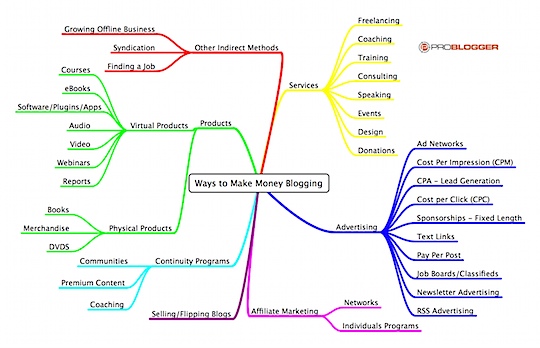
There are many ways to monetize a blog. To give you a quick sense of the many methods check out this “money map” I created a year or so back, which outlines just some that I brainstormed.

Ways to Make Money Blogging.png

.
3. There are no formulas

From time to time, people have released products that claim to be formulas for success when it comes to making money online. They outline steps to follow to “guarantee” you’ll make money.

In my experience there is no formula.

Each full-time blogger I’ve met in the last ten years has forged their own path and has a unique story to tell. They have often acted on hunches and made surprising discoveries along the way.

There are certainly similarities in many of the stories but each blogger has their own personality and style, each one is reaching a different audience, and each niche tends to monetize differently.

The key lesson is to be aware of what others are doing and to learn what you can from each other, but to also be willing to forge your own path as well!

4. Many niches monetize

One common critique of the topic of monetizing of blogs is that the only people making money from blogging are the ones writing about how to make money blogging.

This is simply not true.

In the above list of speakers from our Melbourne event you’ll notice I included topic/niche of each blogger. None sell products teaching others to make money blogging—all are on blogging on “normal,” every-day topics.

My own experience of having a blog about blogging (ProBlogger) and a blog about Photography is that it is my photography blog that is by far the most profitable blog (I’d estimate it’s ten times more profitable).

I’ve interviewed numerous full-time bloggers of late in a webinar series including:


  • Sarah Wilson
  • Tsh Oxenreider
  • Ana White

Interestingly, none of them make money by teaching others to make money online. Sarah largely blogs about health and wellbeing, Tsh blogs about simple living, and Ana blogs about woodwork.

5. Most bloggers don’t make a full-time living from blogging

Every time I’ve surveyed readers of ProBlogger about their earnings, we’ve seen that those making money from blogging are in the minority.

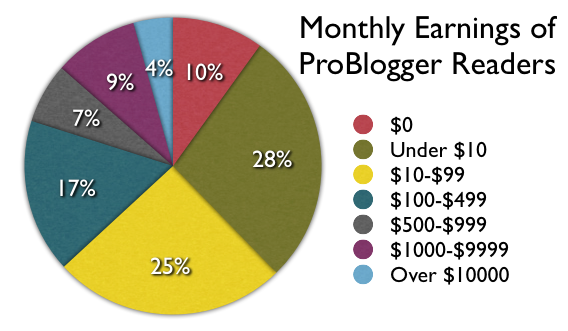
In a recent survey of 1500 ProBlogger readers we asked about their monthly earnings. What you’re seeing below is the spread of earnings from readers who are attempting to make money blogging (note: not all ProBlogger readers attempt to make money, so not all are included in these results).


Keep in mind that ProBlogger readers are generally newish bloggers—about half of those who took this survey had been blogging for less than two years.

So of those trying to make money blogging, 10% don’t make anything and 28% are making less than 30 cents per day. A total of 63% make less than $3.50 per day.

Let’s be clear—most bloggers who are attempting to make money are not making a living from blogging.

Having said that, of the 1508 bloggers surveyed 65 (4%) are making over $10,000 per month (over six figures per year) and a further 9% were doing over $1000 per month (which is at least a part-time level of income).

My feeling, having been attending blogging conferences for six or so years now, is that the number of full-time bloggers is on the rise, and there are actually quite a few more people now at least making the equivalent of a couple of days’ work a week in income from their blogs.

However, most bloggers don’t make much.

6. It takes time to build

When I dig down into the stats from the survey on income levels above, and do some analysis of those who are in the top income bracket, it is fascinating to look at how long they’ve been blogging.

85% of those in that top income bracket have been blogging for four years or more. Almost all of the others had been blogging for three or four years.

This certainly was my own experience. I blogged for a year without making money and once I started monetizing it was around two years of gradual increases before I approached a full-time income level. It would have been four years before I joined that top bracket of income (over $10,000 per month).

Blogging for money is not a get-rich-quick thing. It takes time to build an audience, to build a brand, and to build trust and a good reputation.

And of course even with four or five years of blogging behind you, there’s no guarantee of a decent income.

7. It takes a lot of work

Longevity is not the only key to a profitable blog. The other common factor that I’ve noticed in most full-time bloggers is that they are people of action.

Passivity and blogging don’t tend to go hand in hand.

Blogging as “passive income stream” is another theme that we hear in many make-money-blogging products, however it is far from my own experience.
I’ve worked harder on my business over the last ten years than I’ve worked on anything in my life before this. It is often fun and gives me energy, but it takes considerable work to create content on a daily basis, to keep abreast of what’s going on in the community, to monitor the business side of things, to create products to sell, to build an audience, and so on.

The key is to build blogs that matter to people, that are original, interesting, and helpful. But this doesn’t just happen—it takes a lot of work.


Conclusions

Yes, it is possible to make money blogging. There is an ever-increasing number of people making money from blogging at a part-time to full-time level —however they are still in the minority.

Those who do make a living from blogging come from a wide range of niches, however one of the most common factors between them is that they’ve been at it for a long while.

How long have you been blogging? Are you looking to make money from it—and have you already? Share your experiences in the comments.


Source: http://www.problogger.net/archives/2012/11/28/can-you-really-make-money-blogging-7-things-i-know-about-making-money-from-blogging/

Thursday, 9 October 2014

Why Are So Many Internet Start-Up’s Failing Today?

Online Business Failures

In the real world of brick and mortar business, every day millions of people are dragging themselves from their comfortable beds, performing their morning rituals of washing and breakfast to head to their jobs. In their daily grind some are thinking that there must be a better and easier way to make a living.

All these millions know someone or know of someone who has “made it” by quitting their boring existence and become their own boss using their own computers in the comfort and ease of home.

While the idea of working from home sounds like an ideal solution, most are just not preparing. Many of these unhappy people will just quit their jobs and jump right into the first internet marketing business they find with no preparation, no knowledge of what they are doing, no education, and no hope of success. Failure is their only option and they are not even aware of it.

According to many sources, more than 90% (Ninety percent) of all Internet business start-ups end in failure within the first 120 (one hundred twenty) days. And that number is all too accurate: NINETY PERCENT!

This alarming failure rate goes unheeded for a number of reasons:

1. Many don’t know the statistical probabilities they face.
2. Many don’t see themselves as being part of the failures or they wouldn’t leap.
3. Many are talked into things they are unprepared for.
4. Many don’t know the basic tenant of – “If you fail to plan, then you plan to fail.”

Of course, success is still a possibility. There IS that other 10% (ten percent) that do succeed. For them, success doesn’t happen by accident. And success isn’t just a crap shoot. Success happens because of some very important factors.

Success happens because people learn about internet marketing and how it works. They do not expect to get rich quick or be able to make a killing overnight and retire to a tropical isle.

It is strange but somehow the same people, who wouldn’t dream of starting a real world business, think they can make a go of an internet business even though they have no business background.

People think that an internet business just means that they no longer have to get up and go to work. They think they can simply work when the feel like it and still make a good living. They do not understand that any business requires them to work hard and sometimes work long hours.

Some Wrong Ideas on the Internet

That 90% failure rate of new Internet businesses really is not surprising when you think about the sort of people who start an internet business.

Most people seem to think that being a successful internet marketer is as easy as getting a website built and getting their own domain name and they could not be farther from reality.

Being a successful internet marketer requires self-discipline. People read books like “4 Hour Work Week” and think that partying all night, sleeping until noon and then 3 or 4 hours with a computer will make them rich.

There is not a magic button to push to have instant massive traffic to their million-dollar-like website and fistfuls of cash in their bank. It is just not going to happen.

Internet marketing does not run on auto-pilot. And while established internet marketing types do not put in the long, boring hours they have built their businesses by doing that in the past.

It does not happen overnight for anybody. Most people are not prepared for the time requirement necessary for an internet business to achieve success.

They Do Not Have a Business Background

All businesses whether large or small, Internet or “brick and mortar” have two things in common: they are a BUSINESS and must be operated like a business! Business people must understand accepted business practices.

There are simple and basic concepts like “acceptable over-head expenses in relation to projected income”. All entrepreneurs need to understand profit and loss and what constitutes each.

It is not a requirement to have a college degree in business to be successful but it wouldn’t hurt. On the other hand some basic business knowledge is an absolute necessity.

If it is difficult to balance your check book, then it might be a good idea to keep your day job and forget about being in business.

Yes, you can hire an accounting firm that will tell you WHEN to make tax deposits, but they will not tell you IF you need to make tax deposits.

An accountant can tell you if you made a profit but not how you make it. If you have no business background get some good business advice before you consider opening any business.

The fact is that all successful businesses follow the rules of sound business principles. A successful business is not an accident. The numbers tell the story that only 10% of all new internet businesses are successful or are even still in existence after their first 120 days.

Even the expectation of profit is not reasonable for the first few month.

Have sufficient resources available for everything from startup costs to personal needs for a period of time. It’s called “capital” and there is no alternative to plenty of it.

They Do Not Have The Right Mindset!

Most of us have heard the phrase, “He has an attitude!” And it is often a derogatory remark made about a person with a negative attitude.

The word “attitude” is important when thinking about marketing start-ups. A good attitude or a good mind set will not guarantee success but a bad attitude or a bad mind set can guarantee failure.

Let’s examine a few attitudes that will absolutely guarantee failure:


  1. I can work when I want to. This is absolutely wrong! You cannot just work when it suits you. Expect many long and sometimes boring hours of hard work for your business to succeed.
  2. I can get rich quick! This is a dangerous one. While getting rich quick is possible, there are too many “get rich quick” schemes that are only ways for the unscrupulous to take advantage of the willing. Expect to be wealthy in whatever time it takes. It is possible to make a very comfortable living in internet marketing but it is not usually quick or easy.
  3. I don’t need a business plan. Internet business is still a business. All business principles apply to online business as they do to brick and mortar business. It is imperative that you have a plan for your success based on sound business principles.
  4. Internet business people do not have a boss. You are the boss. A good boss sees that all work is completed on time and in full, or you will fail. Set up a work schedule and goals to meet or you will find yourself working at a job under a boss who does do those things and maybe for minimum wage.

Ways to Avoid Failure

Starting a business … any business … has no guarantee of success, period!

Even large multi-national businesses can fail in a new business venture. Failure is always an option and the possibility or probability of success can be enhanced.

You can increase your possibility of success by:


  1. Making a business plan BEFORE starting your online business. To remind you one of the things I said at the beginning: “If you fail to plan, then you plan to fail.” A plan for success is a requirement. Have the steps listed in great detail including reasonable cost estimates for completing each step.
  2. Expect to work hard to achieve your goals. Never expect things to be easy. Most of the time things are not as easy as they appear. Each successive step will require its own work, time and patience. Sometimes things don’t go right on the first try. Be willing to keep going again and again until you succeed.
  3. Do not fall for a get-rich-quick schemes. The internet woods are full of those who prey upon those who are looking for quick and easy ways to become rich. Most are ways for the other person to get rich quick from your money.

Remember those statistics! Ninety percent of all new internet businesses fail in the first 120 days. You don’t have to be part of that majority. You can become a part of that 10% minority of successful internet business enterprises. Find something that others are having success with – to the level you want your own success, do what they do, and you will have your own success. Be prepared to do whatever it takes for as long as it takes.


Source: http://www.chrisducker.com/internet-business-failures/