Showing posts with label How to start an Online Business. Show all posts

Monday, 5 January 2015

How to Start an E-mail Marketing Business

Are you interested in starting an email marketing company? Do you need a sample email marketing business plan template? If YES, then I advice you read on.

According to Wikipedia, researchers estimated that about US$1.51 billion was spent on e-mail marketing campaigns by companies in the United States of America in 2011. This amount is also expected to grow to about $2.468 billion by 2016. This shows just how much e-mail marketing is gaining relevance in the business world today.

E-mail marketing involves sending out promotional messages to clients/prospective clients through e-mails. Such messages could be advertisements, updates, brand awareness campaigns or requests.

E-mail marketing seeks to build a relationship between a seller and his clients or to preserve an existing relationship and further build trust and loyalty between a seller and his clients.

What are the types of e-mail marketing services?

  • Direct emails

Direct e-mails are sent to promote a particular product or sales offer. Companies who offer e-mail marketing services gather the e-mail addresses of people they wish to send such messages to by buying prospective leads from companies who offer lead generation services. Sometimes, an e-mail marketing company may offer both services.

  • Transactional e-mails

Transactional e-mails are sent to complete or confirm a transaction initiated by a client with the sending company. For instance, if a prospective client visits your sales website and fills a registration form asking for further details about a particular product, transactional e-mails would then be sent to such a client to further engage the customer and trigger his interest in the products.

E-mail marketing service companies have become relevant over the years as many companies have discovered their effectiveness and how they can help to increase sales compared to other methods of advertisement.

Most companies would rather outsource their e-mail marketing services to professionals who possess the necessary skills and expertise to achieve an effective e-mail marketing campaign. It would also allow the company focus on other aspects of the business.

You can begin a career in e-mail marketing by starting your own e-mail marketing company. Below is a guide to help you get started.

Starting an Email Marketing Company – Sample Business Plan Template

  • Write your business plan

The first step in setting your own e-mail marketing company is to draft your business plan. In your business plan, you should be able to identify your target customers and how you will reach them. You should also identify all the strengths, weaknesses, opportunities and threats of the business.

  • Decide on the services you want to offer

You should also decide on the category of e-mail marketing services you would be offering. E-mail marketing involves several aspects. There are those who specialize in developing good e-mail marketing content that would help to sell products, there are also others who specialize in building e-mail lists and lead generation for their clients.

Therefore, you have to decide on the services that you are willing and able to provide to your clients.

  • Observe your competitors

Going into a business like this requires that you carry out a thorough research on the business and those who have been in the business before you.

This would help you understand the opportunities and challenges that exist in the e-mail marketing business. You would also be able to devise means of overcoming those challenges when you start your own business.

  • Purchase E-mail Marketing Software

To effectively run your e-mail marketing business, you would need to invest in a very good e-mail marketing software.

E-mail marketing software are used to send bulk e-mails, build e-mail lists for your various clients, develop e-mail marketing content and to track the e-mails sent to see how many were opened and how many were converted to actual sales. E-mail marketing software makes the work faster and easier.

  • 5. Determine your prices

The next thing to do is to figure out how much you should charge for your services. You have to take into consideration your business expenses as well as the time and efforts you will invest in your business before coming up with a competitive price that would justify your efforts and expenses.

  • Devise a sales and marketing strategy

This is a kind of business that needs effective and strategic marketing. You would need to carefully decide on how you want to promote your services and build a customer base.

  • Create a business website

As an e-mail marketer, you can hardly do much without a professionally designed business website. Your website would serve as your landing page where your own clients can check you out. You would also need a good internet service provider and host server that would be able to handle a large volume of data that you would most likely be dealing with.

In conclusion, I want you to know that E-mail marketing is a smart business idea especially now that it is increasingly becoming popular among many companies.

Over the next few years, the usage of e-mail marketing as a means of advertising is expected to rise and you can position your own company to take a large share of the market by starting your own e-mail marketing business now and offering your clients first class services with proven results that would keep them coming back and referring others.


Source: http://www.mytopbusinessideas.com/starting-email-marketing-service/

Monday, 29 December 2014

Online Business Checklist: How to Know if You’re Ready to Market Your Website

Today, becoming an entrepreneur is more accessible than ever thanks to the Internet. There are plenty of online business opportunities, since just about anyone can buy a domain name, put up an e-commerce page, and begin selling their merchandise. However, because of this, the competitive landscape is fierce.

According to Business Insider, less than five percent of all online businesses actually make money. This is due to the fact that the entry point to create one is so low. Don’t be fooled: starting an online business may look easy, but if you don’t have the right tools and knowledge, the millions of other websites, as well as your competitors, can drown you out.

Before you build your website, you need to have an online business plan. The following are some key pointers, as well as an online business checklist, which can help you succeed in the rough terrain of the World Wide Web.

Do Your Research

You might have looked into different online business ideas and decided what yours is going to be. You’ve also met all of your legal requirements, which includes choosing a business structure, looking at what taxes you’ll have to file, and meeting all of your state guidelines. Basically, you know how to start an online business, but you might not know why you’re starting it.

If you don’t know why your company should exist, why customers need your product, why they would buy it from you, and why they need it now, then you might need to go back to the drawing board. Customers can’t decide the “why” for you, and they won’t stick around waiting for you to determine it either.

You have to figure out whether or not you’re adding value to the lives of your potential customers with your online business. If you’re providing what a bunch of other companies are already putting out there, you’ll find that customers may go to them instead, especially if the prices are lower. Once you have the “why” covered, you need to determine exactly who your demographic is, where they hang out online, and how you can reach them.

Choose the Right Web Platform

Chances are, you’re not a top-notch web designer as well as an entrepreneur. Most small business owners aren’t, and it’s by no means a requirement.

Before you choose a host like WordPress or Wix, consult with other online business owners, as well as web designers, as to which platform will be the easiest for you. You want to look for something that’s simple for you to modify, as well as effortless for customers to navigate. The site should also be fast, since customers won’t put up with slow loading times, and have a descriptive domain name that customers will be able to remember.

Develop a Marketing Strategy

Even with your online business website live, no one will know about it unless you have a strategy for marketing it. This is where knowing who your audience is comes in handy.

For example, let’s say you’re hoping to reach young mothers. You’d want to target them on parenting and women’s websites and blogs. You could also try out sites for children. If you’re not much of a writer, you can hire one to create content (such as an article) for these sites and within the article, insert a link that goes to your online business. Hosting a blog for your audience on your site is another option. Just keep in mind that your content needs to be different in order to stand out. You don’t want to post what’s already readily available on other sites. And it’s a good idea to familiarize yourself with copyright law and what constitutes infringement.

You’ll also want to look into where your customers reside on social media sites and set up shop there. Engage by tweeting back at customers when they ask you questions or have complaints, and thank them for commenting on your Facebook page. You should also connect with influencers in your niche who have a lot of followers and ask them if they’d like to do some cross promotion. For a more targeted approach to marketing, you can try out paid search ads on Google and hire a search engine optimization expert to optimize your content.

Reassess Your Progress

Once your site is up and you’ve done a good amount of marketing, it’s time to assess whether you’re getting the results you need.

This is where Google Analytics comes in handy. This online platform can tell how many visitors you had on a particular page, how much time they spent on your website, how many pages they viewed, how many visitors you received in a given time period, and more.

If you haven’t met your sales goals for the month in your e-store, try expanding your marketing efforts. Reach out to customers on social media and see if they have any suggestions. Running an online business is constant work, and you have to stay on top of your game in order to be recognized amongst the competition.


Are you ready to start your online Business in 2015? Just let me know!


Source: https://www.legalzoom.com/articles/online-business-checklist-ready-to-market-your-website

Wednesday, 5 November 2014

6 Home-Based Businesses You Can Start Today, Online

The Internet has paved the way for effortless communication, so it’s no wonder more and more entrepreneurs are turning to home-based businesses. What was once perceived as working from the couch and wearing pajamas while fulfilling customer orders has evolved to some pretty lucrative small business ventures.

With a household headquarters in mind, here are 6 examples of some of popular and successful home-based businesses you can start in a neighborhood near you.


 Photo: Maison Scotch
Photo: Maison Scotch

Professional Blogger
Everyone’s favorite form of keeping an online diary is also a great way to make money from the comfort of your own home. Blogging from home is growing in popularity not only because there are practically zero startup costs, but also because it’s a great way of turning self-expression into profit. Before you quit your day job, it’s important to remember that financial success with blogging does not happen over night. It takes discipline in many online arenas including self-promotion, content creation, and SEO. But whether you blog for yourself or guest blog for others, blogging from home can translate into a steady (and sometimes lucrative) income.

Online Retailer
The number one go-to source for consumers looking to buy something is the Internet. So, why not take advantage of the Internet-as-a-storefront mentality and sell something online? There are plenty of online businesses to start, so pick a market and run with it. From services to products, as long as there’s a need for what you want to sell, you’ll be in business. For instance, if you’re a website or graphic designer, sell your services to those in need of design help. Or if you collect antiques, source products on eBay and turn your passion into an income. Just keep in mind that customer service is just as important online as it is in person.

Tax Accountant
When tax season rolls around, millions of people turn to accountants for filing help. This spells opportunity for those with a background in accounting. Whether you’re a certified public accountant or you’re great at running numbers for friends and family, starting a home-based accounting business can be a real income-maker. Tax accountants aren’t the only accountants out there. Entrepreneurs are always in need of small business accountants and internal auditors. As long as you have experience, freelance accounting allows you to enjoy working from your home or even in a telecommuting capacity.

Artisan
Whether you’re a painter, woodworker, or any creative type in between, selling your crafts online is a great way to turn your skills into a steady income. Besides, consumers are always looking for unique gift ideas, especially during the holiday season. There are plenty of ways to sell your crafts online from creating an independent website to joining art-inspired sites like Etsy. Likewise, social media is a creative’s best friend when it comes to spreading the word about arts and crafts, so get social with your selling tactics.

Photographer
A picture says a thousand words and starting a home-based photography business is the perfect way to turn every shot into income. As long as you have an eye for photography and adequate equipment, you can start your own wedding or all-occasion photography business from the comfort of your own home. If catching magical moments on camera isn’t really your thing or you’re more of a straightforward photographer, websites are always in need of stock photos. Submitting stock photos of just about anything to websites can garner a steady income.

Freelance Writer
If you’ve ever heard the saying that content is king — it’s probably because websites, online products, landing pages, and blogs are always in need of good copy. With some solid writing skills and a good at-home work ethic, you can become a freelance copywriter in no time without even leaving the house. There are millions of writing options to choose from, so freelance copywriting gives you the opportunity to learn new things or write about topics you already know. From how-to articles to technical pieces to family topics, freelance writing is a never-ending opportunity.

With the right skills and passion, the occupations above are a great way to make your home-based business dreams come true. Do you run a home-based business? Please feel free to share your experiences with us in the comments below.


Source

Tuesday, 21 October 2014

Can You REALLY Make Money Blogging? [7 Things I Know About Making Money from Blogging]

Every now and again I am pulled aside at a conference or am emailed and/or tweeted by someone wanting to get the “real” scoop on whether it is possible to make money blogging.


  • Is it really possible to make a living from blogging?
  • Is it just a small number of people making money from blogging?
  • Is it only really possible to make money blogging if you write about the topic of making money blogging?

I completely understand the questions and would probably want to add one more:


  • If it is really possible to make money blogging, how likely is it that you’ll succeed?


I’ve written many times here on ProBlogger about this in the hope of giving a realistic picture of the topic, but I think it is worth touching on again because there is a lot of misinformation out there right now.

On one hand, we see hype on the topic. Periodically someone will claim to be able to make millions from blogging quickly. These claims are usually accompanied with the release of a product or service (i.e. they are marketing spin).

On the other hand, I periodically see people writing about how it is impossible to make money blogging (or that anyone claiming to be full time is either a scammer, a liar, or is selling something on the topic of making money online).

The reality is somewhere between these two extremes.


7 Things I know about making money from blogging

1. It is possible

I’ve been blogging for just under ten years and for nine of those I’ve been making money blogging. It started out as just a few dollars a day but in time it gradually grew to becoming the equivalent of a part-time job, then a full-time job, and more recently into a business that employs others.

I used to talk about the specific levels of my earnings when I started ProBlogger but felt increasingly uncomfortable about doing so (it felt a little voyeuristic and a little like a big-headed boasting exercise and I didn’t really see the point in continuing to do it)— but my income has continued to grow each year since I began.

On some levels I was at the right place at the right time—I got into blogging early (in 2002 … although I felt I was late to it at the time) and have been fortunate enough to have started blogs at opportune times on the topics I write about.

However I know of quite a few other bloggers who make a living from blogging, many of whom have not been blogging anywhere near as long as I have.

For some it is a hobby that keeps them in coffee; for others it is the equivalent of a part time job/supplementing other income from “real jobs” or helping their family out as they attend to other commitments (raising a family). For others it is a full-time thing.

I’ll give you some examples below.

2. There is no single way to monetize blogs

Recently at our Melbourne ProBlogger event I featured numerous Australian bloggers in our speaker lineup who fit somewhere in the part-time to full-time spectrum. They included:


  • Nicole Avery (Parenting/Organization Blog)
  • Jules Clancy (Food Blog)
  • Nikki Parkinson (Fashion Blog)
  • Mrs Woog (‘Life’ Blog)
  • Gavin Aung Than (Cartoon Blog)
  • Cintia Gonzalez (Craft Blog)
  • Christina Butcher (Hair Blog)
  • Caz and Craig Makepeace (Travel Blog)
  • Nathalie Brown (Child Behaviour Blog)

The year before, we had others, including:

  • Lucy Feagins (Design Blog)
  • Emma Merkas (Dating Blog)
  • Chris Hunter (Motorbike Blog)
  • Phoebe Montague (Fashion Blog)

Most of these bloggers are full-time (or well on the way to being full-time bloggers). They come from a wide array of niches and all monetize quite differently—doing everything from selling advertising, to having membership areas, to selling ebooks, to running affiliate promotions, to promoting their offline businesses, to selling themselves as speakers, to having book deals, and so on. Many have a combination of different income streams.

They are all also Australian, and are just the tip of the iceberg in terms of what is happening here in Australia—the same thing is being replicated around the globe.

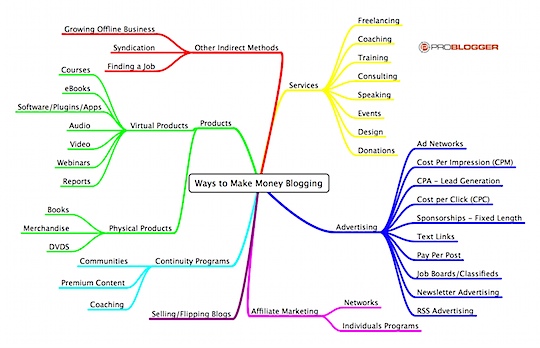
There are many ways to monetize a blog. To give you a quick sense of the many methods check out this “money map” I created a year or so back, which outlines just some that I brainstormed.

Ways to Make Money Blogging.png

.
3. There are no formulas

From time to time, people have released products that claim to be formulas for success when it comes to making money online. They outline steps to follow to “guarantee” you’ll make money.

In my experience there is no formula.

Each full-time blogger I’ve met in the last ten years has forged their own path and has a unique story to tell. They have often acted on hunches and made surprising discoveries along the way.

There are certainly similarities in many of the stories but each blogger has their own personality and style, each one is reaching a different audience, and each niche tends to monetize differently.

The key lesson is to be aware of what others are doing and to learn what you can from each other, but to also be willing to forge your own path as well!

4. Many niches monetize

One common critique of the topic of monetizing of blogs is that the only people making money from blogging are the ones writing about how to make money blogging.

This is simply not true.

In the above list of speakers from our Melbourne event you’ll notice I included topic/niche of each blogger. None sell products teaching others to make money blogging—all are on blogging on “normal,” every-day topics.

My own experience of having a blog about blogging (ProBlogger) and a blog about Photography is that it is my photography blog that is by far the most profitable blog (I’d estimate it’s ten times more profitable).

I’ve interviewed numerous full-time bloggers of late in a webinar series including:


  • Sarah Wilson
  • Tsh Oxenreider
  • Ana White

Interestingly, none of them make money by teaching others to make money online. Sarah largely blogs about health and wellbeing, Tsh blogs about simple living, and Ana blogs about woodwork.

5. Most bloggers don’t make a full-time living from blogging

Every time I’ve surveyed readers of ProBlogger about their earnings, we’ve seen that those making money from blogging are in the minority.

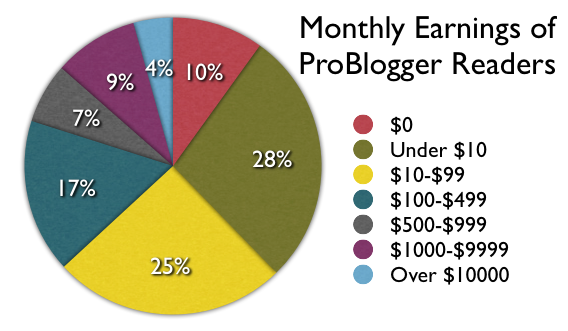
In a recent survey of 1500 ProBlogger readers we asked about their monthly earnings. What you’re seeing below is the spread of earnings from readers who are attempting to make money blogging (note: not all ProBlogger readers attempt to make money, so not all are included in these results).


Keep in mind that ProBlogger readers are generally newish bloggers—about half of those who took this survey had been blogging for less than two years.

So of those trying to make money blogging, 10% don’t make anything and 28% are making less than 30 cents per day. A total of 63% make less than $3.50 per day.

Let’s be clear—most bloggers who are attempting to make money are not making a living from blogging.

Having said that, of the 1508 bloggers surveyed 65 (4%) are making over $10,000 per month (over six figures per year) and a further 9% were doing over $1000 per month (which is at least a part-time level of income).

My feeling, having been attending blogging conferences for six or so years now, is that the number of full-time bloggers is on the rise, and there are actually quite a few more people now at least making the equivalent of a couple of days’ work a week in income from their blogs.

However, most bloggers don’t make much.

6. It takes time to build

When I dig down into the stats from the survey on income levels above, and do some analysis of those who are in the top income bracket, it is fascinating to look at how long they’ve been blogging.

85% of those in that top income bracket have been blogging for four years or more. Almost all of the others had been blogging for three or four years.

This certainly was my own experience. I blogged for a year without making money and once I started monetizing it was around two years of gradual increases before I approached a full-time income level. It would have been four years before I joined that top bracket of income (over $10,000 per month).

Blogging for money is not a get-rich-quick thing. It takes time to build an audience, to build a brand, and to build trust and a good reputation.

And of course even with four or five years of blogging behind you, there’s no guarantee of a decent income.

7. It takes a lot of work

Longevity is not the only key to a profitable blog. The other common factor that I’ve noticed in most full-time bloggers is that they are people of action.

Passivity and blogging don’t tend to go hand in hand.

Blogging as “passive income stream” is another theme that we hear in many make-money-blogging products, however it is far from my own experience.
I’ve worked harder on my business over the last ten years than I’ve worked on anything in my life before this. It is often fun and gives me energy, but it takes considerable work to create content on a daily basis, to keep abreast of what’s going on in the community, to monitor the business side of things, to create products to sell, to build an audience, and so on.

The key is to build blogs that matter to people, that are original, interesting, and helpful. But this doesn’t just happen—it takes a lot of work.


Conclusions

Yes, it is possible to make money blogging. There is an ever-increasing number of people making money from blogging at a part-time to full-time level —however they are still in the minority.

Those who do make a living from blogging come from a wide range of niches, however one of the most common factors between them is that they’ve been at it for a long while.

How long have you been blogging? Are you looking to make money from it—and have you already? Share your experiences in the comments.


Source: http://www.problogger.net/archives/2012/11/28/can-you-really-make-money-blogging-7-things-i-know-about-making-money-from-blogging/

Thursday, 16 October 2014

Golden Rules of Goal Setting

Five Rules to Set Yourself Up for Success

Have you thought about what you want to be doing in five years' time?

Are you clear about what your main objective at work is at the moment?

Do you know what you want to have achieved by the end of today?


If you want to succeed, you need to set goals. Without goals you lack focus and direction.

Goal setting not only allows you to take control of your life's direction; it also provides you a benchmark for determining whether you are actually succeeding. Think about it: Having a million dollars in the bank is only proof of success if one of your goals is to amass riches. If your goal is to practice acts of charity, then keeping the money for yourself is suddenly contrary to how you would define success.

To accomplish your goals, however, you need to know how to set them. You can't simply say, "I want" and expect it to happen. Goal setting is a process that starts with careful consideration of what you want to achieve, and ends with a lot of hard work to actually do it. In between there are some very well defined steps that transcend the specifics of each goal. Knowing these steps will allow you to formulate goals that you can accomplish.

Here are our five golden rules of goal setting:

The Five Golden Rules

1. Set Goals that Motivate You

When you set goals for yourself, it is important that they motivate you: this means making sure that they are important to you, and that there is value in achieving them. If you have little interest in the outcome, or they are irrelevant given the larger picture, then the chances of you putting in the work to make them happen are slim. Motivation is key to achieving goals.

Set goals that relate to the high priorities in your life. Without this type of focus, you can end up with far too many goals, leaving you too little time to devote to each one. Goal achievement requires commitment, so to maximize the likelihood of success, you need to feel a sense of urgency and have an "I must do this" attitude. When you don't have this, you risk putting off what you need to do to make the goal a reality. This in turn leaves you feeling disappointed and frustrated with yourself, both of which are de-motivating. And you can end up in a very destructive "I can't do anything or be successful at anything" frame of mind.

Tip:
To make sure your goal is motivating, write down why it's valuable and important to you. Ask yourself, "If I were to share my goal with others, what would I tell them to convince them it was a worthwhile goal?" You can use this motivating value statement to help you if you start to doubt yourself or lose confidence in your ability to actually make the goal happen.


2. Set SMART Goals

You have probably heard of "SMART goals" already. But do you always apply the rule? The simple fact is that for goals to be powerful, they should be designed to be SMART. There are many variations of what SMART stands for, but the essence is this – goals should be:

  • Specific
  • Measurable
  • Attainable
  • Relevant
  • Time Bound

Set Specific Goals

Your goal must be clear and well defined. Vague or generalized goals are unhelpful because they don't provide sufficient direction. Remember, you need goals to show you the way. Make it as easy as you can to get where you want to go by defining precisely where you want to end up.

Set Measurable Goals
Include precise amounts, dates, and so on in your goals so you can measure your degree of success. If your goal is simply defined as "To reduce expenses" how will you know when you have been successful? In one month's time if you have a 1 percent reduction or in two years' time when you have a 10 percent reduction? Without a way to measure your success you miss out on the celebration that comes with knowing you have actually achieved something.

Set Attainable Goals
Make sure that it's possible to achieve the goals you set. If you set a goal that you have no hope of achieving, you will only demoralize yourself and erode your confidence.

However, resist the urge to set goals that are too easy. Accomplishing a goal that you didn't have to work hard for can be anticlimactic at best, and can also make you fear setting future goals that carry a risk of non-achievement. By setting realistic yet challenging goals, you hit the balance you need. These are the types of goals that require you to "raise the bar" and they bring the greatest personal satisfaction.

Set Relevant Goals
Goals should be relevant to the direction you want your life and career to take. By keeping goals aligned with this, you'll develop the focus you need to get ahead and do what you want. Set widely scattered and inconsistent goals, and you'll fritter your time – and your life – away.

Set Time-Bound Goals
You goals must have a deadline. Again, this means that you know when you can celebrate success. When you are working on a deadline, your sense of urgency increases and achievement will come that much quicker.


3. Set Goals in Writing

The physical act of writing down a goal makes it real and tangible. You have no excuse for forgetting about it. As you write, use the word "will" instead of "would like to" or "might." For example, "I will reduce my operating expenses by 10 percent this year," not "I would like to reduce my operating expenses by 10 percent this year." The first goal statement has power and you can "see" yourself reducing expenses, the second lacks passion and gives you an excuse if you get sidetracked.

Tip 1:
Frame your goal statement positively. If you want to improve your retention rates say, "I will hold on to all existing employees for the next quarter" rather than "I will reduce employee turnover." The first one is motivating; the second one still has a get-out clause "allowing" you to succeed even if some employees leave.

Tip 2:
If you use a To-Do List  , make yourself a To-Do List template that has your goals at the top of it. If you use an Action Program  , then your goals should be at the top of your Project Catalog.
Post your goals in visible places to remind yourself every day of what it is you intend to do. Put them on your walls, desk, computer monitor, bathroom mirror or refrigerator as a constant reminder.


4. Make an Action Plan

This step is often missed in the process of goal setting. You get so focused on the outcome that you forget to plan all of the steps that are needed along the way. By writing out the individual steps, and then crossing each one off as you complete it, you'll realize that you are making progress towards your ultimate goal. This is especially important if your goal is big and demanding, or long-term. Read our article on Action Plans   for more on how to do this.


5. Stick With It!

Remember, goal setting is an ongoing activity not just a means to an end. Build in reminders to keep yourself on track, and make regular time-slots available to review your goals. Your end destination may remain quite similar over the long term, but the action plan you set for yourself along the way can change significantly. Make sure the relevance, value, and necessity remain high.


Key Points
Goal setting is much more than simply saying you want something to happen. Unless you clearly define exactly what you want and understand why you want it the first place, your odds of success are considerably reduced. By following the Five Golden Rules of Goal Setting you can set goals with confidence and enjoy the satisfaction that comes along with knowing you achieved what you set out to do.
So, what will you decide to accomplish today?

Source: http://www.mindtools.com/pages/article/newHTE_90.htm
Source:http://crossfitcphs.files.wordpress.com/2011/08/smart_goals1.jpg

Thursday, 9 October 2014

Why Are So Many Internet Start-Up’s Failing Today?

Online Business Failures

In the real world of brick and mortar business, every day millions of people are dragging themselves from their comfortable beds, performing their morning rituals of washing and breakfast to head to their jobs. In their daily grind some are thinking that there must be a better and easier way to make a living.

All these millions know someone or know of someone who has “made it” by quitting their boring existence and become their own boss using their own computers in the comfort and ease of home.

While the idea of working from home sounds like an ideal solution, most are just not preparing. Many of these unhappy people will just quit their jobs and jump right into the first internet marketing business they find with no preparation, no knowledge of what they are doing, no education, and no hope of success. Failure is their only option and they are not even aware of it.

According to many sources, more than 90% (Ninety percent) of all Internet business start-ups end in failure within the first 120 (one hundred twenty) days. And that number is all too accurate: NINETY PERCENT!

This alarming failure rate goes unheeded for a number of reasons:

1. Many don’t know the statistical probabilities they face.
2. Many don’t see themselves as being part of the failures or they wouldn’t leap.
3. Many are talked into things they are unprepared for.
4. Many don’t know the basic tenant of – “If you fail to plan, then you plan to fail.”

Of course, success is still a possibility. There IS that other 10% (ten percent) that do succeed. For them, success doesn’t happen by accident. And success isn’t just a crap shoot. Success happens because of some very important factors.

Success happens because people learn about internet marketing and how it works. They do not expect to get rich quick or be able to make a killing overnight and retire to a tropical isle.

It is strange but somehow the same people, who wouldn’t dream of starting a real world business, think they can make a go of an internet business even though they have no business background.

People think that an internet business just means that they no longer have to get up and go to work. They think they can simply work when the feel like it and still make a good living. They do not understand that any business requires them to work hard and sometimes work long hours.

Some Wrong Ideas on the Internet

That 90% failure rate of new Internet businesses really is not surprising when you think about the sort of people who start an internet business.

Most people seem to think that being a successful internet marketer is as easy as getting a website built and getting their own domain name and they could not be farther from reality.

Being a successful internet marketer requires self-discipline. People read books like “4 Hour Work Week” and think that partying all night, sleeping until noon and then 3 or 4 hours with a computer will make them rich.

There is not a magic button to push to have instant massive traffic to their million-dollar-like website and fistfuls of cash in their bank. It is just not going to happen.

Internet marketing does not run on auto-pilot. And while established internet marketing types do not put in the long, boring hours they have built their businesses by doing that in the past.

It does not happen overnight for anybody. Most people are not prepared for the time requirement necessary for an internet business to achieve success.

They Do Not Have a Business Background

All businesses whether large or small, Internet or “brick and mortar” have two things in common: they are a BUSINESS and must be operated like a business! Business people must understand accepted business practices.

There are simple and basic concepts like “acceptable over-head expenses in relation to projected income”. All entrepreneurs need to understand profit and loss and what constitutes each.

It is not a requirement to have a college degree in business to be successful but it wouldn’t hurt. On the other hand some basic business knowledge is an absolute necessity.

If it is difficult to balance your check book, then it might be a good idea to keep your day job and forget about being in business.

Yes, you can hire an accounting firm that will tell you WHEN to make tax deposits, but they will not tell you IF you need to make tax deposits.

An accountant can tell you if you made a profit but not how you make it. If you have no business background get some good business advice before you consider opening any business.

The fact is that all successful businesses follow the rules of sound business principles. A successful business is not an accident. The numbers tell the story that only 10% of all new internet businesses are successful or are even still in existence after their first 120 days.

Even the expectation of profit is not reasonable for the first few month.

Have sufficient resources available for everything from startup costs to personal needs for a period of time. It’s called “capital” and there is no alternative to plenty of it.

They Do Not Have The Right Mindset!

Most of us have heard the phrase, “He has an attitude!” And it is often a derogatory remark made about a person with a negative attitude.

The word “attitude” is important when thinking about marketing start-ups. A good attitude or a good mind set will not guarantee success but a bad attitude or a bad mind set can guarantee failure.

Let’s examine a few attitudes that will absolutely guarantee failure:


  1. I can work when I want to. This is absolutely wrong! You cannot just work when it suits you. Expect many long and sometimes boring hours of hard work for your business to succeed.
  2. I can get rich quick! This is a dangerous one. While getting rich quick is possible, there are too many “get rich quick” schemes that are only ways for the unscrupulous to take advantage of the willing. Expect to be wealthy in whatever time it takes. It is possible to make a very comfortable living in internet marketing but it is not usually quick or easy.
  3. I don’t need a business plan. Internet business is still a business. All business principles apply to online business as they do to brick and mortar business. It is imperative that you have a plan for your success based on sound business principles.
  4. Internet business people do not have a boss. You are the boss. A good boss sees that all work is completed on time and in full, or you will fail. Set up a work schedule and goals to meet or you will find yourself working at a job under a boss who does do those things and maybe for minimum wage.

Ways to Avoid Failure

Starting a business … any business … has no guarantee of success, period!

Even large multi-national businesses can fail in a new business venture. Failure is always an option and the possibility or probability of success can be enhanced.

You can increase your possibility of success by:


  1. Making a business plan BEFORE starting your online business. To remind you one of the things I said at the beginning: “If you fail to plan, then you plan to fail.” A plan for success is a requirement. Have the steps listed in great detail including reasonable cost estimates for completing each step.
  2. Expect to work hard to achieve your goals. Never expect things to be easy. Most of the time things are not as easy as they appear. Each successive step will require its own work, time and patience. Sometimes things don’t go right on the first try. Be willing to keep going again and again until you succeed.
  3. Do not fall for a get-rich-quick schemes. The internet woods are full of those who prey upon those who are looking for quick and easy ways to become rich. Most are ways for the other person to get rich quick from your money.

Remember those statistics! Ninety percent of all new internet businesses fail in the first 120 days. You don’t have to be part of that majority. You can become a part of that 10% minority of successful internet business enterprises. Find something that others are having success with – to the level you want your own success, do what they do, and you will have your own success. Be prepared to do whatever it takes for as long as it takes.


Source: http://www.chrisducker.com/internet-business-failures/

Wednesday, 8 October 2014

How to Start a Business Online

7 tried and true steps for attracting visitors to your site--and getting them to buy.


There is a proven sequence of steps you can follow to guarantee your success when you're starting a small business online. I've seen thousands of people start and grow successful businesses by doing the following:
  1. Find a need and fill it.
  2. Write copy that sells.
  3. Design and build an easy-to-use website.
  4. Use search engines to drive traffic to your site.
  5. Establish an expert reputation for yourself.
  6. Follow up with your customers and subscribers with e-mail.
  7. Increase your income through back-end sales and upselling.
Anyone, from newbie to seasoned online entrepreneur, can benefit from this process in learning how to start a business online.

Step 1: Find a need and fill it

Most people who are just starting out make the mistake of looking for a product first, and a market second.
To boost your chances of success, start with a market. The trick is to find a group of people who are searching for a solution to a problem, but not finding many results. The internet makes this kind of market research easy:
  • Visit online forums to see what questions people ask and what problems they're trying to solve.
  • Do keyword research to find keywords that a lot of people are searching, but for which not many sites are competing.
  • Check out your potential competitors by visiting their sites and taking note of what they're doing to fill the demand. Then you can use what you've learned and create a product for a market that already exists--and do it better than the competition.

Step 2: Write copy that sells

There's a proven sales copy formula that takes visitors through the selling process from the moment they arrive to the moment they make a purchase:
  1. Arouse interest with a compelling headline.
  2. Describe the problem your product solves.
  3. Establish your credibility as a solver of this problem.
  4. Add testimonials from people who have used your product.
  5. Talk about the product and how it benefits the user.
  6. Make an offer.
  7. Make a strong guarantee.
  8. Create urgency.
  9. Ask for the sale.
Throughout your copy, you need to focus on how your product or service is uniquely able solve people's problems or make their lives better. Think like a customer and ask "What's in it for me?"

Step 3: Design and build your website

Once you've got your market and product, and you've nailed down your selling process, now you're ready for your small-business web design. Remember to keep it simple. You have fewer than five seconds to grab someone's attention--otherwise they're gone, never to be seen again. Some important tips to keep in mind:
  • Choose one or two plain fonts on a white background.
  • Make your navigation clear and simple, and the same on every page.
  • Only use graphics, audio or video if they enhance your message.
  • Include an opt-in offer so you can collect e-mail addresses.
  • Make it easy to buy--no more than two clicks between potential customer and checkout.
  • Your website is your online storefront, so make it customer-friendly.

Step 4: Use search engines to drive targeted buyers to your site

Pay-per-click advertising is the easiest way to get traffic to a brand-new site. It has two advantages over waiting for the traffic to come to you organically. First, PPC ads show up on the search pages immediately, and second, PPC ads allow you to test different keywords, as well as headlines, prices and selling approaches. Not only do you get immediate traffic, but you can also use PPC ads to discover your best, highest-converting keywords. Then you can distribute the keywords throughout your site in your copy and code, which will help your rankings in the organic search results.

Step 5: Establish an expert reputation for yourself

People use the internet to find information. Provide that information for free to other sites, and you'll see more traffic and better search engine rankings. The secret is to always include a link to your site with each tidbit of information. 
  • Give away free, expert content. Create articles, videos or any other content that people will find useful. Distribute that content through online article directories or social media sites.
  • Include "send to a friend" links on valuable content on your website.
  • Become an active expert in industry forums and social networking sites where your target market hangs out.
You'll reach new readers. But even better, every site that posts your content will link back to yours. Search engines love links from relevant sites and will reward you in the rankings.

Step 6: Use the power of e-mail marketing to turn visitors into buyers.

When you build an opt-in list, you're creating one of the most valuable assets of your online business. Your customers and subscribers have given you permission to send them e-mail. That means:
  • You're giving them something they've asked for.
  • You're developing lifetime relationships with them.
  • The response is 100 percent measurable.
  • E-mail marketing is cheaper and more effective than print, TV or radio because it's highly targeted.
Anyone who visits your site and opts in to your list is a very hot lead. And there's no better tool than e-mail for following up with those leads.

Step 7: Increase your income through back-end sales and upselling 

One of the most important internet marketing strategies is to develop every customer's lifetime value. At least 36 percent of people who have purchased from you once will buy from you again if you follow up with them. Closing that first sale is by far the most difficult part--not to mention the most expensive. So use back-end selling and upselling to get them to buy again:
  • Offer products that complement their original purchase.
  • Send out electronic loyalty coupons they can redeem on their next visit.
  • Offer related products on your "Thank You" page after they purchase.
Reward your customers for their loyalty and they'll become even more loyal.
The internet changes so fast that one year online equals about five years in the real world. But the principles of how to start and grow a successful online business haven't changed at all. If you're just starting a small business online, stick to this sequence. If you've been online awhile, do a quick review and see if there's a step you're neglecting, or never got around to doing in the first place. You can't go wrong with the basics.