Affiliate marketing has become a trending topic in the digital marketing community, and for good reason! This low-risk, high-reward opportunity is great for those who want to monetize their love of a product.
Despite some claims, affiliate marketing won’t make you an overnight millionaire. But that doesn’t mean you can’t make a serious profit. Successful affiliates are advocates for the products they’re referring – and they’re reaping the rewards!
Keep reading to find out if affiliate marketing is right for you – and tips on how you can become an affiliate all-star.
What Is Affiliate Marketing?
Think of affiliate marketers as the middlemen between clients and brands. Is there a product or service you don’t hesitate to recommend to family or friends? Partnering with these brands is a great way to get rewarded for your endorsement.
Affiliate marketers earn commission by referring traffic and sales to a retailer’s website through their own promotional efforts. Prospective affiliates can join a program through a merchandiser directly or a network that manages multiple affiliate programs.
What Are The Benefits Of Affiliate Marketing?
- Low-Risk, High Reward: Becoming an affiliate usually doesn’t requires no start-up fees or investment.
- Advanced Tracking Tools: A good affiliate program provides you with the tools to measure your campaign’s effectiveness.
- No “Selling” Experience Required: It’s as simple as creating good content.
- Not Your Average Job: Create a steady flow of income by promoting a company’s products and services.
Choosing A Niche
When choosing an affiliate marketing program, first ask yourself a few questions:
- Are you knowledgeable in the topic?
- Is the content something people are searching for?
- What problem are you trying to solve?
- Is there room for growth? Can you add value to the content
Your answers will help you identify if a niche is right for you.
How Do You Drive Traffic?
When you sign up, you’ll receive a unique affiliate commissions code. This is used to track the visitors and sales that were directed from your efforts. But how do you drive traffic to a merchandiser’s website in the first place?
Some common affiliate promotional strategies include:
- Blogging
- Building up an email list
- Social Media
- Videos + Podcasting
- Writing reviews
- Word-of-mouth
- Paid advertising
- Banners
- Email Marketing
- Social media ads
- Contests
Don’t be afraid to get creative in your approach! Blogs like Affiliate Tip, AM Navigator, ShareASale and ABestWeb are great resources for campaign inspiration.
How Do You Build An Audience?
There are a number of tracking tools that give you the power to track the reach of your campaigns. Some frequently used services include:
- Google Analytics is a free service that lets you measure your advertising ROI, track your social reach and manage your applications. With its suite of features, you can analyze visitor traffic and ensure you’re getting the most out of your marketing efforts.
- Page Insights provides information about user activity on your Facebook page. You can view metrics, identify your most engaging posts and gather information on your audience.
- YouTube Analytics lets you monitor the performance of your channel, with up-to-date metrics and reports.
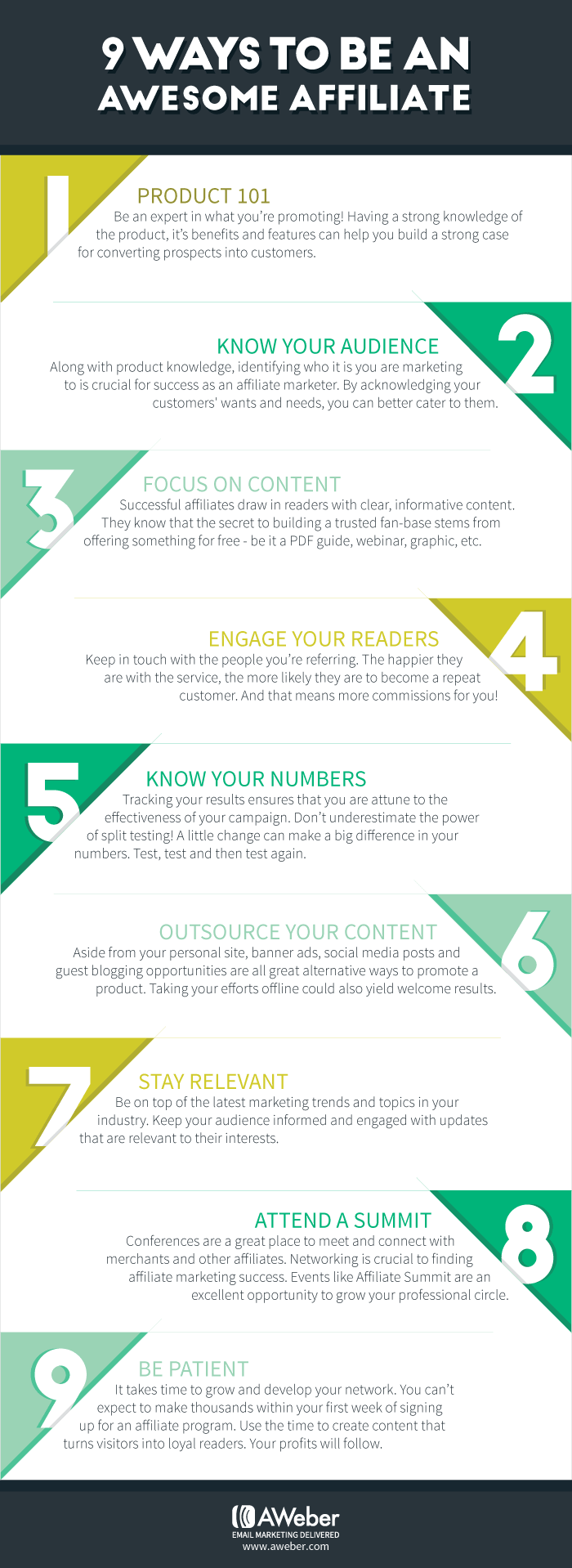
9 Ways To Be An Awesome Affiliate
What’s Next?
Have a passion for email marketing? Consider using AWeber as your autoresponder to boost your affiliate marketing!.
How to market your business using online forums
Forum marketing is a great way to make your online business stand out from the crowd. Forum users are generally net savvy and open to making online purchases. Many forum users are also respected experts and bloggers in the specific topics covered by the forum.
Forum marketing is a high ROI strategy because making a good impression in front of this savvy and influential audience can help your marketing message spread far and wide.
Follow this step-by-step guide to effectively use forum marketing as a part of your overall online marketing strategy and avoid some common mistakes.
1. Find the right forums
Not all forums are worth your time. Successful forum marketing means finding the right community for your business.
Look for popular forums that cover your niche topic. Start by asking your employees, suppliers, and customers which online communities they hang out in. Also try searching forum hub sites such as Board Reader, Big Boards, and Board Tracker using niche-specific keywords.
Narrow your list to 5-10 forums that will be worth your time using the following criteria:
- Look for forums that have at least 1,000 members and 10,000 posts.
- Make sure the forum gets at least ten to fifteen new posts on a daily basis.
- Ignore forums that are overrun by spam.
- Avoid forums hosted by your direct competitors.
2. Create an account as soon as possible
Seniority is important in forum communities. Users with older registration dates are given more deference than newer users. Some forums even prevent new users from posting for the first few days after their initial registration. Given the tremendous advantage of early registration, you should create your forum accounts as soon as possible.
Effective forum marketing means that it is part of your long-term strategy. Think of forums as a permanent marketing channel for your business, instead of just one of many targets to blast your hot new advertising campaign.
3. Check the user agreement and posting guidelines
During the registration process you will be asked to agree to the forum's user agreement and posting guidelines. Read these rules and guidelines carefully. There is a lot of boilerplate legal language in these documents, so it is tempting to just skip over them and click yes without reading. However, many forums have unique guidelines that you need to pay attention to.
Some of the most important issues to look for include:
- Are users allowed to place links in their posts?
- Are users allowed to promote their own businesses?
- Are users allowed to post commercial messages in their signatures?
- Are users allowed to contact other members for commercial purposes?
- What restrictions are placed on new users?
- What special privileges are given to veteran users?
4. Pick a good user name and avatar
Your user name and avatar are the first things other users will notice about you. Pick a user name that is easy to remember and pronounce. Using your real name might be appropriate, especially if your name is closely identified with your brand. Stay away from bizarre number combination or weird misspellings. Do not pick user names that only have meaning for you but would otherwise be nonsensical to everyone else (e.g. your favorite grade school teacher's initials).
Avatars are small pictures attached to all your posts. A good head shot of yourself or cute pictures of your kids or pets make the best avatars. Avoid using any pictures that might be considered offensive or controversial.
5. Create a compelling profile
A good profile can help you establish credibility on the forum. Provide a solid description of your expertise and experience. Feel free to add in a couple of personal tidbits to humanize your profile. Information like your hometown, your pet's name, or your favorite sports team are good ways to break the ice. Stay away from sharing potentially polarizing information such as political or religious affiliation.
Provide contact information so other users can get in touch with you if they are interested in learning more about your business. A lot of spammers and identity thieves search through forums for personal information. Therefore, you should only share information you wouldn't mind being made public, such as a throwaway webmail address.
6. Introduce yourself
Many forums encourage new users to introduce themselves to the community by making an introductory post. This is usually done in threads especially designated for welcoming new members. These threads are usually called some variation of "Say Hi Here," "How Did You Find Us," or " New Members Check In Here."
Your introductory post should include a brief description of your expertise and an explanation of why you joined the forum. Let the other users know that your main goal is to contribute to and learn from the community. Do not make any marketing pitches in your first post. If you try to sell anything in your first post you will very likely get banned.
7. Spend some time lurking
Resist the urge to start posting right away. Forums are tight-knit communities that tend to shun and haze newcomers. Spend some time reading the forum to get a sense of the community's special quirks and cultural norms. Figure out who the influential users are and note which topics are perennial favorites. Learning this information will help you fit in more quickly.
8. Make valuable contributions to the community
This is the key to successful forum marketing. Whenever anyone asks a question related to your products or services, dazzle them with incredibly useful answers. These situations are opportunities to demonstrate your expertise and to generate good will. Backup your advice with links to trusted sources, and respond to follow up questions quickly.
Leave out your sales pitch in the beginning. Any hint of bias in your initial posts will erase all your hard work. By keeping your answers objective, the entire community will start thinking of you as a trusted expert. They will soon start asking you for your recommendations. When you get direct inquiries for recommendations you may then safely mention your business without appearing biased.
9. Put your website's address in your signature
Forum signatures are blocks of text or graphic that are attached to the end of all your posts. Most people use signatures to display their favorite quotes or links to their favorite websites. Some forums also allow users to use signatures to promote their own websites. If you are in a forum that allows self-promotional signatures, make sure you take full advantage of this opportunity and create a forum marketing signature that works.
Do not abuse this opportunity by putting flashy images or long advertising messages in your signature. An accurate, short description of your business and a link to your website is the best way to go.
10. Stay away from drama
Do not get drawn into heated arguments. It would be a shame to get banned just because you started arguing whether Han shot first with some 14-year-old kid from Scranton. Here's how you can avoid the drama:
- Constantly remind yourself that your mission here is to build good will for your business.
- Stay away from charged topics like politics or religion.
- Resist the urge to respond to criticism. If you have to answer, at least give yourself a couple of hours to cool off before responding.
- Use emoticons to indicate when you are being facetious.
- End discussions the moment you sense that it is getting contentious. Just say you agree to disagree and that you want to move on to other more pleasant topics.
11. Create win-win marketing campaigns
Once you have the respect of the users you can start more aggressive marketing campaigns. Focus on marketing techniques that provide a benefit for the forum community. For example, offer the forum members special discounts, free samples, or fun contests. Be sure to get the permission of the forum's moderators before you start these campaigns.
12. Be careful how you outsource forum marketing
Many marketing firms use bots or low-skilled foreign workers to spam forums. This is not the type of marketing you want. Forum spam may bring in a little temporary traffic to your website, but in the long run these campaigns can seriously damage your reputation. When you hire a marketing firm, make sure they understand that you will only accept ethical marketing practices that will enhance your image.
Source: http://onlinebusiness.about.com/od/gettingtrafficmarketing/tp/forum-marketing.htm
Article marketing is an online advertising technique widely used by successful businesses today and one of the best ways to enhance the visibility of your website, thus generating more website traffic and increasing your sales. With the following article marketing tips, we would like to help you make the most of this efficient tool that can make your site rank high on any search engine.
Including Relevant Content on Your Site
The first of our article marketing tips is to provide relevant, useful articles on your website. This is the first step of establishing yourself as a great, dependable seller or service provider. One of the most important things before building awareness to your site with the help of other tools is to make your website attractive and informative, and the texts published on your site are the best way to achieve this.
You can choose from several ways to make your site interesting with the help of article marketing. You can include pages on your site that give useful advice, tips or suggestions about your niche; you can have pages that contain testimonials and reviews, but whatever type of articles you choose, you must make sure they are 100% original and relevant to your niche.
The articles you publish on your site also need to be written correctly – you don’t want to read poorly written articles about the topics you are interested in and neither do your prospective customers. The style and the content of the articles is also important: you should try to make them interesting and fun to read, and you should also try to come up with real problems that your readers might face, then provide solutions, raising the reader’s interest in your products or services.
Article Marketing Tips to Create Texts Structured the Right Way
Do not forget about the structure of your articles, either. Organize your texts in a clear, informative manner – including subtitles and bullet-points are great ways to keep the reader interested.
Another thing you must bear in mind when you create your articles is keyword usage. Internet users type keywords into their browser when they are looking for information. If your articles are structured around the right keywords, the sites these articles are published on will appear among the first hits in the user’s browser, so the more relevant the keywords are, the more likely it is that the user will find your site and visit it.
And how to find the right keywords? The internet provides many different tools that you can use for keyword research. These tools allow you to enter keywords that you consider relevant for your topic and they will display the competition level and the number of searches for that keyword, also providing alternative keywords to use. A good article contains primary, secondary and long tail keywords as well, so you should come up with several different sets of keywords grouped according to their relevance for your topic. You must introduce keywords into the title and the subtitles as well – the title should always contain your main keyword, to tell search engines what the text is going to be about.
Once you have found the right keywords, it is time to organize your unique article around them. You will have to enter the keyword with a certain density into the text, the recommended percentage being 1% (the keyword entered once every 100 words in the article means a 1% density).
Backlinking with Your Articles
Our article marketing tips continue with suggestions about how to use your articles the most efficiently. Once you have created content about your activity and you published it on your own site, there is another efficient way to attract make your business more visible: to publish articles on other websites, with a technique called building backlinks. This tactic consists in posting relevant, interesting, well-formulated articles structured around the right content and containing the URL of your domain, on other, authoritative websites with the purpose of driving traffic towards your site. You can start posting your articles on social media sites and professional forums. and you can publish them on blogs as well, each of these posts pointing towards your site, encouraging visitors to check out your products.
Using Article Submission Services
If you consider the task of creating your own articles energy and time-consuming, you can hire other companies to leverage their experience in the area to your advantage. These companies are experts in finding the right keywords for your content, writing high-quality, properly structured articles and publishing them on authoritative sites to generate the highest possible traffic for your web site. They usually offer different packages so that you can choose the one that best suits your objectives and your budget, but all these packages have two things in common: the articles included are written in a professional manner and they will be published using the most sophisticated online marketing tools.
Forget about those newfangled article marketing or submission widgets – see what Google’s Matt Cutts thinks about them.
Article marketing is one of the most efficient tools of website promotion, so our best tip is to start using it. Whether you write and publish your articles yourself or you hire professionals to do that for you, good articles can boost your sales within a very short time.
Source: https://www.prchecker.net/article-marketing-tips.html
Everyone loves a good tip, right? Here are 55 quick tips for search engine optimization that even your mother could use to get cooking. Well, not my mother, but you get my point. Most folks with some web design and beginner SEO knowledge should be able to take these to the bank without any problem.
1. If you absolutely MUST use Java script drop down menus, image maps or image links, be sure to put text links somewhere on the page for the spiders to follow.
2. Content is king, so be sure to have good, well-written, and unique content that will focus on your primary keyword or keyword phrase.
3. If content is king, then links are queen. Build a network of quality backlinks. Remember, if there is no good, logical reason for a site to link to you, you don’t want the link.
4. Don’t be obsessed with PageRank. It is just one isty bitsy part of the ranking algorithm. A site with lower PR can actually outrank one with a higher PR.
5. Be sure you have a unique, keyword focused Title tag on every page of your site. And, if you MUST have the name of your company in it, put it at the end. Unless you are a household name, your business name will probably get few searches.
6. Fresh content can help improve your rankings. Add new, useful content to your pages on a regular basis. Content freshness adds relevancy to your site in the eyes of the search engines.
7. Be sure links to your site and within your site use your keyword phrase. In other words, if your target is “blue widgets” then link to “blue widgets” instead of a “Click here” link.
8. Focus on search phrases, not single keywords, and put your location in your text (“our Palm Springs store” not “our store”) to help you get found in local searches.
9. Don’t design your web site without considering SEO. Make sure your web designer understands your expectations for organic SEO. Doing a retrofit on your shiny new Flash-based site after it is built won’t cut it. Spiders can crawl text, not Flash or images.
10. Use keywords and keyword phrases appropriately in text links, image ALT attributes and even your domain name.
11. Check for canonicalization issues – www and non-www domains. Decide which you want to use and 301 redirect the other to it. In other words, if http://www.domain.com is your preference, then http://domain.com should redirect to it.
12. Check the link to your home page throughout your site. Is index.html appended to your domain name? If so, you’re splitting your links. Outside links go to http://www.domain.com and internal links go to http://www.domain.com/index.html.
Ditch the index.html or default.php or whatever the page is and always link back to your domain.
13. Frames, Flash and AJAX all share a common problem – you can’t link to a single page. It’s either all or nothing. Don’t use Frames at all and use Flash and AJAX sparingly for best SEO results.
14. Your URL file extension doesn’t matter. You can use .html, .htm, .asp, .php, etc. and it won’t make a difference as far as your SEO is concerned.
15. Got a new web site you want spidered? Submitting through Google’s regular submission form can take weeks. The quickest way to get your site spidered is by getting a link to it through another quality site.
16. If your site content doesn’t change often, your site needs a blog because search spiders like fresh text. Blog at least three time a week with good, fresh content to feed those little crawlers.
17. When link building, think quality, not quantity. One single, good, authoritative link can do a lot more for you than a dozen poor quality links, which can actually hurt you.
18. Search engines want natural language content. Don’t try to stuff your text with keywords. It won’t work. Search engines look at how many times a term is in your content and if it is abnormally high, will count this against you rather than for you.
19. Text around your links should also be related to your keywords. In other words, surround the link with descriptive text.
20. If you are on a shared server, do a blacklist check to be sure you’re not on a proxy with a spammer or banned site. Their negative notoriety could affect your own rankings.
21. Be aware that by using services that block domain ownership information when you register a domain, Google might see you as a potential spammer.
22. When optimizing your blog posts, optimize your post title tag independently from your blog title.
23. The bottom line in SEO is Text, Links, Popularity and Reputation.
24. Make sure your site is easy to use. This can influence your link building ability and popularity and, thus, your ranking.
25. Give link love, Get link love. Don’t be stingy with linking out. That will encourage others to link to you.
26. Search engines like unique content that is also quality content. There can be a difference between unique content and quality content. Make sure your content is both.
27. If you absolutely MUST have your main page as a splash page that is all Flash or one big image, place text and navigation links below the fold.
28. Some of your most valuable links might not appear in web sites at all but be in the form of e-mail communications such as newletters and zines.
29. You get NOTHING from paid links except a few clicks unless the links are embedded in body text and NOT obvious sponsored links.
30. Links from .edu domains are given nice weight by the search engines. Run a search for possible non-profit .edu sites that are looking for sponsors.
31. Give them something to talk about. Linkbaiting is simply good content.
32. Give each page a focus on a single keyword phrase. Don’t try to optimize the page for several keywords at once.
33. SEO is useless if you have a weak or non-existent call to action. Make sure your call to action is clear and present.
34. SEO is not a one-shot process. The search landscape changes daily, so expect to work on your optimization daily.
35. Cater to influential bloggers and authority sites who might link to you, your images, videos, podcasts, etc. or ask to reprint your content.
36. Get the owner or CEO blogging. It’s priceless! CEO influence on a blog is incredible as this is the VOICE of the company. Response from the owner to reader comments will cause your credibility to skyrocket!
37. Optimize the text in your RSS feed just like you should with your posts and web pages. Use descriptive, keyword rich text in your title and description.
38. Use keyword rich captions with your images.
39. Pay attention to the context surrounding your images. Images can rank based on text that surrounds them on the page. Pay attention to keyword text, headings, etc.
40. You’re better off letting your site pages be found naturally by the crawler. Good global navigation and linking will serve you much better than relying only on an XML Sitemap.
41. There are two ways to NOT see Google’s Personalized Search results:
(1) Log out of Google
(2) Append &pws=0 to the end of your search URL in the search bar
42. Links (especially deep links) from a high PageRank site are golden. High PR indicates high trust, so the back links will carry more weight.
43. Use absolute links. Not only will it make your on-site link navigation less prone to problems (like links to and from https pages), but if someone scrapes your content, you’ll get backlink juice out of it.
44. See if your hosting company offers “Sticky” forwarding when moving to a new domain. This allows temporary forwarding to the new domain from the old, retaining the new URL in the address bar so that users can gradually get used to the new URL.
45. Understand social marketing. It IS part of SEO. The more you understand about sites like Digg, Yelp, del.icio.us, Facebook, etc., the better you will be able to compete in search.
46. To get the best chance for your videos to be found by the crawlers, create a video sitemap and list it in your Google Webmaster Central account.
47. Videos that show up in Google blended search results don’t just come from YouTube. Be sure to submit your videos to other quality video sites like Metacafe, AOL, MSN and Yahoo to name a few.
48. Surround video content on your pages with keyword rich text. The search engines look at surrounding content to define the usefulness of the video for the query.
49. Use the words “image” or “picture” in your photo ALT descriptions and captions. A lot of searches are for a keyword plus one of those words.
50. Enable “Enhanced image search” in your Google Webmaster Central account. Images are a big part of the new blended search results, so allowing Google to find your photos will help your SEO efforts.
51. Add viral components to your web site or blog – reviews, sharing functions, ratings, visitor comments, etc.
52. Broaden your range of services to include video, podcasts, news, social content and so forth. SEO is not about 10 blue links anymore.
53. When considering a link purchase or exchange, check the cache date of the page where your link will be located in Google. Search for “cache:URL” where you substitute “URL” for the actual page. The newer the cache date the better. If the page isn’t there or the cache date is more than an month old, the page isn’t worth much.
54. If you have pages on your site that are very similar (you are concerned about duplicate content issues) and you want to be sure the correct one is included in the search engines, place the URL of your preferred page in your sitemaps.
55. Check your server headers. Search for “check server header” to find free online tools for this. You want to be sure your URLs report a “200 OK” status or “301 Moved Permanently ” for redirects. If the status shows anything else, check to be sure your URLs are set up properly and used consistently throughout your site.
Maybe a little technical here and there, but most of them easy to understand and quick to use in your blog. Other tips? Please share.
Source: http://www.searchenginejournal.com/55-quick-seo-tips-even-your-mother-would-love/
Blogging is a great tool for writing, sharing news and photos or art and just generally reaching out to the nameless ranks of people combing the internet every day in search of news and entertainment. TopTenREVIEWS have reviewed the best of the best blog software programs in the hope of showing you just how fun and easy creating a blog can be.
The hard part for bloggers seems to be:
10. Consistency
Your readers and search engines love consistency. If you post three times a week, every week, this is considered the bare minimum for attracting and maintaining a readership. There is such a thing as too much blogging, though. Posting once a day is considered normal, meaning you’re not living in a dark cave staring at the glowing rectangle all day every day. But every post you make is a new page to be indexed by the search engines, so after one year you will have more than 300 pages in the web with your name on it!
9. Originality
With the ever-growing legions of bloggers out there, internet devotees are always on the lookout for the next great, original blog concept. One blogger might be devoted to showcasing photos of the rooftops of St. Petersburg. Many blogs are devoted to fashion and celebrity gossip, but there aren’t that many documenting people dressed in the gothic style during the hot days of summer.
8. Personality
Whether you create a web persona for the purpose of blogging or you plan to put your real self out there, personality is essential to a good blog read. This gift comes naturally to some bloggers and not at all to others. Whichever you are, your writings will reveal this personality to the world. A lot of bloggers give up fast when they receive negative feedback that is taken personally, but keep in mind that all writing media is subjected to waves of rejection. Don’t give up – there are mean, anonymous people out there surfing the web leaving rude, baseless comments, but there are also plenty more people with constructive comments to offer.
7. Brevity
Be brief in your blog posts. Break up text with cuts, subheadings, bullet lists, photos – people reading on the web tend to scan for anything that slows down or catches their eye. If you want to keep your readers reading, be succinct!
6. Diversity
Multi-media is almost a must these days. Text, video, photo, audio – use all of it in your blog to create well-written posts that are augmented with images or other media. As long as you’re on the way to becoming a blog superstar, might as well go for those YouTube views as well. Uploading your video to YouTube is a great example of how to drive traffic back to your site, as well.
5. Social networking
Use Facebook, Twitter, MySpace, whatever your social network of choice is to drive traffic to your blog, alert your friends you have a new post.
4. Collaboration
Use online relationships to collaborate on blog posts and expand your readership – encourage comments, comment on other people’s blogs, link freely and share traffic.
3. Promotion
Commenting on other blogs and getting your blog noticed joins up with social networking here. If you are promoting a product on your blog pay attention to other bloggers promoting a similar product. Use your best judgment to decide what works and what doesn’t. But please, no spamming – it is discourteous, not cool, other users will not take kindly and search engines will penalize you (remove your pages from the index).
2. Other media
Why limit yourself to just a blog? Podcasts are a great example of new media working with blogs to make them even more up-to-date and interesting – your readers will enjoy hearing your actual voice and it will heighten their reading of your content in the future. Check out TypePad blog software for integrated podcasting capability.
1. Fun
The most important part of blogging is having fun and loving your blog. If you choose to blog about something you have a passion for that will come through across the vast and nebulous internet. Additionally, the blog will be sustainable for you because you care about it.
Source: http://blog-software-review.toptenreviews.com/top-10-tips-for-blogging.html
How do you feel about your current social media marketing plan? Like many, you may focus most of your time on Twitter, Facebook, and LinkedIn. While these three services put you in position to drive a lot of traffic, there is another you may be overlooking: Pinterest.
Social Media Examiner shared their top tips for marketing your company on Pinterest. Here are a few of our favorites:
1. INCLUDE PRICE TAGS
Pinterest users aren’t just looking for creative inspiration on the network. They’re also ready to buy. Make sure you include a price tag in the pins you create or repin.
2. USE PIN IT FOR LATER LINKS
Publish a blog post, then pin an image from the article to a board. Copy the url of the pin. Use that same image for a post on your Google+ page.

3. SHOW PINS TO NEWSLETTER READERS
Turn Your Customer’s email inbox into a “Pinbox” by including a few of your best Pinterest pins in your weekly newsletter or your regular email. Include a screenshot of your Pinterest Pin(s) in your newsletter. Place a clickable link on the image that links to the Pinterest Pin. When newsletter readers click on the image they’re taken to that pin on Pinterest where they also browse your pinboards to see what else you have. It’s a win-win.
4. PROMOTE YOUR PRESENCE
Many marketers are surprised to learn that even if the brand Pinterest account they manage has a great profile, fans aren’t likely to seek it out or ‘stumble’ upon it on Pinterest, even if the brand is one of their favorites. Here are some ideas you can use to let fans or subscribers know your brand has Pinterest profile:
Tweet about Pinterest 2-3 times a week.
Post on Facebook once a week to once every two weeks.
Send an email mentioning Pinterest and feature a Pinterest profile widget at least once a month.
Add a (free) Pinterest app to your Facebook account.
In addition to social media promotion, optimize your website with a profile widget, ‘follow us’ buttons, and ‘pin it’ buttons on your images.
5. DRIVE TRAFFIC WITH BLOG BOARDS
By creating a blog board, you provide a place for your followers to find all your blog posts. Followers also automatically see any new blogs you pin on their homepage. After you publish a blog post on your site, pin it onto your board. Make sure to include a brief summary of the article, a relevant high-quality image and a link back to the blog post itself.
Source: http://socialmediaweek.org/blog/2014/08/7-pinterest-marketing-tips-improve-visibility/