Affiliate marketing has become a trending topic in the digital marketing community, and for good reason! This low-risk, high-reward opportunity is great for those who want to monetize their love of a product. Despite some claims, affiliate marketing won’t make you an overnight millionaire. But that doesn’t mean you can’t make a serious profit. Successful affiliates are advocates for the products they’re referring – and they’re reaping the rewards! Keep reading to find out if affiliate marketing is right for you – and tips on how you can become an affiliate all-star. What Is Affiliate Marketing? Think of affiliate marketers as the middlemen between clients and brands. Is there a product or service you don’t hesitate to recommend to family or friends? Partnering with these brands is a great way to get rewarded for your endorsement. Affiliate marketers earn commission by referring traffic and sales to a retailer’s website through their own promotional efforts. Prospective affiliates can join a program through a merchandiser directly or a network that manages multiple affiliate programs. What Are The Benefits Of Affiliate Marketing?
Low-Risk, High Reward: Becoming an affiliate usually doesn’t requires no start-up fees or investment.
Advanced Tracking Tools: A good affiliate program provides you with the tools to measure your campaign’s effectiveness.
No “Selling” Experience Required: It’s as simple as creating good content.
Not Your Average Job: Create a steady flow of income by promoting a company’s products and services.
Choosing A Niche When choosing an affiliate marketing program, first ask yourself a few questions:
Are you knowledgeable in the topic?
Is the content something people are searching for?
What problem are you trying to solve?
Is there room for growth? Can you add value to the content
Your answers will help you identify if a niche is right for you. How Do You Drive Traffic? When you sign up, you’ll receive a unique affiliate commissions code. This is used to track the visitors and sales that were directed from your efforts. But how do you drive traffic to a merchandiser’s website in the first place? Some common affiliate promotional strategies include:
Don’t be afraid to get creative in your approach! Blogs like Affiliate Tip, AM Navigator, ShareASale and ABestWeb are great resources for campaign inspiration. How Do You Build An Audience? There are a number of tracking tools that give you the power to track the reach of your campaigns. Some frequently used services include:
Google Analytics is a free service that lets you measure your advertising ROI, track your social reach and manage your applications. With its suite of features, you can analyze visitor traffic and ensure you’re getting the most out of your marketing efforts.
Page Insights provides information about user activity on your Facebook page. You can view metrics, identify your most engaging posts and gather information on your audience.
YouTube Analytics lets you monitor the performance of your channel, with up-to-date metrics and reports.
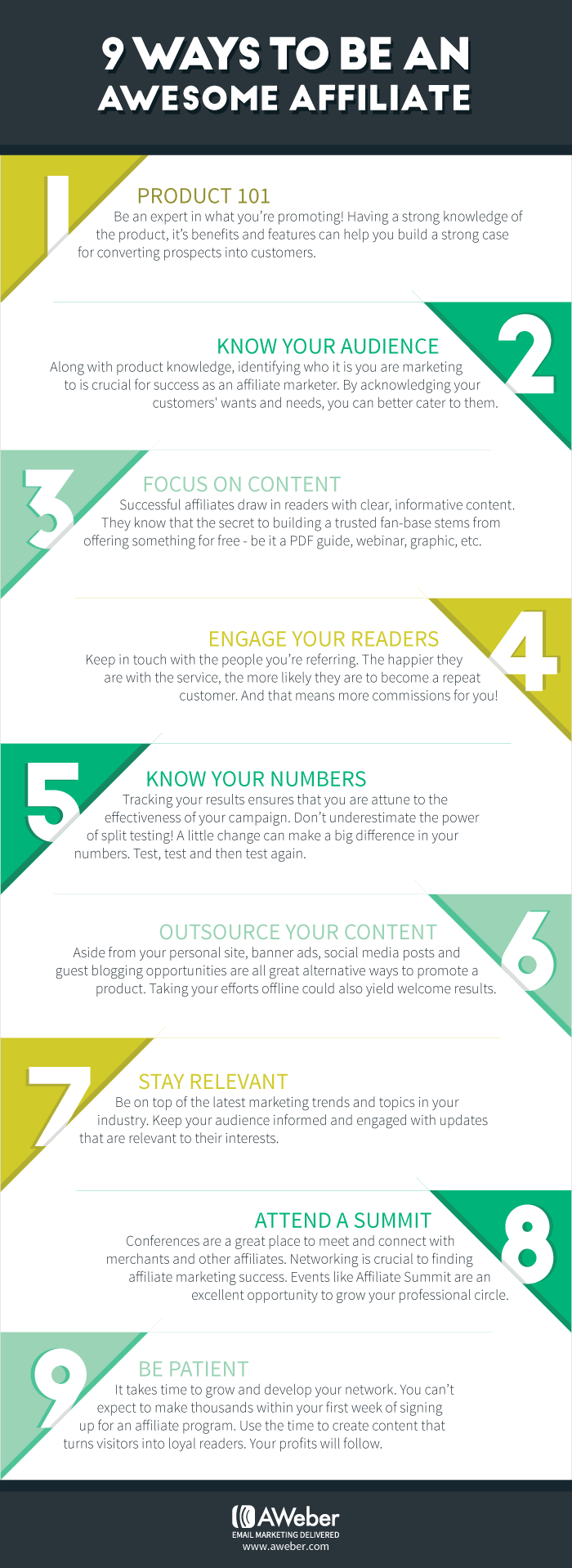
9 Ways To Be An Awesome Affiliate
What’s Next? Have a passion for email marketing? Consider using AWeber as your autoresponder to boost your affiliate marketing!.
A couple years back, an article that claimed “precisely zero” women work in the affiliate marketing industry hit the internet, upsetting many female powerhouses who play a large role in the space to this day. Although the article was unfounded and written off of very little research, it brought to light that some people perceive affiliate marketing as an exclusively-male profession. Why? The reasons vary. Some believe that women stray due to the nature of industry-related events, such as a network luncheons taking place at a gentlemen’s club. Others speculate that women avoid technology-related occupations and, therefore, don’t take interest in the tech-oriented environment of performance marketing. Fortunately, cold hard facts debunk the perceptions people have about women in this space. For starters, women dominate the US labor force, holding more than 51% of all professional occupations and filling roughly 49% of marketing-related occupations. In the affiliate marketing realm, they hold over a third of the positions open to advertising professionals. Furthermore, women make up almost a third of tech-related occupations in the US. When comparing these statistics to numbers over the past decade and placing them up against their male counterparts, it reveals that not only is the number of female employees in the workplace growing steadily, but the female presence has increased proportionately across male-dominated fields as women are slowing taking over jobs traditionally held by men. Considering the numbers, people who speculate that women avoid affiliate marketing positions simply don’t know the facts. Beyond statistics, however, they also overlook something women bring to the space that their male peers may disregard. Biologically speaking, men focus on facts, numbers and the hierarchical structure of business. Women, however, are more likely to concentrate on experiences, relationships and the broader picture of a business opportunity. This quality is exceptionally useful in performance marketing, where sales are largely driven by consumer appeal. If an advertiser can perceive and fill the underlying needs of their consumer, the numbers will follow. That’s not to say men are incapable of having the same effect or of contributing in the same ways a woman can; it merely points out that women are just as capable of being successful in the affiliate world as men, even if their initial approach is entirely different. Fortunately, women working in affiliate marketing have received more recognition since the ill-advised article went live. Bloggers took to the internet in favor of female affiliate managers making big moves. The largest tradeshow in the industry hosted a speaking panel event during which four knowledgeable and credible women spoke about their satisfaction with their careers, their ability to move ahead despite their gender and the obvious reality that women have a place on all sides of an affiliate company, tech-related or not. Not surprisingly, the female presence continues to grow and mold the future of performance-based marketing. The best advice to women trying to break into affiliate marketing so far? Don’t make business partnerships and opportunities relevant to being male or female and gender roles won’t play a part in your success. Source: http://blog.madrivo.com/women-in-affiliate-marketing/
As you may or may not know, I am personally against any and all form of MLM (multilevel marketing), but proponents of it often ask what other opportunity is there to make money online besides through this method? The answer is affiliate marketing and in my honest opinion/experience, I feel this alternative is far better. What is affiliate marketing? Affiliate marketing is the process of promoting someone else’s product through your website/email/social network. With affiliate marketing, you are essentially a middleman. Here’s how this works in the most basic example: People look for things on the internet, often products/services. They hop onto places like Google and do a search for such things. If you own a website which appears to these people and they visit it, you can sell them something related to their interest. What you sell is a product/service and you act as an affiliate, meaning if they buy it through you, then you earn a commission. Example:
Someone looks for ways to stop their dog from barking, so they hop on Google.
Your site appears and they decide to visit it in hopes of finding an answer to their problem.
Your site shows them ways to help dogs stop barking, as well as promotes a book on disciplining dogs.
They like the information you have to offer and decide to buy the book you are promoting.
Once they buy the book from your site, you earn a commission.
Now take that person and multiply it by the hundreds, thousands and many more who also look for similar things on a weekly basis, then multiply the potential to earn money from these people and you have yourself the potential of a strong online business.
Here are some pros of affiliate marketing: You can sell pretty much ANYTHING as an affiliate. One of the most popular ways affiliates make money online is through product reviews. Since there’s millions of different products available online, there are also millions of different opportunities to promote them. Generally if you do things correctly, you don’t really have to sell much since people already know what they want. As an affiliate, you just make it easier for them to buy it, thus there’s no typical sales process necessary. Cons of affiliate marketing: 1. In 99.9% of cases, you need to have fundamental things in place before you become a successful internet marketing:
A niche.
A website.
Traffic (visitors).
This takes time to amass, but once you do, the rewards and profits can come in on autopilot. Get training on how to do this properly. What is multilevel marketing? Also known as MLM, this is a business model which in has similarities to affiliate marketing, but goes deeper and grey area territory as far as I’m concerned. MLM in general is a process of marketing in which you usually get people to sign up to a program you’re promoting. The more people you sign up, the more you can make in commissions. In that sense, it works exactly like affiliate marketing, but one key difference is this: If the people you refer start to refer others into the business, you can make money of those secondary referrals. Now on paper this may seem like a much more profitable opportunity than affiliate marketing, but as you’ll find out in the cons, theory and realism are 2 different things. The pros of multilevel marketing: 1. Considering you are either a VERY good salesman or have a large list of leads at your disposal, you can make a lot of money through referring people into an MLM. This is something most people lack and thus fail in the business (among other reasons). 2. You can potentially make a lot of money with an MLM vs affiliate marketing. The cons of multilevel marketing: 1. Generally, many MLM programs get a bad rep because often times they are accused of being pyramid schemes. mlm pyramid scheme 2. It is VERY difficult to sell an MLM program/product to someone. Unlike in affiliate marketing where people come to you, with MLM programs, generally you come to them and it is VERY rare that you can sell an idea to someone. Most of the time, people are sold on a business idea of how they can make a lot of money through an MLM, only to find out the hard way it’s just a dream. 3. Many MLM programs come and go (often because they are pyramid schemes) so it is very difficult to find stability. Even if you have a strong list of people who follow you everywhere you go, it’s difficult to keep hopping from one MLM to another and maintaining credibility within your list’s eyes, at least from my point of view. They are however people who keep doing this and make a very successful living doing so. I am personally not for that sort of business because I feel it is basically a wild goose chase for many. 4. There are a lot of MLM programs which have their own products to sell to others. They recruit people, sell them these products and allow them to re-sell it. Usually the process of re-selling is difficult in my experience because the products being sold have other competitors on the market, often times more popular, making it even more difficult to sell. Affiliate marketing vs MLM. And the winner is… I have to say affiliate marketing. I have tried MLM before and did not succeed. What I can absolutely say without a doubt is this: If you want to succeed in either industry, I suggest doing it online and if that’s the case to get proper training on doing so. Personally I advise against getting involved with MLM’s because I feel they are more difficult to sell to people, not to mention their business model can be VERY questionable. With affiliate marketing, there is massive potential to not only make a lot of money, but also genuinely help people as well as materialize a success online business which is built upon YOUR personal passion. I know I am a bit biased towards MLM programs, so if you agree/disagree with my position on this, let me know in the comments section below! Source: http://howtomakehonestmoneyonline.com/why-affiliate-marketing-is-superior-to-mlm
How to Create Additional Sources of Income in Your Home Business I first came across the concept of multiple streams of income in Barbara Winter’s book, Making a Living Without a Job, in which she recommends creating multiple profit centers. Robert Allen, the real estate entrepreneur, also wrote a couple books promoting the idea of multiple streams of income. Creating more than one income stream sounds overwhelming, after all, you already have one source of work, now you need to create more? The short answer is yes. The benefits of having of several sources of income include: 1. It’s easier to create several small income producing streams over one large one. For example, it’s easier to create three streams that earn $1,000 than one stream that earns $3,000. 2. It reduces the risk of being left without any income. If you’re laid off or one source of income drops, you have other sources to help you get by. Especially in home business, which has an ebb and flow, you can offset the ebbs through having more than one source of income. 3. It helps you avoid boredom in work by having different things to do every day. 4. You can create income streams based on your interests, talents and passions. Of course, there are a few challenges with multiple income streams including: 1. It’s difficult to keep on top of all tasks that need to be done for every income stream. 2. It’s a balancing act to give enough attention to each income stream to keep them growing and profitable. Barbara Winter likens it to plate spinning. 3. The start-up time for each income stream is time and energy consuming. Even with the challenges, I recommend developing more than one income stream. The easiest way to create multiple income streams is to build streams related to your home business. Here are tips to adding more income streams to your home business. 1. Take out a piece of paper and write your main business product or service in the middle to start a mindmap. If you’re a virtual assistant, you’d write VA in the middle of the paper. 2. Create four spokes titled “Products,” “Services,” “Advertising/Affiliate,” and “Other” off of your main product or service. 3. Create spokes off of each of these options with ideas on how you can make money at them. Earning sources include books, courses, merchandise, coaching, freelancing, speaking, training, selling advertising and affiliate marketing. For example, a virtual assistant can create tangible or digital products, such as books, courses, and videos that teach others how to be a virtual assistant in the “products” spoke. For services, she can offer additional services, coaching or speaking (i.e. How a Virtual Assistant Can Save Businesses Time and Money). Under other, she can expand her business by bringing on contract virtual assistants and become a manager of a VA company. Not all businesses will be able to come up with ideas for each spoke, but every business should be able to develop extra income streams from their home business idea. 4. Focus first on passive income streams that you create once but they continue to generate income. For example, writing a book is a passive income stream. You write it once and sell it over and over. The word passive is a little deceptive because you need to market the book. Nevertheless, compared to non-passive sources of income, which you need to do over and over to make money such as providing a service, passive income streams require less time once they’re created. Other forms of passive income include other written (i.e. courses), audio or video creations, affiliate marketing, licensing your idea, franchising or continuity programs (i.e. memberships). 5. Next, focus on income streams that can expand your business. For example, public speaking or teaching can create additional income, as well as generate new clients. 6. Wait until one income stream is up and running before starting the next. Putting your focus into many areas at once dilute your efforts and slow you down. 7. Drop an income stream if it isn’t working. You want to give your additional income streams the time and effort needed to get them running, but if they don’t start generating income or if you hate it, drop it. For example, I don’t like having appointments. While I enjoy coaching people, to do so requires appointments, so I don’t do much coaching. Although adding income streams takes time, creating them within your current business is faster and easier than starting completely new income streams from scratch. This method of generating extra sources of income works well for any size business in any industry. For example, Amazon.com started by selling books. Today it sells thousands of other products including its own product, the Kindle, and is a print and digital publisher. Originally, my website, Work-At-Home Success only provided information and resources about working from home. Today, through the site, I offer ecourses and print and digital books, and I speak in-person and via phone or web to groups all over the world. Plus I sell advertising and promote affiliate programs. With creativity, planning and focus, you create additional sources of income for your business, as well. Source: http://homebusiness.about.com/od/growing/fl/Making-Multiple-Streams-of-Income.htm
Are you interested in starting an email marketing company? Do you need a sample email marketing business plan template? If YES, then I advice you read on. According to Wikipedia, researchers estimated that about US$1.51 billion was spent on e-mail marketing campaigns by companies in the United States of America in 2011. This amount is also expected to grow to about $2.468 billion by 2016. This shows just how much e-mail marketing is gaining relevance in the business world today. E-mail marketing involves sending out promotional messages to clients/prospective clients through e-mails. Such messages could be advertisements, updates, brand awareness campaigns or requests. E-mail marketing seeks to build a relationship between a seller and his clients or to preserve an existing relationship and further build trust and loyalty between a seller and his clients. What are the types of e-mail marketing services?
Direct emails
Direct e-mails are sent to promote a particular product or sales offer. Companies who offer e-mail marketing services gather the e-mail addresses of people they wish to send such messages to by buying prospective leads from companies who offer lead generation services. Sometimes, an e-mail marketing company may offer both services.
Transactional e-mails
Transactional e-mails are sent to complete or confirm a transaction initiated by a client with the sending company. For instance, if a prospective client visits your sales website and fills a registration form asking for further details about a particular product, transactional e-mails would then be sent to such a client to further engage the customer and trigger his interest in the products. E-mail marketing service companies have become relevant over the years as many companies have discovered their effectiveness and how they can help to increase sales compared to other methods of advertisement. Most companies would rather outsource their e-mail marketing services to professionals who possess the necessary skills and expertise to achieve an effective e-mail marketing campaign. It would also allow the company focus on other aspects of the business. You can begin a career in e-mail marketing by starting your own e-mail marketing company. Below is a guide to help you get started. Starting an Email Marketing Company – Sample Business Plan Template
Write your business plan
The first step in setting your own e-mail marketing company is to draft your business plan. In your business plan, you should be able to identify your target customers and how you will reach them. You should also identify all the strengths, weaknesses, opportunities and threats of the business.
Decide on the services you want to offer
You should also decide on the category of e-mail marketing services you would be offering. E-mail marketing involves several aspects. There are those who specialize in developing good e-mail marketing content that would help to sell products, there are also others who specialize in building e-mail lists and lead generation for their clients. Therefore, you have to decide on the services that you are willing and able to provide to your clients.
Observe your competitors
Going into a business like this requires that you carry out a thorough research on the business and those who have been in the business before you. This would help you understand the opportunities and challenges that exist in the e-mail marketing business. You would also be able to devise means of overcoming those challenges when you start your own business.
Purchase E-mail Marketing Software
To effectively run your e-mail marketing business, you would need to invest in a very good e-mail marketing software. E-mail marketing software are used to send bulk e-mails, build e-mail lists for your various clients, develop e-mail marketing content and to track the e-mails sent to see how many were opened and how many were converted to actual sales. E-mail marketing software makes the work faster and easier.
5. Determine your prices
The next thing to do is to figure out how much you should charge for your services. You have to take into consideration your business expenses as well as the time and efforts you will invest in your business before coming up with a competitive price that would justify your efforts and expenses.
Devise a sales and marketing strategy
This is a kind of business that needs effective and strategic marketing. You would need to carefully decide on how you want to promote your services and build a customer base.
Create a business website
As an e-mail marketer, you can hardly do much without a professionally designed business website. Your website would serve as your landing page where your own clients can check you out. You would also need a good internet service provider and host server that would be able to handle a large volume of data that you would most likely be dealing with. In conclusion, I want you to know that E-mail marketing is a smart business idea especially now that it is increasingly becoming popular among many companies. Over the next few years, the usage of e-mail marketing as a means of advertising is expected to rise and you can position your own company to take a large share of the market by starting your own e-mail marketing business now and offering your clients first class services with proven results that would keep them coming back and referring others.
In theory, using affiliate commission to boost your income could not be easier or more straightforward. However, in reality, in such a saturated market, it’s important that one is 100% sure of the things to take into account before committing to affiliate sales. Here are the top questions you should consider: - Are you doing it for the right reasons? It’s all well and good thinking that your blog is at the stage where it could start making you money, and it’s true that affiliate marketing is one of the most effective ways to make money online. However, simply because you want to ‘make money’ should not be the sole reason for wanting to continue a blog. Blogging and writing insightful and imaginative articles that strike a chord with your audience should be the ultimate driving force spurring your blog on. Readers will see through posts that are too promotion-heavy. - Do you have a wide enough following? In order to start making some money from your blog, you don’t necessarily need to have thousands and thousands of existing subscribers. In our experience, much of the engagement and comments left on a lifestyle blog will be from individuals who have organically discovered your site through social media pages and not by those who are already subscribed to your blog. If you feel as though your content is generating enough unique views, engagement and comments from a wide plethora of readers, then becoming an affiliate site is absolutely something to consider seriously. - Are you driving enough traffic to your blog from social media platforms? We cannot highlight enough the important role that social media will play in whether or not a move into the realm of affiliate commission is a successful one. By staying active and sharing original content on platforms such as Twitter, Facebook, YouTube, Google + and Pinterest, you can make sure you are continually building your following and chances of making commissions through sales made through your site. It is also worth actively encouraging shares, retweets and re-pins of particularly popular posts, especially by other high-profile bloggers who may follow you. - Is your content engaging enough for your audience? If you are seriously interested in making money through your blog, you will need to start writing reviews of products and services with affiliate marketing in mind. You cannot simply throw links out randomly and expect a wave of commission to start rolling in. It is far more effective to think of the affiliate links as added resources that compliment your existing copy, and not the sole reason you have written the piece in the first place. - Do you have the extra time to dedicate to your blog? Perhaps a rather straightforward point, but chances are you already juggle writing and managing your blog with full-time work or studying. Therefore, an important question to ask yourself is whether you can dedicate the required amount of time to monetising your blog, especially if it starts to do very well for you. Would you be willing to forego the odd night out or shopping trip with friends in order to stay in and work on your blog? If the answer is no, then you might want to re-think your options. - Would you know the kinds of affiliate programs to approach? Affiliate links will earn you commission if you successfully drive a sale to the merchant, which means that a blog reader will need to click on one of your embedded links, and either purchase or sign up to something before you see any kind of commission. Therefore, the more relevant your affiliate ad is to your reader’s likes and preferences, the higher the chances they will click on the link and make a subsequent purchase. Source: http://digitalmarketingmagazine.co.uk/digital-marketing-features/top-tips-for-bloggers-considering-becoming-affiliates/1264 By Mark Russell
You want to make money online, right? Start by realizing that the Internet is the way to go in terms of creating, marketing and selling merchandise, i.e. information products. The Internet has become the place where consumers prefer to purchase things. If you want a piece of that multi-billion-dollar-a-year business, then you need to have an online product that people will want to buy. You can certainly market and sell products manufactured by other companies and individuals (affiliate marketing), but when you produce your own information products, you earn the largest profit margin. Once you understand the basic fundamentals, you will be able to determine what information product will be ideal for you to focus on. Creating your own product is fairly straightforward and don’t cost a tremendous amount on money to produce – it’s just information in product form… Make Sure You’re Information Products Offer Both Quality And Value If you want your product to make an impact, you will want to focus on quality. Just as in the world of brick and mortar stores, merchandise that is made with cheaper materials tend to detract from the quality. The manufacturer will be able to charge less for it, which attracts consumers looking to save money, but it will not earn a positive reputation. When it comes to information products created for the Internet, quality is measured differently. They can include e-books, videos, music, applications, games, and other downloadable items. Generally, when a consumer makes a purchase, they can have them downloaded to their computer within minutes. That the huge advantage of this type of product – it’s available immediately. As a result, quality will be determined by the content and composition of the information. If you take time to produce a quality product with polished content, an attractive cover or image, and something people will find useful, then you will tend to find more success with it than with something that is just thrown together. Deciding On What Information Product To Create You may have some great ideas to market online, but you’re biased. Each of us thinks that we have the best ideas and that all it will take is investing in it with time, effort, and money, and people will be flocking to buy it. The problem with this mentality is that innate bias. We tend to become too excited about certain ideas we have that we believe are winners. It’s important to get some opinions from people who won’t have a vested interest in the idea. Friends and family can sometimes be ideal to ask, but it will be important for you to make sure they know you will want their honest opinion. If your idea is considered unique or ideal, then begin to research anything that may be similar already on the Web. You may think that it’s unique, but other people may already have something similar out there. That doesn’t mean you have to abandon your idea though; instead, determine how your idea is different and better than the others. The Power Of Online Information Products Products that are specifically designed for sale online are unique in that they can be downloaded by the consumer as soon as their transaction is complete. That means that marketing will be as important as the product itself. When you market your product, you will want to speak directly to a need your target audience has and how what you are offering fills that need. Blogging is a great way to promote your information product. Knowing how to start a blog or becoming involved with web hosting is essential to online marketing. Keep these thoughts in mind as you move forward with your idea. Know The Market It is critical that you know the market you will be targeting. What age range will be most interested in it? Will it be men, women, or both? If you create something that would be perfect for middle-aged professional women, but you focus on young, college-aged men, then your merchandise will not sell. Even if you realize that you targeted the wrong audience, make adjustments to the product and your marketing campaign; don’t simply abandon it. The great thing about most things created for Internet sale is that they can be altered without a tremendous amount of expense or effort. As mentioned, marketing is as important to the success of your product as quality. Before you put together this incredible information product that is going to sell like crazy, you should think about marketing. If you promise something of value to the reader, the marketing will become much easier. Develop a balance in which the marketing complements the product. Testimonials are a great way to show prospective buyers that what you’re offering is worth the investment. If you don’t have customers yet, then consider giving some copies away in exchange for those valued testimonials. Solve A Problem As noted earlier, anything marketed for consumers needs to solve a problem. A novel solves the problem of quiet entertainment. An e-book on how to become a successful affiliate marketer solves the problem that inexperienced professionals may have. You should conduct market research to determine precisely how to solve that problem for the consumer. See if there are other products similar to yours that were successful as well as any that weren’t successful. There are often great lessons to be learned from both. Creating a product that you intend to sell online demands a great deal of research on the market before it is actually created. An adage by Benjamin Franklin states that, ‘Success is 1% inspiration and 99% perspiration.’ That idea you have may be incredible, but you still need to do a serious amount of work before you will achieve success with it. You can get rich solving other people’s problems! Source: http://blogsuccessjournal.com/make-money-online/information-products/how-to-create-information-products-that-sell-themselves/
Let’s quickly go over 5 legitimate online home based business ideas that you can use to make money from home using nothing but the internet. We will also see how to cleverly integrate a number of the best online home business ideas together into a powerful money making system, suitable for any newbie. 1. Writing Articles – I first started out in my home business by providing an article writing service to other marketers. I am a quick writer so was able to charge low prices for simple articles for website content and still earn a respectable hourly wage at the same time. There is a high demand for article writers out there right now, since more content equals more traffic and sales for websites. 2. Paid Surveys – Companies are always on the lookout for people to fill in surveys for them. This is either for market research purposes or so that they can capture contact information of people who fill out these surveys for future promotions. Either way, you can earn regular money from home on the internet if you consistently fill out these suveys each and every day.
3. Affilate Marketing – This home based business idea is now moving away from doing work from home jobs for others and instead becoming your own boss as an online entrepreneur. Affiliate marketing is one of the most newbie friendly ways to make money from home because you simply send people to existing proven product pages and earn commissions when sales are made based on your recommendations. You don’t need to handle orders or deal with customer support issues directly. 4. Network Marketing and MLM – In the home based business industry, the MLM and network marketing business models are very popular. This is largely due to the fact that of the leverage gained from being part of a team. Instead of only making money when you make your own sales, with online network marketing you also make money when your team members make sales. It is about leverage the work of others for a predictable monthly residual income. 5. Selling Information Products Online – Instead of promoting other peoples products with affiliate marketing, it is worth looking into creating and selling your own information products. An information product can be an ebook, audio or video series. It is simply your expertise converted into a format that others can follow in a step by step fashion in order to learn a new skill and follow a process to generate results for themselves in whatever it is that you are teaching. Infromation marketing is very popular because you just create the product once and sell it over and over again. You can either get other affiliate marketers to sell your products for you. One of the best home based business ideas that many beginners see success with involves taking advantage of a “business in a box” that lets you pre-designed affiliate products as part of a professional sales funnel. Source: http://recomp-project.eu/?p=78
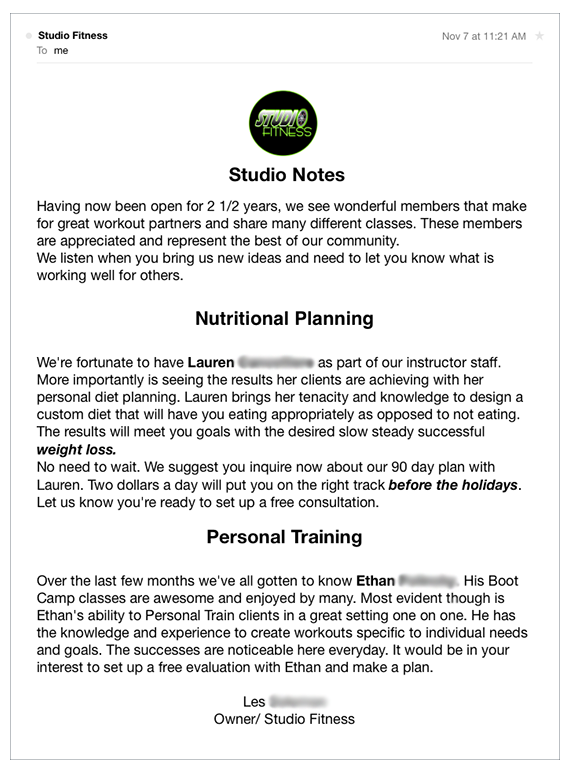
Picture this: You’ve just hit the send button on a new email campaign for your business. You’ve got killer content, a great call to action and an attention-grabbing subject line… or so you think. As you watch your analytics, it becomes clear that your email isn’t getting the results you want. What went wrong? Whether your open rates are suffering or you’re not getting enough click-throughs, there are lots of common email marketing mistakes that even experienced marketers make. The good news is that they can be easily fixed to increase engagement. The mistake: Your content is too self-promotional. If you send an email announcing your new software update, who cares? But if you send an email announcing that it’s possible to cut video upload time in half because of your software update, people will pay attention. It’s all about showing the value of your services while promoting your business. So, how can you do both? The solution: First, identify your audience’s biggest problems. Let’s say you work with a recruiting agency. Your subscribers need resume help, so why not give them a checklist to help them fix common resume faux pas? Brainstorm content ideas based on real problems your customers are having, then show how your services can fix them. From there, you can create an editorial calendar for your email campaign that will help create focused, useful emails. The mistake: Your readers think you’re a robot. What does your From address say? Is it from your own name, your business’s name, or something else? If your open rates are suffering, it could be because your emails lack a personal touch. Your email’s content plays a key role here too. Are you speaking directly to your target audience, or are you using jargony, impersonal industry terms? The solution: One easy way to make your brand more human is to personalize your From address – no one wants to talk to donotreply@email.com. To sound less robotic and more human, write in plain terms. For example, you wouldn’t described someone as economically marginalized, you would say they’re unemployed. Uncomplicated, easy-to-understand language wins over pretentious buzzwords any day. The mistake: Your call to action isn’t very… actionable. Take a look at this email from Studio Fitness.
There is no link to the nutritionist or personal trainer they introduce us to, and while they encourage us to sign up for a plan, there is no link to help us do that either. Oh, and we can’t access the Studio Fitness website from this email. Since there could be any number of gyms named Studio Fitness, leaving subscribers to find their website on their own is probably not a great idea. The solution: What do you want people to do when they read your email? Should they visit your website, sign up for a trial, take a survey? Your call to action needs to be strong and authoritative – people need to be told what to do! Make your call to action loud and clear. The mistake: You’re inconsistent. How would you feel if you received a weekly newsletter and then, without warning, weekly emails turned into 10 emails a day? You wouldn’t be very happy, would you? It sounds a little ridiculous, but it happens more often than you think. Readers tune out and unsubscribe when they don’t receive what they signed up for. The solution: Deliver the emails you promised in your sign up form and stick to an editorial calendar if possible. The mistake: Your follow up series is nonexistent. Let’s say you have a customer who starts a free trial of your software service, but they never follow through and make a purchase. Sad story, right? It certainly will be if you don’t have a triggered-based follow up series in place. The solution: While you can’t control a customer’s behavior, you can control how you react to it. If you set up a follow up email that will automatically send to that customer at the end of their free trial, you have a better shot at keeping them engaged. If they had a question about your service, the email could prompt them to contact you, giving you another opportunity to make the sale. The mistake: Your subject lines are boring. Look at the subject line below. What does it tell us about what lies within the email?
Absolutely nothing. It’s not creative or relevant to the content inside, so there’s nothing about it that would make someone feel compelled to open it. And see that preview text after the subject line? (“If you’re having trouble…”) That space could’ve been used to tease the email too. The solution: You have about 35 characters to work with in your subject line, so make them count! Your subject line needs to grab attention and tell the reader something about the email itself, because that what will sell them on opening your email. The mistake: You’re not using personalization. What’s the best way to get someone’s attention? You address them by their name! It works the same way with email. If you’re not using personalization on your most important messages, you’re missing a real opportunity. The solution: Just like adjusting your From address to your real name, using personalization in your emails is another way to make your business more human. Notice how the email below uses personalization and takes advantage of preview text. The mistake: You’re sending to the wrong people. If you own a burger joint in Philadelphia, you wouldn’t send newsletters to vegetarians in San Francisco, right? This is why segmenting and list management is key, especially for those with growing email lists. The solution: Tell people exactly what they’re signing up for on your sign up form and stick to it. You can also use your form to segment people based on location, interests, or any other preference. If you only want to send emails to those who opened a particular message, you can segment based on open rates too. Once you’ve hit your sweet spot of segmentation, ask your readers for feedback so you can continue sending them content they want. Chances are, you’re guilty of at least one of these mistakes. But don’t sweat it! You can put solutions to work by using an autoresponder like Aweber and readjust what you send to your readers. What tips do you have for driving engagement in your emails? Share them in the comments section! Source: http://blog.aweber.com/articles-tips/common-email-marketing-mistakes-why-your-emails-arent-getting-results.htm
A new year is almost upon us. Wouldn’t it be fun to start a new blog in 2015? I agree! The first step of any new project is the planning stage. Unfortunately, many people (myself included!) have a tendency to forego this step and jump right in. Sometimes this works, but most of the time it just leads to a mess. I’ve been blogging, in some form of another, for over ten years, so take it from me: you need to think ahead. Here are five things to consider before you go any further in the starting-a-blog-process! Don'ts rush it If you’re like me, you come up with an idea and become completely and totally obsessed with it. When the idea of, “Hey, you know, I think I could start my own web design business and actually be successful,” struck me, I wanted nothing more than to jump right in, head over heels. And that’s awesome. But you have to give yourself time. You need time to research, time to develop your product/brand/idea, and time to understand if this is something you actually want to do or if it’s just a passing phase. I spent a good 2-3 months researching product need/pricing and developing my products before I ever launched Dinosaur Stew. The bottom line here is don’t act on impulse, because blogging is not an impulsive thing. It’s a huge commitment and, in order to be successful, you need to commit. Know Why you're Blogging (and have realistic expectations) Are you blogging for fun or because you think you’ll be able to make a quick buck off of it eventually? If you’re only blogging for fun, you don’t have to worry about much. However, if you’re looking to monetize your blog, you need to ensure you’re truly willing to put the work in to make your blog be the best it can be. Most importantly, have realistic expectations. You can start making money your first month of blogging, but–realistically-it likely isn’t going to be more than a couple dollars from Google AdSense advertising because you’ve convinced your best friend and your brother to visit your website every day and click your links. You can make income blogging, but it will take lots of dedication, hard work, and most of all–time! Start writing posts. NOW Before you start your blog, start writing blog posts. This will help you out in a number of ways. First, it’ll help you understand if you actually like blogging. Since writing blog posts, is, obviously, an integral part of blogging, if you hate the writing part, it’s best to find that out sooner than later. Secondly, it will help you understand if the scope of your blog is enough. For example, if you can only think of two posts to write, you might need to expand the topics that your blog will cover. Lastly, if you have a bunch of posts already written before your blog’s launch, you’ll be able to devote more time to promoting your blog, instead of having to spend all of your time coming up with more content. Know your Schedule For many, blogging can be (and is!) a full time job. Keeping up with a blog can be time consuming. Keeping up with a blog can feel like a chore. Can you keep up? Will you want to keep up? Will you still have time for you? Going back to the first tip, it’s easy to act on impulse, but you need to look ahead to the future. If, after eyeing up a calendar, you don’t think you’ll have time to commit to the upkeep of your blog at some point in the relatively close future, don’t waste the time or effort starting one! You can always start your blog at a later date but for now, don’t waste the energy when you could put it to use elsewhere! Know Yourself Is blogging going to help you or hurt you? Is this blog going to help you grow in some way? Even though you might be passionate about something, blogging about it might not be the right thing for you. I’m super passionate about cookies. And cake. And pie. And I know how to blog! I could be the next Averie Cooks! But I know that if I started a dessert recipe blog, I would be rewarded with Type 2 diabetes and an advertising deal for bariatric surgery, and that’s not what I want for myself. Make sure there’s something in it for you, beyond the odd change you get each day in advertising, to make it worthwhile. Are you thinking of start a new blog soon? What do you think of these tips? If you’re already blogging, what would you tell new bloggers? Source: http://dinosaurstew.com/starting-a-blog-in-2015-here-are-5-tips-pre-blogging-tips/
You've heard it time and time again, "The money is in the list!" This is, after all, the Golden Rule of online marketing. But, where's the list? How do you get a list? What do you do once you have the list? These questions can all be answered with one word: Autoresponder! Simply put, an autoresponder is an automated follow-up tool, which you set-up to check back with your prospects through email messages you create and schedule. There are various autoresponder services out there, but the most popular once, by far, are AWeber and Get Response. The reason these two services are at the top of the popularity ratings is that they are simple to use, offer several features like form-creation and broadcasting capabilities, and they have great deliverability ratios (all that means is that it is very unlikely for your messages be sent to your prospects' SPAM folders). Now, the way an autoresponder works is by storing your prospect's information from your opt-in box and getting them on queue to receive your pre-set messages. So, if you have a website (blogs and Facebook business pages can also have opt-in boxes added to them) with an opt-in box which asks prospects to type in their name and email, once someone provides that information, the autoresponder takes care of the rest. Depending on the settings you have established, the new lead (what a prospect becomes after filling-in the opt-in box) will start to receive your messages according to the schedule you have set up. Why do you need an autoresponder? Well, the most obvious reason is that you need a way to build that infamous list! It is absolutely no use to you to have an offer people can only see once, especially if they make a purchase that first time. Also, autoresponders put your marketing and follow-up on autopilot. Think about it, you can set up your list so that people receive emails from you on a set interval for as long as you wish them to. And, the beauty of it is that after the initial set-up, you don't have to do anything else. Another beautiful aspect of having an autoresponder is that it allows you to "broadcast" or send one-time offers to your list with ease. This is another way of capitalizing on your list. Should you get an autoresponder? If you are serious about building an online business, then the answer is YES, ABSOLUTELY, WHAT ON EARTH AREYOU WAITING FOR! Remember, that the money is in the list. You cannot make a living on the internet if you have to go back every day and start from scratch! Imagine how long it would take you to do all the follow-up by phone or writing emails one at a time. AWeber and Get Response are also a great value for their cost. Both go for about $20/month. AWeber will give you the first month for $1. Get Response also has a free version, which can be a good way to test it, if you're still a bit skeptical, but it limits considerably number of leads you can store and broadcast. Also, if you are an affiliate to several opportunities or businesses, then you can broadcast your list with new offers. This means you no longer have to start a business venture from scratch! Autoresponder: by far the BEST tool a network marketer could invest in. Not only is it essential for list-building, but it will truly put your lead management on autopilot. Get your account today!
There must be some reasons some internet marketer can earn millions of dollars while others make zero cents. On the other words, if two equally experienced internet marketers are asked to start their business again but one of them cannot build a list. I am sure that one will quit within one month. This is because he lacks of the most powerful tool to make real money, which is "list building." What is a list building? List building is a powerful and evergreen internet marketing strategy that allows you to contact your website visitors. When visitors browse through your website, they find the information on the website is useful to them then they agree to give their contact (mostly email) to you. They would like to know what else you can offer them. With the list, now you can generate income without driving new traffic every day. Why list building is important? First, it is the main source of income in internet marketing. This is because the majority of the new traffic that you bring in to your website does not buy. They most probably look around and then leave your website. The reason behind it is they are thinking somewhere must have a better offer. Despite the "better offer" does not exist, and they love the information you have provided, they are most likely to forget it and never come back unless they bookmark your site. So you must capture their contact before they click away from your site. As mentioned earlier, people do not buy at the first time you offer them. The research showed that many buyers will only purchase after being offered six to seven times. The fact surprise you, doesn't it? However, do you think the same visitors will come back to your website and be offered for six to seven times? Therefore, holding the subscriber contact information can eventually help you archiving your financial goal. In addition, people refuse to pay their money to you is simply because they do not know who you really are. People prefer to buy with someone they know instead of a stranger. However, they will not offer you a chance to build a relationship with them. You need to grab the opportunity by yourself. Therefore, every new contact you get will be your future friends. Build a good relationship with them, so they are comfortable to buy any services or products from you. If you can build a quality list of 100,000 contacts with an auto responder you now can work less and start making passive income. You will be liberated from the financial trap, work lesser but earn more money. An auto responder such as Aweber.com allows you to follow up your subscribers automatically. This is the why you choose internet marketing, isn't it? Conclusion You have no reasons to say NO to this internet marketing strategy. If your traffic does not convert to sales, you must lack of a quality list in your business. Build a list now to take a large leap for your business growth.
If you have a knack for finding a niche, you might be a great affiliate marketer. With thousands of companies and millions of products to choose from, you can be an affiliate for any type of business you choose. However, you will first need to know more about affiliate promotion. We will cover some vital information in this article. Disclosing your use of internet marketing will let you know if it influences your readers in a positive way. Transparency is always appreciated, particularly in the field of affiliate marketing. Your customers should understand why you market certain goods. If they do, they are more likely to buy them. When you first start web marketing, seek out affiliates who sell products that will resonate with your customer base. Setting up agreements with multiple affiliate networks can give you a good source of income. Don’t work with just anybody; make sure that you do thorough research so you know that you are with the right people. A lot of affiliate communication happens through emails, but the inbox makes an inefficient place to store important information. To make sure you are not missing a beat, copy and paste your tasks into a separate window. By using the document as your reference, you can work more quickly and efficiently. Choosing the hottest products to promote as an affiliate may mean thinner profits. Market quality is important, but quality doesn’t mean oversaturation. The downside of promoting hot products is the intense competition. This might mean you get very little or even no profit. Every single affiliate you choose should be in your site’s niche. This will increase traffic to your website and also assist you in truly understanding the needs and wants of your customer base. Try using paid services like Google Ads for affiliate promotion. Purchasing keyword-driven advertising doesn’t just send traffic to your website, it sends prospective customers who have already shown they are interested in the keyword. Use a deadline for affiliate products that you offer. When people notice there is a short time frame to buy the product, they may hurry up and place an order faster so they can make sure they get it. Incorporating this strategy is an effective way to increase your sales. Understanding your target audience is important to growing your business. It is imperative that you target your readers’ needs. Decipher what is compelling them to visit your site. What is catching their attention? Tell your readers up front that you’re part of an affiliate program. They will feel that you are more trustworthy. This is the beginning of a relationship that may lead to more sales. Avoid using a tracking system from a vendor, unless you are sure it is not a scam. Just look for tracking systems that are legit and offer proof that it works. When backlinking to your site content, be honest about where you are taking your potential customers. If your customer comes to your site looking for an HP tablet, they won’t be able to see iPads. Although you may think it is a clever strategy, a mismatched link will appear shady to visitors. A good product is not the only thing necessary to your career in web marketing. As mentioned previously, there is a lot of information about internet marketing than you may have thought. Use the advice in this article to help you start a successful affiliate promotion campaign. Always take your business seriously. Learn all you can and apply what you know. Source: http://www.mlspro-onlinemarketing.com/affiliate-marketing-tips-that-everyone-should-know/
Affiliate marketing is a type of performance-based marketing in which a business rewards one or more affiliates for each visitor or customer brought by the affiliate's own marketing efforts. The industry has four core players: the merchant (also known as 'retailer' or 'brand'), the network (that contains offers for the affiliate to choose from and also takes care of the payments), the publisher (also known as 'the affiliate'), and the customer. The market has grown in complexity, resulting in the emergence of a secondary tier of players, including affiliate management agencies, super-affiliates and specialized third party vendors.
Affiliate marketing overlaps with other Internet marketing methods to some degree, because affiliates often use regular advertising methods. Those methods include organic search engine optimization (SEO), paid search engine marketing (PPC - Pay Per Click), e-mail marketing, content marketing and in some sense display advertising. On the other hand, affiliates sometimes use less orthodox techniques, such as publishing reviews of products or services offered by a partner. So in simple terms affiliate marketing is: “Selling Other People's Stuff” Source: http://en.wikipedia.org/wiki/Affiliate_marketing