What went wrong?
Whether your open rates are suffering or you’re not getting enough click-throughs, there are lots of common email marketing mistakes that even experienced marketers make. The good news is that they can be easily fixed to increase engagement.
The mistake: Your content is too self-promotional.
If you send an email announcing your new software update, who cares? But if you send an email announcing that it’s possible to cut video upload time in half because of your software update, people will pay attention. It’s all about showing the value of your services while promoting your business.
So, how can you do both?
The solution: First, identify your audience’s biggest problems. Let’s say you work with a recruiting agency. Your subscribers need resume help, so why not give them a checklist to help them fix common resume faux pas? Brainstorm content ideas based on real problems your customers are having, then show how your services can fix them. From there, you can create an editorial calendar for your email campaign that will help create focused, useful emails.
The mistake: Your readers think you’re a robot.
What does your From address say? Is it from your own name, your business’s name, or something else? If your open rates are suffering, it could be because your emails lack a personal touch. Your email’s content plays a key role here too. Are you speaking directly to your target audience, or are you using jargony, impersonal industry terms?
The solution: One easy way to make your brand more human is to personalize your From address – no one wants to talk to donotreply@email.com. To sound less robotic and more human, write in plain terms. For example, you wouldn’t described someone as economically marginalized, you would say they’re unemployed. Uncomplicated, easy-to-understand language wins over pretentious buzzwords any day.
The mistake: Your call to action isn’t very… actionable.
Take a look at this email from Studio Fitness.
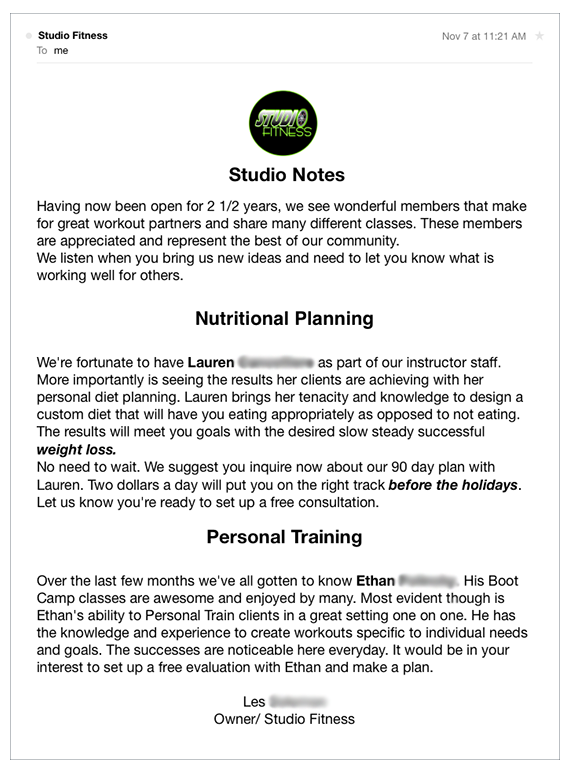
There is no link to the nutritionist or personal trainer they introduce us to, and while they encourage us to sign up for a plan, there is no link to help us do that either. Oh, and we can’t access the Studio Fitness website from this email. Since there could be any number of gyms named Studio Fitness, leaving subscribers to find their website on their own is probably not a great idea.
The solution: What do you want people to do when they read your email? Should they visit your website, sign up for a trial, take a survey? Your call to action needs to be strong and authoritative – people need to be told what to do! Make your call to action loud and clear.
The mistake: You’re inconsistent.
How would you feel if you received a weekly newsletter and then, without warning, weekly emails turned into 10 emails a day? You wouldn’t be very happy, would you? It sounds a little ridiculous, but it happens more often than you think. Readers tune out and unsubscribe when they don’t receive what they signed up for.
The solution: Deliver the emails you promised in your sign up form and stick to an editorial calendar if possible.
The mistake: Your follow up series is nonexistent.
Let’s say you have a customer who starts a free trial of your software service, but they never follow through and make a purchase. Sad story, right? It certainly will be if you don’t have a triggered-based follow up series in place.
The solution: While you can’t control a customer’s behavior, you can control how you react to it. If you set up a follow up email that will automatically send to that customer at the end of their free trial, you have a better shot at keeping them engaged. If they had a question about your service, the email could prompt them to contact you, giving you another opportunity to make the sale.
The mistake: Your subject lines are boring.
Look at the subject line below. What does it tell us about what lies within the email?

Absolutely nothing. It’s not creative or relevant to the content inside, so there’s nothing about it that would make someone feel compelled to open it. And see that preview text after the subject line? (“If you’re having trouble…”) That space could’ve been used to tease the email too.
The solution: You have about 35 characters to work with in your subject line, so make them count! Your subject line needs to grab attention and tell the reader something about the email itself, because that what will sell them on opening your email.
The mistake: You’re not using personalization.
What’s the best way to get someone’s attention? You address them by their name! It works the same way with email. If you’re not using personalization on your most important messages, you’re missing a real opportunity.
The solution: Just like adjusting your From address to your real name, using personalization in your emails is another way to make your business more human. Notice how the email below uses personalization and takes advantage of preview text.

The mistake: You’re sending to the wrong people.
If you own a burger joint in Philadelphia, you wouldn’t send newsletters to vegetarians in San Francisco, right? This is why segmenting and list management is key, especially for those with growing email lists.
The solution: Tell people exactly what they’re signing up for on your sign up form and stick to it. You can also use your form to segment people based on location, interests, or any other preference. If you only want to send emails to those who opened a particular message, you can segment based on open rates too. Once you’ve hit your sweet spot of segmentation, ask your readers for feedback so you can continue sending them content they want.
Chances are, you’re guilty of at least one of these mistakes. But don’t sweat it! You can put solutions to work by using an autoresponder like Aweber and readjust what you send to your readers.
What tips do you have for driving engagement in your emails? Share them in the comments section!
Source: http://blog.aweber.com/articles-tips/common-email-marketing-mistakes-why-your-emails-arent-getting-results.htm

