Most people are aware of the mind-body connection—how your mental processes can affect your physical state. If you feel frightened, your heart races. Being embarrassed can cause you to blush. When you think of something happy, you are likely to smile. Meditating may even lower your blood pressure. But what about the reverse—a body-mind connection? Can altering your physical state in some way affect your mental state?
Accumulating research is revealing that body position, postures, gestures and facial expressions can indeed influence how you think, feel and even behave. For example, if you wrinkle your nose, an odor may smell more unpleasant. Raise your eyebrows and you may be more surprised by something you read. How you physically lean may, oddly enough, affect your perception of size: Lean left and you’re likely to think the Eiffel Tower is shorter than when you lean right. And though it may not have worked for Lady Macbeth, recent studies have found that handwashing can have a psychologically cleansing effect, lessening feelings of guilt and remorse.
Power poses and confidence
Much of the research on the body-mind connection (called embodied cognition by researchers) has focused on various expansive (or “power”) poses, which involve open positions, with arms and elbows away from the body and chin raised—as opposed to closed postures where the legs or arms are crossed, the head is down and the body slumped or slouched over. For example, in a small study published in the journal Psychological Science in 2010, people who sat or stood in expansive poses for just one minute not only felt more powerful and in charge, they also had an increase in testosterone and a decrease in the stress hormone cortisol. “By simply changing physical posture, an individual prepares his or her mental and physiological systems to endure difficult and stressful situations,” the paper concluded.
In another study that year in the same journal, people who assumed open body positions (the ankle of one leg resting on the thigh of the other leg, and an arm resting on the back of a chair) were more likely to take action (pick a card) during a blackjack game and reported a higher sense of power than those in constricted positions (legs together, shoulders dropped, hands under thighs).
Just sitting up straight, a simple power pose, may increase self-confidence, according to a study in the European Journal of Social Psychology in 2009. Participants wrote down their strengths and weaknesses and described themselves in a variety of ways, including whether they were good candidates for a job. Those who did the task while sitting up straight, chest out (“confident” posture) rated themselves higher and had more confidence in their self-attitudes than those who sat slumped, with face looking down at knees (“doubtful” posture). That is, “fake it till you make it.”
Power poses may also help lessen pain, suggested a study in the Journal of Experimental Social Psychology in 2012. People who assumed expansive yoga poses (standing with legs apart and arms raised) had higher tolerance to discomfort and pain than those in submissive (kneeling) or neutral poses (standing with hands at sides). The researchers concluded that even if you don’t have control over your circumstances, you can behave as if you did by assuming a dominant pose, which, in turn, may decrease sensitivity to pain.
Words to the wise: Research on the body-mind connection, though still in its infancy, suggests that you may benefit by paying attention to how you hold your body. If you act as though you feel powerful and self-confident, you may achieve that actual feeling due to changes in body biochemistry. A few caveats: Being aware of the phenomenon may lessen the effect. And even if you achieve the effect, it may not persist over time.
Keep in mind, too, that body postures have a cultural element, as was illustrated by a 2013 study in the Journal of Experimental Social Psychology that included Americans and East Asians. Though some expansive positions (like hands-spread-on-desk pose) increased feelings of power in both groups, the “feet-on-desk” power pose did not have this effect in East Asians because their cultural norms value modesty, restraint and humility. Nor would this pose be viewed well in Arab cultures, which consider it an insult to show the bottoms of shoes.
Source
Showing posts with label Healthy Body Healthy Mind. Show all posts
Showing posts with label Healthy Body Healthy Mind. Show all posts
Wednesday, 9 September 2015

Monday, 17 August 2015
Exercise: 7 benefits of regular physical activity
You know exercise is good for you, but do you know how good? From boosting your mood to improving your sex life, find out how exercise can improve your life.

Want to feel better, have more energy and perhaps even live longer? Look no further than exercise. The health benefits of regular exercise and physical activity are hard to ignore. And the benefits of exercise are yours for the taking, regardless of your age, sex or physical ability. Need more convincing to exercise? Check out these seven ways exercise can improve your life.
No. 1: Exercise controls weight
Exercise can help prevent excess weight gain or help maintain weight loss. When you engage in physical activity, you burn calories. The more intense the activity, the more calories you burn. You don't need to set aside large chunks of time for exercise to reap weight-loss benefits. If you can't do an actual workout, get more active throughout the day in simple ways — by taking the stairs instead of the elevator or revving up your household chores.
No. 2: Exercise combats health conditions and diseases
Worried about heart disease? Hoping to prevent high blood pressure? No matter what your current weight, being active boosts high-density lipoprotein (HDL), or "good," cholesterol and decreases unhealthy triglycerides. This one-two punch keeps your blood flowing smoothly, which decreases your risk of cardiovascular diseases. In fact, regular physical activity can help you prevent or manage a wide range of health problems and concerns, including stroke, metabolic syndrome, type 2 diabetes, depression, certain types of cancer, arthritis and falls.
No. 3: Exercise improves mood
Need an emotional lift? Or need to blow off some steam after a stressful day? A workout at the gym or a brisk 30-minute walk can help. Physical activity stimulates various brain chemicals that may leave you feeling happier and more relaxed. You may also feel better about your appearance and yourself when you exercise regularly, which can boost your confidence and improve your self-esteem.
No. 4: Exercise boosts energy
Winded by grocery shopping or household chores? Regular physical activity can improve your muscle strength and boost your endurance. Exercise and physical activity deliver oxygen and nutrients to your tissues and help your cardiovascular system work more efficiently. And when your heart and lungs work more efficiently, you have more energy to go about your daily chores.
No. 5: Exercise promotes better sleep
Struggling to fall asleep? Or to stay asleep? Regular physical activity can help you fall asleep faster and deepen your sleep. Just don't exercise too close to bedtime, or you may be too energized to fall asleep.
No. 6: Exercise puts the spark back into your sex life
Do you feel too tired or too out of shape to enjoy physical intimacy? Regular physical activity can leave you feeling energized and looking better, which may have a positive effect on your sex life. But there's more to it than that. Regular physical activity can lead to enhanced arousal for women. And men who exercise regularly are less likely to have problems with erectile dysfunction than are men who don't exercise.
No. 7: Exercise can be fun
Exercise and physical activity can be a fun way to spend some time. It gives you a chance to unwind, enjoy the outdoors or simply engage in activities that make you happy. Physical activity can also help you connect with family or friends in a fun social setting. So, take a dance class, hit the hiking trails or join a soccer team. Find a physical activity you enjoy, and just do it. If you get bored, try something new.
The bottom line on exercise
Exercise and physical activity are a great way to feel better, gain health benefits and have fun. As a general goal, aim for at least 30 minutes of physical activity every day. If you want to lose weight or meet specific fitness goals, you may need to exercise more. Remember to check with your doctor before starting a new exercise program, especially if you haven't exercised for a long time, have chronic health problems, such as heart disease, diabetes or arthritis, or you have any concerns.
Source
Thursday, 6 August 2015
Why Steve Jobs Took Long Walks and Why You should Too
Why Everyone From Beethoven, Goethe, Dickens, Darwin To Steve Jobs Took Long Walks and Why You Should Too
One day, when Marc Andreessen, the money man behind such tech giants as Facebook, Twitter, and Zynga, was out driving around his home in Palo Alto, California, he nearly hit a crazy old man crossing the street.
Looking back at the fool he had nearly run over he noticed the trademark blue jeans and black turtle neck. “Oh my god! I almost hit Steve Jobs!” he thought to himself.
It was Jobs that day, out on one of his many walks around the Palo Alto area, where Apple are based. Steve Jobs was famous in the area for his long walks, which he used for exercise, contemplation, problem solving, and even meetings. And Jobs was not alone. Through history the best minds have found that walking, whether a quick five minute jaunt, or a long four hour trek, has helped them compose, write, paint, and create.
Here are five reasons that walking is one of the best ways you can spend your time, and how it can help you think better, get more done, relate better, and live longer.
01. It will help make you more creative
 Though most people have always thought that their best ideas came when the were on the move, now there is scientific evidence to back them up. A 2014 study from Stanford University in the US has shown that people are much more creative when they are walking around as opposed to when they are sitting still. Marily Oppezzo and Daniel Schwartz, who both authored the paper, studied 176 college students as they completed certain creative thinking tasks.
In this study, the authors used an experiment known as Guilford’s Alternative Uses Task. As part of this, they participants were asked to list as many alternative uses for a common object as they can. For instance, a knife could be used to spread butter, to cut bread, to stab someone, or to flick peas. The answers were then scored on originality, number of ideas and detail.
In their study, Oppezzo and Schwartz got the students to perform this task in a few different variations. Either sitting indoors or sitting outdoors, or walking on a treadmill indoors, or walking outside.
They found that when people were walking, either on the treadmill or outdoors, they were 60% more creative than when sitting around.
What’s more, when the participants took a second test after walking, they were still more creative, showing the positive effects of walking continued even after they sat down again.
Though there is no further research into how exactly walking makes you more creative, it is likely that it helps to increase blood flow all around your body, including to the brain to stimulate creativity.
Another interesting finding from the study was that there was no difference between walking on a boring treadmill indoors, and being outside among the birds and the bees. This shows that it is not the environment or sensation that is making walkers more creative, but just the act of walking alone.
It wasn’t all good news for walking in the study though. The researchers also found that if you had to do focused thinking while walking, answering questions that required a single correct answer, the results were no better than when sitting.
This study should give you some evidence if you want to build walking into your daily and business life. A simple walk outside can aid your creative brain if you find yourself stuck at a desk and unable to elicit the next bright spark. Instead of sitting, waiting for inspiration to strike, head outside for five minutes and see if the extra blood flow can get the creative juices flowing.
02. It will help you stay healthy
 In a TED talk two years ago, Nilofer Merchant, a business innovator that pounds the same Silicon Valley streets as Andreessen does and Jobs did, advocated the virtues of meetings on the move. She had trouble fitting exercise into an already hectic day so started taking her meetings standing up.
For many it will be many more as they sit at their desks for the working day and then head home to slump in front of the TV or computer. This is not good for us. Not only are our flabby behinds not built for sitting, but neither are our hearts.
Physical inactivity can lead to heart disease, diabetes, and a large number of cancers. It just doesn’t do us any good to sit around all day. Merchant describes sitting as the new smoking – something which we all do now that is slowly killing us, and that in 10, 20, 50 years time people will look back on as crazy.
In fact, walking is as close to a magic pill that we have. Just 30 minutes of walking each day is enough to dramatically reduce your risk of heart disease, colon cancer, breast cancer and dementia.
Though a good 30 minute walk each day would be best, if you do not have time then you can consider breaking it down into more manageable chunks. 10 minutes in the morning, at noon, and in the evening each will add up and help get your body used to a bit of exercise and like help your heart and brain out as well.
03. It will help you be more productive
If you’ve ever watched the TV show The West Wing you will have heard of the phrase “walk and talk”. In every single episode, the busy staffers of the presidential office were “just too busy, goddammit” to sit around and have meetings, so they would always be discussing, conniving, and gossiping on the move. Though this has become a cliché, something the cast now send up, it’s actually a brilliant idea.
Meetings on the move or walking meetings are very “in vogue” at the moment, particularly in Silicon Valley. The idea being that there is no reason really to hold a meeting over a big piece of wood, so why not take it outside and get some exercise at the same time. Nilofer Merchant says that walking meetings now account for 70% of her exercise during the week, and that they are far more productive than other types of meetings.
For one, there is little distraction. People leave their blackberry’s and smartphones in their pockets when out of a walking meeting, and obviously do not have one eye on their computer screen as can happen when you meet with someone in their office. Plus, you know that you are not going to be disturbed if you are out and about. Of course, this leads to problems for some people.
Also, people do not know how to act or conduct themselves in such meetings. How do you take notes on the move, for instance? (hint: the same way you do when sitting down – with a pen and paper). Merchant says that, though people can feel awkward about such meetings, they soon see the benefits and are happy to go for walk and talks if you give them a heads up. They then can dress appropriately in sneakers instead of high heels.
Of course, the previously mentioned health and creativity benefits also make walking meetings far better than their sit-down cousins.
If you want to start having your meetings on the move, the best idea is to start with a colleague that also wants to get out and about. Arrange a walking meeting each week where you can discuss work issues together and brainstorm ideas. Then you can reach out to others to gauge interest. As Merchant says, give people warning that you are going mobile and you will probably not have any complaints, and probably a lot more ideas.
04. It’s a great way to communicate
Steve Jobs and Mark Zuckerberg both like first meetings with people to be on the move. This is because a walking conversation is so much more natural and distraction-free than most other types of meetings.
Part of this is because these type of meetings are not so great in that there are more than two people. Though you can get a group of people together for a mass walk and talk, it makes more sense for these meetings to be a one-on-one. The job interview for my first job in science was a walking meeting, as me and my soon-to-be boss walked through the streets of Lausanne, Switzerland discussing where we wanted neuroscience to be in 20 years time.
You might find that if you are having difficulty communicating an idea to a colleague, then you both heading outside and taking the idea for a few laps around the local park helps immensely.
Again, it is likely that the increased blood flow helps you to come up with not only more creative ideas and solutions to problems, but also helps you express those ideas more fluently and helps you communicate with co-workers.
05. You will be following in the footsteps of giants
Steve Job's penchant for walks was revealed in the recent Walter Isaacson biography of the Man and the reason for walking’s recent renaissance within the tech elite, but he was hardly the first creative genius to discover that ideas flourish on the move.
Beethoven was an avid walker, taking short breaks to stretch his legs while working, and then spending his afternoons wandering around Vienna. He always took a pencil and paper with him to write down anything that struck him. You can see, or rather hear, the influence of these woodland walks in his symphonies, particularly his 6th Symphony, known as his Pastoral Symphony for its country and woodland elements.
Beethoven’s love of walking rubbed off on another genius of the time, Goethe. The composer and the poet meet in the resort town of Teplice on the Czech-German border and went for a walk and talk through the town. Perhaps, though, this is not the best example of a great walking meeting as, though Beethoven originally idolized Goethe, this was very much a case of never meet your idols. The two disliked each other and never met again. Though I hope Goethe continued his walks.
Another of history’s walking enthusiasts was Charles Dickens. Whether in London or at his country house in Kent he always took long walks. And when I say long, I mean long. Dickens could rack up 30 miles a day, or rather night, walking. He would walk whenever the mood took him and whenever he had something to think about, continuing around the streets of London or the country lanes of Kent until the issue was resolved in his head.
This may be a case of the cure is worse than the disease – walking 30 miles each day is unlikely to be very good for you or your joints. If 30 minutes is the minimum you are supposed to walk, then 30 miles is probably nearing the maximum. But it worked for Dickens, as he created some of his most remarkable and memorable characters when out walking, either through thought or through observing the city and people around him.
Another Victorian heavyweight that enjoyed a ramble around Kent was another Charles, Charles Darwin. Darwin had a gravel path installed at his home, not unlike a race track, that he would walk around each day as he thought about problems. The number of laps he did depended on the difficultly of the problem at hand. He would stack stones at the start of his walk and the knock them down one by one as he went round, describing the difficulty of the problem as a three, four, or five-flint problem.
Mark Zuckerberg, the founder of Facebook, in particular is very fond of a walking meeting. If you are lucky enough to be being considered for a high up position at Facebook, don’t expect to be interviewed by Zuckerberg in his office. No, the man will take you on a tour of the campus, pointing out the different divisions and sounding you out about your experience and thoughts on the company. His piecè de résistance is to finish the walk and talk meeting on a promontory overlooking Silicon Valley and the other tech giants, telling you that he is bigger, better, and richer than all below, in true super-villain style. Presumably you get pushed off if you decline his offer.
Jack Dorsey, co-founder of Twitter and now heading up digital finance company Square, takes all new hires at Square for his ‘Gandhi walk’ on their first Friday. This is an epic walk through the streets of San Francisco to the Square offices while he espouses on the guiding principles behind Square.
If you are choosing to spend your afternoons rambling in the woods, or chose to take people out for a wander rather than meet in a stuffy office, you know you are in good company.
Take a walk today!
The conclusion is… walking is great. Not only will it make you more creative, it will help you get those ideas over to your colleagues better and allow you to fit more into your day. All while helping you not to die early. Fantastic.
So, why don’t we do it? Well, sometimes it’s cold outside, or raining, or we are feeling sluggish, or any other of a thousand reasons we have to not get up and out each day.
But if you start with just finding a few extra minutes each day for a walk, or try to move some part of your day, such as meetings outside, then you’ll find that walking is as natural as… walking. You’ll think more, do more, learn more, and live longer. Get walking!
By: Andrew Tate Source
One day, when Marc Andreessen, the money man behind such tech giants as Facebook, Twitter, and Zynga, was out driving around his home in Palo Alto, California, he nearly hit a crazy old man crossing the street.
Looking back at the fool he had nearly run over he noticed the trademark blue jeans and black turtle neck. “Oh my god! I almost hit Steve Jobs!” he thought to himself.
It was Jobs that day, out on one of his many walks around the Palo Alto area, where Apple are based. Steve Jobs was famous in the area for his long walks, which he used for exercise, contemplation, problem solving, and even meetings. And Jobs was not alone. Through history the best minds have found that walking, whether a quick five minute jaunt, or a long four hour trek, has helped them compose, write, paint, and create.
Here are five reasons that walking is one of the best ways you can spend your time, and how it can help you think better, get more done, relate better, and live longer.
01. It will help make you more creative

In this study, the authors used an experiment known as Guilford’s Alternative Uses Task. As part of this, they participants were asked to list as many alternative uses for a common object as they can. For instance, a knife could be used to spread butter, to cut bread, to stab someone, or to flick peas. The answers were then scored on originality, number of ideas and detail.
In their study, Oppezzo and Schwartz got the students to perform this task in a few different variations. Either sitting indoors or sitting outdoors, or walking on a treadmill indoors, or walking outside.
They found that when people were walking, either on the treadmill or outdoors, they were 60% more creative than when sitting around.
To add to this, 81% of the participants saw an increase in creativity when they were walking.
What’s more, when the participants took a second test after walking, they were still more creative, showing the positive effects of walking continued even after they sat down again.
Though there is no further research into how exactly walking makes you more creative, it is likely that it helps to increase blood flow all around your body, including to the brain to stimulate creativity.
Another interesting finding from the study was that there was no difference between walking on a boring treadmill indoors, and being outside among the birds and the bees. This shows that it is not the environment or sensation that is making walkers more creative, but just the act of walking alone.
It wasn’t all good news for walking in the study though. The researchers also found that if you had to do focused thinking while walking, answering questions that required a single correct answer, the results were no better than when sitting.
This study should give you some evidence if you want to build walking into your daily and business life. A simple walk outside can aid your creative brain if you find yourself stuck at a desk and unable to elicit the next bright spark. Instead of sitting, waiting for inspiration to strike, head outside for five minutes and see if the extra blood flow can get the creative juices flowing.
02. It will help you stay healthy

In her TED talk she produced a startling statistic – we are on our butts for almost 10 hours of the day on average.
For many it will be many more as they sit at their desks for the working day and then head home to slump in front of the TV or computer. This is not good for us. Not only are our flabby behinds not built for sitting, but neither are our hearts.
Physical inactivity can lead to heart disease, diabetes, and a large number of cancers. It just doesn’t do us any good to sit around all day. Merchant describes sitting as the new smoking – something which we all do now that is slowly killing us, and that in 10, 20, 50 years time people will look back on as crazy.
In fact, walking is as close to a magic pill that we have. Just 30 minutes of walking each day is enough to dramatically reduce your risk of heart disease, colon cancer, breast cancer and dementia.
Though a good 30 minute walk each day would be best, if you do not have time then you can consider breaking it down into more manageable chunks. 10 minutes in the morning, at noon, and in the evening each will add up and help get your body used to a bit of exercise and like help your heart and brain out as well.
03. It will help you be more productive
If you’ve ever watched the TV show The West Wing you will have heard of the phrase “walk and talk”. In every single episode, the busy staffers of the presidential office were “just too busy, goddammit” to sit around and have meetings, so they would always be discussing, conniving, and gossiping on the move. Though this has become a cliché, something the cast now send up, it’s actually a brilliant idea.
Meetings on the move or walking meetings are very “in vogue” at the moment, particularly in Silicon Valley. The idea being that there is no reason really to hold a meeting over a big piece of wood, so why not take it outside and get some exercise at the same time. Nilofer Merchant says that walking meetings now account for 70% of her exercise during the week, and that they are far more productive than other types of meetings.
For one, there is little distraction. People leave their blackberry’s and smartphones in their pockets when out of a walking meeting, and obviously do not have one eye on their computer screen as can happen when you meet with someone in their office. Plus, you know that you are not going to be disturbed if you are out and about. Of course, this leads to problems for some people.
iPhone Separation Anxiety is real, and people do not like the idea about being away from their desks and electronic contact for any length of time.
Also, people do not know how to act or conduct themselves in such meetings. How do you take notes on the move, for instance? (hint: the same way you do when sitting down – with a pen and paper). Merchant says that, though people can feel awkward about such meetings, they soon see the benefits and are happy to go for walk and talks if you give them a heads up. They then can dress appropriately in sneakers instead of high heels.
Of course, the previously mentioned health and creativity benefits also make walking meetings far better than their sit-down cousins.
If you want to start having your meetings on the move, the best idea is to start with a colleague that also wants to get out and about. Arrange a walking meeting each week where you can discuss work issues together and brainstorm ideas. Then you can reach out to others to gauge interest. As Merchant says, give people warning that you are going mobile and you will probably not have any complaints, and probably a lot more ideas.
04. It’s a great way to communicate
Steve Jobs and Mark Zuckerberg both like first meetings with people to be on the move. This is because a walking conversation is so much more natural and distraction-free than most other types of meetings.
Part of this is because these type of meetings are not so great in that there are more than two people. Though you can get a group of people together for a mass walk and talk, it makes more sense for these meetings to be a one-on-one. The job interview for my first job in science was a walking meeting, as me and my soon-to-be boss walked through the streets of Lausanne, Switzerland discussing where we wanted neuroscience to be in 20 years time.
The naturalness of two people walking along in deep discussion and thought is definitely why these walking meetings are catching on.
You might find that if you are having difficulty communicating an idea to a colleague, then you both heading outside and taking the idea for a few laps around the local park helps immensely.
Again, it is likely that the increased blood flow helps you to come up with not only more creative ideas and solutions to problems, but also helps you express those ideas more fluently and helps you communicate with co-workers.
05. You will be following in the footsteps of giants
Steve Job's
penchant for walks was revealed in the recent Walter Isaacson biography of the Man and the reason for walking’s recent renaissance within the tech elite, but he was hardly the first creative genius to discover that ideas flourish on the move.Beethoven was an avid walker, taking short breaks to stretch his legs while working, and then spending his afternoons wandering around Vienna. He always took a pencil and paper with him to write down anything that struck him. You can see, or rather hear, the influence of these woodland walks in his symphonies, particularly his 6th Symphony, known as his Pastoral Symphony for its country and woodland elements.
Beethoven’s love of walking rubbed off on another genius of the time, Goethe. The composer and the poet meet in the resort town of Teplice on the Czech-German border and went for a walk and talk through the town. Perhaps, though, this is not the best example of a great walking meeting as, though Beethoven originally idolized Goethe, this was very much a case of never meet your idols. The two disliked each other and never met again. Though I hope Goethe continued his walks.
Another of history’s walking enthusiasts was Charles Dickens. Whether in London or at his country house in Kent he always took long walks. And when I say long, I mean long. Dickens could rack up 30 miles a day, or rather night, walking. He would walk whenever the mood took him and whenever he had something to think about, continuing around the streets of London or the country lanes of Kent until the issue was resolved in his head.
This may be a case of the cure is worse than the disease – walking 30 miles each day is unlikely to be very good for you or your joints. If 30 minutes is the minimum you are supposed to walk, then 30 miles is probably nearing the maximum. But it worked for Dickens, as he created some of his most remarkable and memorable characters when out walking, either through thought or through observing the city and people around him.
Another Victorian heavyweight that enjoyed a ramble around Kent was another Charles, Charles Darwin. Darwin had a gravel path installed at his home, not unlike a race track, that he would walk around each day as he thought about problems. The number of laps he did depended on the difficultly of the problem at hand. He would stack stones at the start of his walk and the knock them down one by one as he went round, describing the difficulty of the problem as a three, four, or five-flint problem.
Jobs’ walks around Silicon Valley have led to this being a particularly common trait among young tech leaders.
Mark Zuckerberg, the founder of Facebook, in particular is very fond of a walking meeting. If you are lucky enough to be being considered for a high up position at Facebook, don’t expect to be interviewed by Zuckerberg in his office. No, the man will take you on a tour of the campus, pointing out the different divisions and sounding you out about your experience and thoughts on the company. His piecè de résistance is to finish the walk and talk meeting on a promontory overlooking Silicon Valley and the other tech giants, telling you that he is bigger, better, and richer than all below, in true super-villain style. Presumably you get pushed off if you decline his offer.
Jack Dorsey, co-founder of Twitter and now heading up digital finance company Square, takes all new hires at Square for his ‘Gandhi walk’ on their first Friday. This is an epic walk through the streets of San Francisco to the Square offices while he espouses on the guiding principles behind Square.
If you are choosing to spend your afternoons rambling in the woods, or chose to take people out for a wander rather than meet in a stuffy office, you know you are in good company.
Take a walk today!
The conclusion is… walking is great. Not only will it make you more creative, it will help you get those ideas over to your colleagues better and allow you to fit more into your day. All while helping you not to die early. Fantastic.
So, why don’t we do it? Well, sometimes it’s cold outside, or raining, or we are feeling sluggish, or any other of a thousand reasons we have to not get up and out each day.
But if you start with just finding a few extra minutes each day for a walk, or try to move some part of your day, such as meetings outside, then you’ll find that walking is as natural as… walking. You’ll think more, do more, learn more, and live longer. Get walking!
By: Andrew Tate Source
Monday, 3 August 2015
5 Health Principles | Dr. Deepak Chopra
Dr. Deepak Chopra is an Indian-born American author and public speaker. He is an alternative medicine advocate and a promoter of popular forms of spirituality.
Chopra obtained a medical degree in India before emigrating in 1970 to the United States. As a physician he specialized in endocrinology and became Chief of Staff at the New England Memorial Hospital (NEMH). [1]
He states there are 5 principles that improve a healthier life.
1. Get good and enough sleep
2. Exercise
3. Control (negative) emotions
4. Meditate
5. Have a balanced diet
Anyway there is enough food for thought, but don't only think...Act!
[1] Wikipedia
Chopra obtained a medical degree in India before emigrating in 1970 to the United States. As a physician he specialized in endocrinology and became Chief of Staff at the New England Memorial Hospital (NEMH). [1]
He states there are 5 principles that improve a healthier life.
1. Get good and enough sleep
"Sleep is when our soul actually refreshes our Body"
2. Exercise
"My body is a projection of my consciousness"
3. Control (negative) emotions
"Meditation takes you beyond the mind's noisy chatter into the pure awareness that is the source of all your happiness, inspiration, and love"
5. Have a balanced diet
"If you find a better way to be happy than by overeating, your body will naturally return to it's balanced state"
So far these 5 health principles, but this is just in a nutshell, so please check some of his books like his most recent one: What Are You Hungry For?: The Chopra Solution to Permanent Weight Loss, Well-Being and Lightness of Soul
Or the bestseller: The Seven Spiritual Laws Of Success: A Practical Guide to the Fulfillment of Your Dreams
Anyway there is enough food for thought, but don't only think...Act!
Wednesday, 15 July 2015
Five Things Successful People Do Before They Go To Bed
The time before going to bed is critical to ensure that one closes out the day that has passed, plans for the day ahead, but it is also critical that the mind is calmed so that one has a restful sleep. Too many successful executives get this wrong. One can only burn the candle at both ends for so long before it will mean that they are not as productive as they should be at work, and not as happy as they should be overall. Based on research and conversation with successful executives on the topic, here are the five things that successful people do before they go to sleep:
1. Spend Time with Family
Successful executive often have a difficult time drawing the line between work and personal life, simply picking work back up upon arrival at home. The time to decompress with family is essential. As David Brooks points out, a happy marriage (and by extension a happy family) is more important than a good job to one’s well being. I must admit that I was also struck by Alex Blumberg’s thoughts during episode four of the excellent Startup podcast entitled, “Startups are Risky Business“, in which he describes how he was overcome with emotion in reading Shel Silverstein’s The Giving Tree, and learning for the first time the lesson intended for parents: you only have so much time before your children will be independent of you. Make the most of your time with them.

2. Read
Successful people read prodigiously. The reading should not always be about topics related to work, mind you. Reading fiction or non-fiction in fields not directly related to your own may also have the added benefit of providing unusual and less obvious insights to take to work, as so much innovation happens at the intersection of disciplines. Ultimately, though, simply reading for enjoyment is a key way to relax. A study by the National Institutes of Health suggests that reading tablets or eReaders may be disruptive to sleep because of the light that is emitted by such platforms. Old fashioned books and magazines are the better option before going to bed.
3. Plan in Order to Relax the Mind
It may seem counter-intuitive that thinking about one’s plans will help calm the mind, but having a well documented plan means that you can rest knowing that the plan will be there when you awaken. Here is how it is done:
Many people have difficulty drifting off to sleep at night because the still have the day’s events playing in their heads, and they are concerned about the day ahead. Reduce these concerns with some well timed planning. According to Business Insider, American Express AXP CEO Kenneth Chenault “likes to write down the top three things he wants to accomplish the next day. This helps him prioritize first thing the next morning.
4. Turn Off the Cellphone and Other Computing
The sounds emitted by mobile phones, computers, and tablets are needless distractions when you are drifting off to sleep. Quell that issue by turning them all off. This will allow you to focus on one thing at a time, whether it is your family, reading, or planning. In fact, it is during these times of relative quiet when new ideas may come. Barry Gordon, who is a professor of neurology and cognitive science at the Johns Hopkins University School of Medicine noted in Scientific American that “Although thoughts appear to “pop” into awareness before bedtime, their cognitive precursors have probably been simmering for a while. Once those preconscious thoughts gather sufficient strength, the full spotlight of consciousness beams down on them. The mind’s freewheeling friskiness is only partly under our control, so shutting our mind off before we sleep is not possible.” By having fewer distractions at the end of the day, these ideas may surface. It is useful to have a notepad and a pen on your night stand (as opposed to your phone or tablet) to note these ideas when they occur to you.

5. Get Seven Hours of Sleep
There has been new sleep research that suggests that seven hours sleep may be better than the eight that your mother condoned. Whatever the number, though, getting enough sleep is crucial to ensure maximum memory and brain performance in the day ahead. You might ask, ,”I thought the topic related to activities before sleeping, not while sleeping.” Planning the amount of time one sleeps is of critical importance, so working back from wake-up times to ensure that seven hours is achieved is optimal.
Source
1. Spend Time with Family
Successful executive often have a difficult time drawing the line between work and personal life, simply picking work back up upon arrival at home. The time to decompress with family is essential. As David Brooks points out, a happy marriage (and by extension a happy family) is more important than a good job to one’s well being. I must admit that I was also struck by Alex Blumberg’s thoughts during episode four of the excellent Startup podcast entitled, “Startups are Risky Business“, in which he describes how he was overcome with emotion in reading Shel Silverstein’s The Giving Tree, and learning for the first time the lesson intended for parents: you only have so much time before your children will be independent of you. Make the most of your time with them.
2. Read
Successful people read prodigiously. The reading should not always be about topics related to work, mind you. Reading fiction or non-fiction in fields not directly related to your own may also have the added benefit of providing unusual and less obvious insights to take to work, as so much innovation happens at the intersection of disciplines. Ultimately, though, simply reading for enjoyment is a key way to relax. A study by the National Institutes of Health suggests that reading tablets or eReaders may be disruptive to sleep because of the light that is emitted by such platforms. Old fashioned books and magazines are the better option before going to bed.
3. Plan in Order to Relax the Mind
It may seem counter-intuitive that thinking about one’s plans will help calm the mind, but having a well documented plan means that you can rest knowing that the plan will be there when you awaken. Here is how it is done:
- Create a list of what was accomplished in the prior day
- Note what was not accomplished, and what should be to dos for the day ahead
- Note new to dos for the day ahead
Many people have difficulty drifting off to sleep at night because the still have the day’s events playing in their heads, and they are concerned about the day ahead. Reduce these concerns with some well timed planning. According to Business Insider, American Express AXP CEO Kenneth Chenault “likes to write down the top three things he wants to accomplish the next day. This helps him prioritize first thing the next morning.
4. Turn Off the Cellphone and Other Computing
The sounds emitted by mobile phones, computers, and tablets are needless distractions when you are drifting off to sleep. Quell that issue by turning them all off. This will allow you to focus on one thing at a time, whether it is your family, reading, or planning. In fact, it is during these times of relative quiet when new ideas may come. Barry Gordon, who is a professor of neurology and cognitive science at the Johns Hopkins University School of Medicine noted in Scientific American that “Although thoughts appear to “pop” into awareness before bedtime, their cognitive precursors have probably been simmering for a while. Once those preconscious thoughts gather sufficient strength, the full spotlight of consciousness beams down on them. The mind’s freewheeling friskiness is only partly under our control, so shutting our mind off before we sleep is not possible.” By having fewer distractions at the end of the day, these ideas may surface. It is useful to have a notepad and a pen on your night stand (as opposed to your phone or tablet) to note these ideas when they occur to you.
5. Get Seven Hours of Sleep
There has been new sleep research that suggests that seven hours sleep may be better than the eight that your mother condoned. Whatever the number, though, getting enough sleep is crucial to ensure maximum memory and brain performance in the day ahead. You might ask, ,”I thought the topic related to activities before sleeping, not while sleeping.” Planning the amount of time one sleeps is of critical importance, so working back from wake-up times to ensure that seven hours is achieved is optimal.
Source
Monday, 29 June 2015
15 Foods That Help You Stay Hydrated
These high-water-content foods are refreshing, filled with nutrients, and naturally low in calories. (part 2)
9) Spinach
Water content: 91.4% water
Iceberg lettuce may have a higher water content, but spinach is usually a better bet overall. Piling raw spinach leaves on your sandwich or salad provides nearly as much built-in hydration, with an added nutritional punch.
Spinach is rich in lutein, potassium, fiber, and brain-boosting folate, and just one cup of raw leaves contains 15% of your daily intake of vitamin E—an important antioxidant for fighting off the damaging molecules known as free radicals.
10) Star fruit
Water content: 91.4% water
This tropical fruit, also known as carambola, comes in sweet and tart varieties and has a juicy texture similar to pineapple. Its eye-catching shape looks great in a fruit salad or as an edible garnish on the rim of a summer cocktail, and as an added bonus it's rich in antioxidants, especially epicatechin—a heart-healthy compound also found in red wine, dark chocolate, and green tea.
One note of caution: People with kidney problems should avoid star fruit because of its high levels of oxalic acid.
11) Strawberries
Water content: 91.0%

All berries are good foods for hydration, but juicy red strawberries are easily the best of the bunch. Raspberries and blueberries both hover around 85% water, while blackberries are only slightly better at 88.2%.
"I love strawberries blended in a smoothie or mixed with plain nonfat yoghurt—another hydrating food," Gans says. Strawberries add natural sweetness to the yoghurt, she adds, and the combo of carbohydrates, fiber, and protein make a great post-workout recovery snack.
12) Broccoli
Water content: 90.7%
Like its cousin cauliflower, raw broccoli adds a satisfying crunch to a salad. But its nutritional profile—lots of fiber, potassium, vitamin A, and vitamin C—is slightly more impressive. What's more, broccoli is the only cruciferous vegetable (a category that contains cabbage and kale, in addition to cauliflower) with a significant amount of sulforaphane, a potent compound that boosts the body's protective enzymes and flushes out cancer-causing chemicals.
13) Grapefruit
Water content: 90.5%
This juicy, tangy citrus fruit can help lower cholesterol and shrink your waistline, research suggests. In one study, people who ate one grapefruit a day lowered their bad (LDL) cholesterol by 15.5% and their triglycerides by 27%. In another, eating half a grapefruit—roughly 40 calories—before each meal helped dieters lose about three and a half pounds over 12 weeks. Researchers say that compounds in the fruit help fuel fat burn and stabilize blood sugar, therefore helping to reduce cravings.
14) Baby carrots
Water content: 90.4%
A carrot's a carrot, right? Not when it comes to water content. As it turns out, the baby-sized carrots that have become a staple in supermarkets and lunch boxes contain more water than full-size carrots (which are merely 88.3% water).
The ready-to-eat convenience factor is hard to top, as well. Snack on them right out of the bag, dip them in hummus or guacamole, or—for a bit of added crunch and bright orange colour—chop them up and add them to salads or salsas.
15) Cantaloupe
Water content: 90.2%
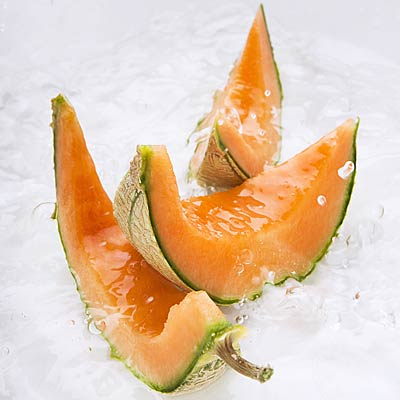
This succulent melon provides a big nutritional payoff for very few calories. One six-ounce serving—about one-quarter of a melon—contains just 50 calories but delivers a full 100% of your recommended daily intake of vitamins A and C.
"I love cantaloupe as a dessert," Gans says. "If you've got a sweet tooth, it will definitely satisfy." Tired of plain old raw fruit? Blend cantaloupe with yogurt and freeze it into sherbet, or puree it with orange juice and mint to make a refreshing soup.
Enjoy your summer with these "water eating" tips!
Source
9) Spinach
Water content: 91.4% water
Iceberg lettuce may have a higher water content, but spinach is usually a better bet overall. Piling raw spinach leaves on your sandwich or salad provides nearly as much built-in hydration, with an added nutritional punch.
Spinach is rich in lutein, potassium, fiber, and brain-boosting folate, and just one cup of raw leaves contains 15% of your daily intake of vitamin E—an important antioxidant for fighting off the damaging molecules known as free radicals.
10) Star fruit
Water content: 91.4% water
This tropical fruit, also known as carambola, comes in sweet and tart varieties and has a juicy texture similar to pineapple. Its eye-catching shape looks great in a fruit salad or as an edible garnish on the rim of a summer cocktail, and as an added bonus it's rich in antioxidants, especially epicatechin—a heart-healthy compound also found in red wine, dark chocolate, and green tea.
One note of caution: People with kidney problems should avoid star fruit because of its high levels of oxalic acid.
11) Strawberries
Water content: 91.0%
All berries are good foods for hydration, but juicy red strawberries are easily the best of the bunch. Raspberries and blueberries both hover around 85% water, while blackberries are only slightly better at 88.2%.
"I love strawberries blended in a smoothie or mixed with plain nonfat yoghurt—another hydrating food," Gans says. Strawberries add natural sweetness to the yoghurt, she adds, and the combo of carbohydrates, fiber, and protein make a great post-workout recovery snack.
12) Broccoli
Water content: 90.7%
Like its cousin cauliflower, raw broccoli adds a satisfying crunch to a salad. But its nutritional profile—lots of fiber, potassium, vitamin A, and vitamin C—is slightly more impressive. What's more, broccoli is the only cruciferous vegetable (a category that contains cabbage and kale, in addition to cauliflower) with a significant amount of sulforaphane, a potent compound that boosts the body's protective enzymes and flushes out cancer-causing chemicals.
13) Grapefruit
Water content: 90.5%
This juicy, tangy citrus fruit can help lower cholesterol and shrink your waistline, research suggests. In one study, people who ate one grapefruit a day lowered their bad (LDL) cholesterol by 15.5% and their triglycerides by 27%. In another, eating half a grapefruit—roughly 40 calories—before each meal helped dieters lose about three and a half pounds over 12 weeks. Researchers say that compounds in the fruit help fuel fat burn and stabilize blood sugar, therefore helping to reduce cravings.
14) Baby carrots
Water content: 90.4%
A carrot's a carrot, right? Not when it comes to water content. As it turns out, the baby-sized carrots that have become a staple in supermarkets and lunch boxes contain more water than full-size carrots (which are merely 88.3% water).
The ready-to-eat convenience factor is hard to top, as well. Snack on them right out of the bag, dip them in hummus or guacamole, or—for a bit of added crunch and bright orange colour—chop them up and add them to salads or salsas.
15) Cantaloupe
Water content: 90.2%
This succulent melon provides a big nutritional payoff for very few calories. One six-ounce serving—about one-quarter of a melon—contains just 50 calories but delivers a full 100% of your recommended daily intake of vitamins A and C.
"I love cantaloupe as a dessert," Gans says. "If you've got a sweet tooth, it will definitely satisfy." Tired of plain old raw fruit? Blend cantaloupe with yogurt and freeze it into sherbet, or puree it with orange juice and mint to make a refreshing soup.
Enjoy your summer with these "water eating" tips!
Source
15 Foods That Help You Stay Hydrated
These high-water-content foods are refreshing, filled with nutrients, and naturally low in calories.
Eat your water
According to the old rule of thumb, you're supposed to drink eight glasses of water per day (and some experts recommend even more). That can seem like a daunting task on some days, but here's the catch: You don't have to drink all that water. Roughly 20% of our daily H2O intake comes from solid foods, especially fruits and vegetables.
It's still important to drink plenty of water—especially in the summertime—but you can also quench your thirst with these 15 hugely hydrating foods, all of which are at least 90% water by weight.
1) Cucumber
Water content: 96.7%
This summer veggie—which has the highest water content of any solid food—is perfect in salads, or sliced up and served with some hummus, says Keri Gans, RD, author of The Small Change Diet: 10 Steps to a Thinner and Healthier You and a consultant to Mindbloom, a technology company that makes life-improvement apps.
Want to pump up cucumber's hydrating power even more? Try blending it with nonfat yogurt, mint, and ice cubes to make cucumber soup. "Soup is always hydrating, but you may not want to eat something hot in the summertime," Gans says. "Chilled cucumber soup, on the other hand, is so refreshing and delicious any time of year."
2) Iceberg lettuce
Water content: 95.6%
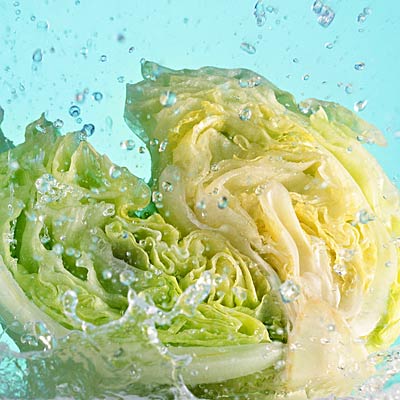
Iceberg lettuce tends to get a bad rap, nutrition-wise. Health experts often recommend shunning it in favour of darker greens like spinach or romaine lettuce, which contain higher amounts of fiber and nutrients such as folate and vitamin K. It's a different story when it comes to water content, though: Crispy iceberg has the highest of any lettuce, followed by butterhead, green leaf, and romaine varieties.
So when the temperature rises, pile iceberg onto sandwiches or use it as a bed for a healthy chicken salad. Even better: Ditch the tortillas and hamburger buns and use iceberg leaves as a wrap for tacos and burgers.
3) Celery
Water content: 95.4%
That urban legend about celery having negative calories isn't quite true, but it's pretty close. Like all foods that are high in water, celery has very few calories—just 6 calories per stalk. And its one-two punch of fiber and water helps to fill you up and curb your appetite.
This lightweight veggie isn't short on nutrition, however. Celery contains folate and vitamins A, C, and K. And thanks in part to its high water content, celery neutralizes stomach acid and is often recommended as a natural remedy for heartburn and acid reflux.
4) Radishes
Water content: 95.3%

These refreshing root vegetables should be a fixture in your spring and summer salads. They provide a burst of spicy-sweet flavour—and colour!—in a small package, and more importantly they're filled with antioxidants such as catechin (also found in green tea).
A crunchy texture also makes radishes a perfect addition to healthy summer coleslaw—no mayo required. Slice them up with shredded cabbage and carrots, sliced snow peas, and chopped hazelnuts and parsley, and toss with poppy seeds, lemon juice, olive oil, salt, and pepper.
5) Tomatoes
Water content: 94.5%
Sliced and diced tomatoes will always be a mainstay of salads, sauces, and sandwiches, but don't forget about sweet cherry and grape varieties, which make an excellent hydrating snack, Gans says. "They're great to just pop in your mouth, maybe with some nuts or some low-sodium cheese," she says. "You get this great explosion of flavor when you bite into them."
Having friends over? Skewer grape tomatoes, basil leaves, and small chunks of mozzarella on toothpicks for a quick and easy appetizer.
6) Green peppers
Water content: 93.9%
Bell peppers of all shades have a high water content, but green peppers lead the pack, just edging out the red and yellow varieties (which are about 92% water). And contrary to popular belief, green peppers contain just as many antioxidants as their slightly sweeter siblings.
Peppers are a great pre-dinner or late-night snack, Gans says. "We tell people to munch on veggies when they have a craving, but a lot of people get bored of carrots and celery pretty quickly," she says. "Peppers are great to slice up when you get home from work, while you're making or waiting for dinner."
7) Cauliflower
Water content: 92.1%
Don't let cauliflower's pale complexion fool you: In addition to having lots of water, these unassuming florets are packed with vitamins and phytonutrients that have been shown to help lower cholesterol and fight cancer, including breast cancer. (A 2012 study of breast cancer patients by Vanderbilt University researchers found that eating cruciferous veggies like cauliflower was associated with a lower risk of dying from the disease or seeing a recurrence.)
"Break them up and add them to a salad for a satisfying crunch," Gans suggests. "You can even skip the croutons!"
8) Watermelon
Water content: 91.5% water
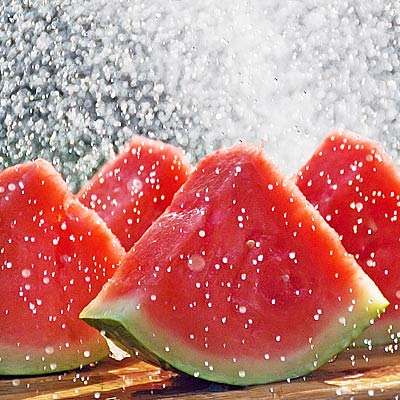
It's fairly obvious that watermelon is full of, well, water, but this juicy melon is also among the richest sources of lycopene, a cancer-fighting antioxidant found in red fruits and vegetables. In fact, watermelon contains more lycopene than raw tomatoes—about 12 milligrams per wedge, versus 3 milligrams per medium-sized tomato.
Although this melon is plenty hydrating on its own, Gans loves to mix it with water in the summertime. "Keep a water pitcher in the fridge with watermelon cubes in the bottom," she says. "It's really refreshing, and great incentive to drink more water overall."
This is part 1 of hydration 15 foods, in the next post you find the other 7 foods.
Enjoy!
Source
Eat your water
According to the old rule of thumb, you're supposed to drink eight glasses of water per day (and some experts recommend even more). That can seem like a daunting task on some days, but here's the catch: You don't have to drink all that water. Roughly 20% of our daily H2O intake comes from solid foods, especially fruits and vegetables.
It's still important to drink plenty of water—especially in the summertime—but you can also quench your thirst with these 15 hugely hydrating foods, all of which are at least 90% water by weight.
1) Cucumber
Water content: 96.7%
This summer veggie—which has the highest water content of any solid food—is perfect in salads, or sliced up and served with some hummus, says Keri Gans, RD, author of The Small Change Diet: 10 Steps to a Thinner and Healthier You and a consultant to Mindbloom, a technology company that makes life-improvement apps.
Want to pump up cucumber's hydrating power even more? Try blending it with nonfat yogurt, mint, and ice cubes to make cucumber soup. "Soup is always hydrating, but you may not want to eat something hot in the summertime," Gans says. "Chilled cucumber soup, on the other hand, is so refreshing and delicious any time of year."
2) Iceberg lettuce
Water content: 95.6%
Iceberg lettuce tends to get a bad rap, nutrition-wise. Health experts often recommend shunning it in favour of darker greens like spinach or romaine lettuce, which contain higher amounts of fiber and nutrients such as folate and vitamin K. It's a different story when it comes to water content, though: Crispy iceberg has the highest of any lettuce, followed by butterhead, green leaf, and romaine varieties.
So when the temperature rises, pile iceberg onto sandwiches or use it as a bed for a healthy chicken salad. Even better: Ditch the tortillas and hamburger buns and use iceberg leaves as a wrap for tacos and burgers.
3) Celery
Water content: 95.4%
That urban legend about celery having negative calories isn't quite true, but it's pretty close. Like all foods that are high in water, celery has very few calories—just 6 calories per stalk. And its one-two punch of fiber and water helps to fill you up and curb your appetite.
This lightweight veggie isn't short on nutrition, however. Celery contains folate and vitamins A, C, and K. And thanks in part to its high water content, celery neutralizes stomach acid and is often recommended as a natural remedy for heartburn and acid reflux.
4) Radishes
Water content: 95.3%
These refreshing root vegetables should be a fixture in your spring and summer salads. They provide a burst of spicy-sweet flavour—and colour!—in a small package, and more importantly they're filled with antioxidants such as catechin (also found in green tea).
A crunchy texture also makes radishes a perfect addition to healthy summer coleslaw—no mayo required. Slice them up with shredded cabbage and carrots, sliced snow peas, and chopped hazelnuts and parsley, and toss with poppy seeds, lemon juice, olive oil, salt, and pepper.
5) Tomatoes
Water content: 94.5%
Sliced and diced tomatoes will always be a mainstay of salads, sauces, and sandwiches, but don't forget about sweet cherry and grape varieties, which make an excellent hydrating snack, Gans says. "They're great to just pop in your mouth, maybe with some nuts or some low-sodium cheese," she says. "You get this great explosion of flavor when you bite into them."
Having friends over? Skewer grape tomatoes, basil leaves, and small chunks of mozzarella on toothpicks for a quick and easy appetizer.
6) Green peppers
Water content: 93.9%
Bell peppers of all shades have a high water content, but green peppers lead the pack, just edging out the red and yellow varieties (which are about 92% water). And contrary to popular belief, green peppers contain just as many antioxidants as their slightly sweeter siblings.
Peppers are a great pre-dinner or late-night snack, Gans says. "We tell people to munch on veggies when they have a craving, but a lot of people get bored of carrots and celery pretty quickly," she says. "Peppers are great to slice up when you get home from work, while you're making or waiting for dinner."
7) Cauliflower
Water content: 92.1%
Don't let cauliflower's pale complexion fool you: In addition to having lots of water, these unassuming florets are packed with vitamins and phytonutrients that have been shown to help lower cholesterol and fight cancer, including breast cancer. (A 2012 study of breast cancer patients by Vanderbilt University researchers found that eating cruciferous veggies like cauliflower was associated with a lower risk of dying from the disease or seeing a recurrence.)
"Break them up and add them to a salad for a satisfying crunch," Gans suggests. "You can even skip the croutons!"
8) Watermelon
Water content: 91.5% water
It's fairly obvious that watermelon is full of, well, water, but this juicy melon is also among the richest sources of lycopene, a cancer-fighting antioxidant found in red fruits and vegetables. In fact, watermelon contains more lycopene than raw tomatoes—about 12 milligrams per wedge, versus 3 milligrams per medium-sized tomato.
Although this melon is plenty hydrating on its own, Gans loves to mix it with water in the summertime. "Keep a water pitcher in the fridge with watermelon cubes in the bottom," she says. "It's really refreshing, and great incentive to drink more water overall."
This is part 1 of hydration 15 foods, in the next post you find the other 7 foods.
Enjoy!
Source
Subscribe to:
Posts (Atom)