Showing posts with label Balance in life. Show all posts

Monday, 3 August 2015

5 Health Principles | Dr. Deepak Chopra

Dr. Deepak Chopra is an Indian-born American author and public speaker. He is an alternative medicine advocate and a promoter of popular forms of spirituality.

Chopra obtained a medical degree in India before emigrating in 1970 to the United States. As a physician he specialized in endocrinology and became Chief of Staff at the New England Memorial Hospital (NEMH). [1]

He states there are 5 principles that improve a healthier life. 

1. Get good and enough sleep


"Sleep is when our soul actually refreshes our Body"

2. Exercise


"My body is a projection of my consciousness"

3. Control (negative) emotions
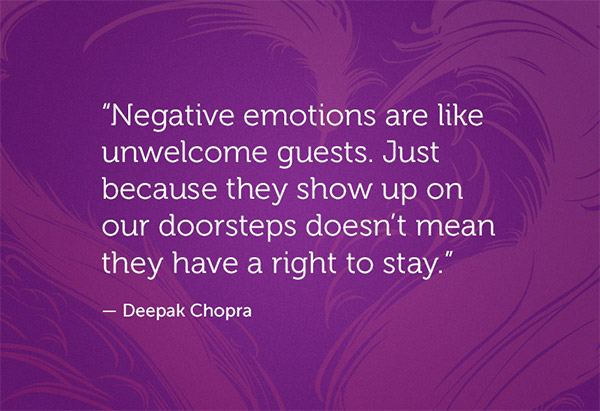

"Negative emotions are like unwelcome guests" Quote deepak Chopra

4. Meditate


"Meditation takes you beyond the mind's noisy chatter into the pure awareness that is the source of all your happiness, inspiration, and love"

5. Have a balanced diet


"If you find a better way to be happy than by overeating, your body will naturally return to it's balanced state"


So far these 5 health principles, but this is just in a nutshell, so please check some of his books like his most recent one: What Are You Hungry For?: The Chopra Solution to Permanent Weight Loss, Well-Being and Lightness of Soul


Anyway there is enough food for thought, but don't only think...Act!

[1] Wikipedia

Thursday, 25 June 2015

How to Stop Self-Sabotage Behaviour

5 tips to get you out of your own way


"Self-sabotage is when we say we want something and then go about making sure it doesn't happen." 
~ Alyce P. Cornyn-Selby


A talkative mouse, a rat, and a small shrew were trapped in a flood, desperately clinging to the side of a lily pad - and sinking fast! A helpful owl came to their rescue, first telling the rat to clamp its teeth onto its talons as the owl flew to safety and then returning for the shrew, who received similar instructions. Finally, as the tides rose ever higher, the owl came back for our talkative mouse.

"You are rescued and will live!" said the owl. "But I've noticed you talk a lot. Promise me you'll keep your mouth closed around my legs and on no account open it, or you'll fall to your fate!"

"Of course!" said the mouse, who proceeded to clamp his mouth onto his feathered rescuer's landing gear.

They took off and flew across the floods. The owl was about to land on some high ground, but the mouse decided he wanted to alight some other place to get dry.

"Not there..." shouted the mouse, but those were the last words he ever spoke as he fell into the swirling waters below.

We can all laugh at such a silly tale because we never behave in such self-destructive ways, do we? Of course we do - although perhaps not as obviously - but why?

The main reasons for self-sabotaging behaviour
Okay, the mouse's behaviour came from ignorance and heedlessness; he just didn't think. But we mess things up for ourselves in other ways, too - and for other reasons, which include:


  • The familiarity of 'failure'. Maybe we're so used to situations not working out or to being around 'dysfunctional people' that it feels easier to 'put a spanner in the works' by behaving in some way that either worsens or destroys something promising - a kind of 'better the devil you know'.
  • An unconscious need to be in control. If we feel something is bound to fail because it's 'too good to last', we might engineer its failure somehow so as to maintain a sense that we are still in control (because we caused it to fail).
  • Feeling unworthy. Low self-esteem may drive people to feel they 'don't deserve' success or happiness.
  • Bad habits such as excessive drinking, smoking, or uncontrolled anger.
  • Need for excitement. It might be an otherwise perfect sunny afternoon and seemingly out of the blue, Joe picks a fight, goes into a silent mood, or drags up some unrelated contentious issue from the past. Suddenly, the afternoon turns into a battleground. The desire for 'excitement' can take different forms, not all of them constructive.

But surely if people know they are doing this, they wouldn't do it!

So is sabotaging ourselves an unconscious affliction?
People seldom mean to sabotage themselves. It's not generally a conscious decision to spoil things - and that's a problem. We can be left with the feeling: "Why did I do that?!" Many of our emotional drivers remain unconscious, which is why chronic self-saboteurs will often use conscious justification (or what seem like excuses) to explain why they had to:

Yell at their professor and get kicked off the course.
Break off contact with a friend who was about to offer them a great job.
End a promising relationship.
Early learning - or should I say mis-learning - can create the habit of self-sabotage and 'things going right' may seem like a scary and foreign country. If you feel you are prone to this sort of behaviour, then these tips may well help you (as long as you let them).

1) Observe yourself
Forget justifying why you did (or didn't do) this or that; just watch yourself. The adage "don't listen to what people say, but watch what they do" to see what they're really like can be applied to yourself equally well. Imagine you're someone else whose behaviour you're watching. Ask yourself: "What did I do there?" and "What was driving it?" Was it fear, spite, the need to be in control (even if that control is related to making things fail), the need for excitement through conflict, or the desire for attention through sympathy?

One client who did this realized that he had been unconsciously reluctant to earn more than his (bullying) father had done when he was alive: "As if I couldn't betray him by being better off than he had been." This realization helped him overcome this limiting belief once he had observed it operating within himself. He decided to actually ignore it until the old compulsion not to succeed became a faint whisper, then died away all together.

What do you sabotage and how? Get to 'know the machine'. Seeing your own behaviour more clearly has nothing to do with over-applied self-blame, but rather being more objective.

2) Remember that success isn't black or white
Strongly imagine (and get into the habit of strongly imagining) what true success will be like, because it may be different from what you'd been unconsciously assuming. Successful relationships, for example, don't work well all of the time; earning good money doesn't solve all problems. Success isn't black or white; it's all relative. So remember that becoming successful (in whatever way) won't feel so strange when it happens, because it is a natural part of being human - but the idea of success may feel strange.

3) Don't throw the baby out with the bathwater
People often self-sabotage because of perfectionism - if it isn't perfect, then what's the point? You may have heard about recent research (1) which showed that people on strict diets, trying to lose weight, will more likely overeat if they feel they have veered off their diet even slightly: "What the hell, I've blown it now. I might as well completely binge!" People not on diets don't do this so much. So if you have a little setback or mini-failure, consciously stop yourself from throwing it all away and seeing the 'whole thing as just ruined' and then really ruining it.

4) Think beyond yourself
Most of us don't like to consider ourselves as selfish, but it is also true to say (not from a judgemental perspective; more of an observational one) that self-sabotage ruins stuff for others and is therefore a selfish behaviour. People so often deny they are behaving selfishly because they don't intend to be selfish. But behaviour is behaviour.

So the lover who feels compelled to end a great relationship hurts another, the co-worker who sabotages a project scuppers it for everyone else, the father who sabotages financial opportunities spoils the chance of a better standard of living for his family, and so on. Once we get into the habit of seeing the needs of the wider group rather than just our own emotional impulses, it actually becomes harder to sabotage situations.

5) Explore life
All of life is an exploration. Imagine if Cinderella had decided she really couldn't go to the ball, even when she had the opportunity; or if the ugly duckling had concluded it wasn't 'good enough' to fly high with the swans. Being open to life means seeing where certain experiences will take you and accepting openly the good as well as the bad. Of course, if something really isn't working or it genuinely isn't for you, that's fine; but if it's really a reluctance to explore life and to experience the good and healthy, then it is an area that needs some self-work.

The mouse in our story failed to observe the bigger picture when he felt compelled to talk, but you're not a mouse (I'm presuming) - so you shouldn't live like one.


1)Research by Janet Polivy and colleagues at the University of Toronto (Polivy et al., 2010) found that in experiments, it turned out that those who were on a diet and thought they'd blown their limit ate more cookies than those who weren't on a diet. In fact, over 50% more! This is an example of self-sabotage as a result of perceived 'failure', which hadn't been that bad anyway.

Source

Monday, 18 May 2015

Enjoy your Success: 5 Tips

Is it possible to have both? To be successful and enjoy it? Here are 5 tips to make it happen.

Balance
Before even starting up any business,it's a good idea to consider how to balance your business with your life. For example you could use practical tools to be able to work when and where it suits you and automate your business not only to gain efficiency, but also scalability.

Work when it suits you
Not everybody is the same, maybe you are a morning person or you prefer working on certain tasks in the evening. Work when it suits you best. Working on what you actually like and at the times you like it, will make you more efficient and happy. 

Teach others
To free up time it is useful to focus on teaching to others and transfer responsibilities. Certain activities can even be done better by others depending their existing skills. You will become much more productive via teaching. 

Learn to say NO
Prioritise the things you want to do not only in business, but very important also in your social life. Say no to the things in your private live that are taking too much quantity of free time and focus on quality time.

Live in the moment
Do not expect happiness to come at the point you succeed. You will sacrifice your time in pursuit of success. Live in the moment and enjoy the journey. "The journey is the reward."


Wednesday, 13 May 2015

Life is Laughing!

So okay I have been away from blogging on this Blog for some months now. 

Initially it all started with my little boy being poorly, hospital visits and just general bad feeling. 

After he got well I took some extra time to rethink what I really find important in life. I have been reading about values in life and I have even finished my first draft version of my personal "Mission Statement".

I realized that if I want to be successful in life, I will have to make sure to do it for the right reasons.

My search will not only focus on success, but it will be a journey to find a fun, meaningful, successful and balanced life. One that I can enjoy!

I hope you would like to follow me on my journey. 

I have made the first step by creating a draft version of my mission statement, now I will take it to the next level and work on my goals that will be congruent with my values.

You can make the first step too, as Tony Robbins says: 


PS: As I'm Dutch I also started blogging in Dutch about this subject. If you understand it, go check it out at www.banens.nl.