Let’s quickly go over 5 legitimate online home based business ideas that you can use to make money from home using nothing but the internet.
We will also see how to cleverly integrate a number of the best online home business ideas together into a powerful money making system, suitable for any newbie.
1. Writing Articles – I first started out in my home business by providing an article writing service to other marketers. I am a quick writer so was able to charge low prices for simple articles for website content and still earn a respectable hourly wage at the same time. There is a high demand for article writers out there right now, since more content equals more traffic and sales for websites.
2. Paid Surveys – Companies are always on the lookout for people to fill in surveys for them. This is either for market research purposes or so that they can capture contact information of people who fill out these surveys for future promotions. Either way, you can earn regular money from home on the internet if you consistently fill out these suveys each and every day.
3. Affilate Marketing – This home based business idea is now moving away from doing work from home jobs for others and instead becoming your own boss as an online entrepreneur. Affiliate marketing is one of the most newbie friendly ways to make money from home because you simply send people to existing proven product pages and earn commissions when sales are made based on your recommendations. You don’t need to handle orders or deal with customer support issues directly.
4. Network Marketing and MLM – In the home based business industry, the MLM and network marketing business models are very popular. This is largely due to the fact that of the leverage gained from being part of a team. Instead of only making money when you make your own sales, with online network marketing you also make money when your team members make sales. It is about leverage the work of others for a predictable monthly residual income.
5. Selling Information Products Online – Instead of promoting other peoples products with affiliate marketing, it is worth looking into creating and selling your own information products. An information product can be an ebook, audio or video series. It is simply your expertise converted into a format that others can follow in a step by step fashion in order to learn a new skill and follow a process to generate results for themselves in whatever it is that you are teaching. Infromation marketing is very popular because you just create the product once and sell it over and over again. You can either get other affiliate marketers to sell your products for you.
One of the best home based business ideas that many beginners see success with involves taking advantage of a “business in a box” that lets you pre-designed affiliate products as part of a professional sales funnel.
Source: http://recomp-project.eu/?p=78
Monday, 15 December 2014

Friday, 12 December 2014
15 Tips for a Powerful LinkedIn Profile
Not getting the traction you'd like to see on your LinkedIn page? Try these 15 tips for a powerful profile.
1. Segment Your Connections.
This simple tip can save you a mountain of work later. Let's say you're on LinkedIn to meet:
If you don't segment your connections, they're all going to be lumped into a folder LinkedIn calls "Untagged." Then when you want to contact potential JV partners, you'll have no idea which ones those are.
So you'll want to segment all of your connections - new and old - into appropriate folders to take maximum advantage of LinkedIn's ability to hook you up with the right people.
2. Certain Keyword Placement has a Bigger Effect Than Others.
Keywords in your name, your headline, your company name, your job title and your skills rank higher in the search results than keywords in other sections. Be sure to use a variety of keywords and terms in describing what you do, and also offer to show up in a variety of search results.
3. Don't Annoy Your Contacts.
When you're updating your LinkedIn profile, your contacts are alerted to every little change as you make them unless you do the following: Open your privacy controls and turn off activity broadcasts, and change the setting for "select who can see your activity feed" to "only you."
4. Widen Your Scope.
Join groups so you can connect with people who are in your target audience but are not contacts. Then reach out to these people and ask them to join your network.
5. If You're Ambitious...
Join 50 LinkedIn groups which can boost your ranking.
6. Highlight Your Best Info.
You can add, remove and rearrange entire sections of your profile any way you prefer to lead with your strengths. When in edit mode, hover your mouse over the double sided arrow that's next to the edit link for each section and you'll see a 4 arrowed icon. Click, drag and drop it to another position in your profile. Or customize your profile with personalized sections of your own making.
7. Hit The Magic Number.
Your goal is to get at least 500 connections, for two reasons. First, it widens your audience. Second, that magic number 500 has a psychological impact on people viewing your profile. Once you hit 500, aim for 1,000 for the same reasons.
8. Use Your Aliases.
Maybe you've changed your name or people commonly misspell your name. Or maybe you've got nicknames or more than one version for your first name, such as Dave and David. Include all of these names in your summary to make it easier for people to find you.
9. Accept Messages From Anyone.
It used to be that LinkedIn members could only contact you if they were connected to you or if they purchased InMail messages. But now Premium Users are automatically opted into an Open Profile setting, which will let anyone message you for free. And as a Premium member, you can always select to switch this off at any time.
10. Track Who Is Viewing Your Profile.
Premium users can now access a list of who's viewed their profile for the last 90 days. You might want to contact some of these members back and start a conversation.
11. Distinguish Yourself From Competitors.
Where appropriate, integrate your personal point of view into your summary and possibly your experience. Then join groups where you can share your point of view as it relates to your expertise. You'll stand apart from the crowd and attract your own tribe of like-thinkers.
12. Use Premium As Needed.
If you want to reach out to people but you can only contact them through Premium, then sign up by the month. Do all the reaching out you need to do and then cancel your premium subscription.
13. Wait.
Don't reach out to potential contacts until your profile is sparkling. You only get one chance to make a first LinkedIn impression, so make it a good one. But don't let this be a reason to procrastinate, either. Set a deadline to get your profile together and then immediately start reaching out to others.
14. Create a Company Page.
If you have a company, you need a company page.
15. Publish Company Status Updates. This gives LinkedIn users more reason to follow your company page. Plus, you can use segmentation to tailor your updates to specific audiences as well
Source: http://EzineArticles.com/8584260
1. Segment Your Connections.
This simple tip can save you a mountain of work later. Let's say you're on LinkedIn to meet:
- Customers
- JV partners
- Media contacts
If you don't segment your connections, they're all going to be lumped into a folder LinkedIn calls "Untagged." Then when you want to contact potential JV partners, you'll have no idea which ones those are.
So you'll want to segment all of your connections - new and old - into appropriate folders to take maximum advantage of LinkedIn's ability to hook you up with the right people.
2. Certain Keyword Placement has a Bigger Effect Than Others.
Keywords in your name, your headline, your company name, your job title and your skills rank higher in the search results than keywords in other sections. Be sure to use a variety of keywords and terms in describing what you do, and also offer to show up in a variety of search results.
3. Don't Annoy Your Contacts.
When you're updating your LinkedIn profile, your contacts are alerted to every little change as you make them unless you do the following: Open your privacy controls and turn off activity broadcasts, and change the setting for "select who can see your activity feed" to "only you."
4. Widen Your Scope.
Join groups so you can connect with people who are in your target audience but are not contacts. Then reach out to these people and ask them to join your network.
5. If You're Ambitious...
Join 50 LinkedIn groups which can boost your ranking.
6. Highlight Your Best Info.
You can add, remove and rearrange entire sections of your profile any way you prefer to lead with your strengths. When in edit mode, hover your mouse over the double sided arrow that's next to the edit link for each section and you'll see a 4 arrowed icon. Click, drag and drop it to another position in your profile. Or customize your profile with personalized sections of your own making.
7. Hit The Magic Number.
Your goal is to get at least 500 connections, for two reasons. First, it widens your audience. Second, that magic number 500 has a psychological impact on people viewing your profile. Once you hit 500, aim for 1,000 for the same reasons.
8. Use Your Aliases.
Maybe you've changed your name or people commonly misspell your name. Or maybe you've got nicknames or more than one version for your first name, such as Dave and David. Include all of these names in your summary to make it easier for people to find you.
9. Accept Messages From Anyone.
It used to be that LinkedIn members could only contact you if they were connected to you or if they purchased InMail messages. But now Premium Users are automatically opted into an Open Profile setting, which will let anyone message you for free. And as a Premium member, you can always select to switch this off at any time.
10. Track Who Is Viewing Your Profile.
Premium users can now access a list of who's viewed their profile for the last 90 days. You might want to contact some of these members back and start a conversation.
11. Distinguish Yourself From Competitors.
Where appropriate, integrate your personal point of view into your summary and possibly your experience. Then join groups where you can share your point of view as it relates to your expertise. You'll stand apart from the crowd and attract your own tribe of like-thinkers.
12. Use Premium As Needed.
If you want to reach out to people but you can only contact them through Premium, then sign up by the month. Do all the reaching out you need to do and then cancel your premium subscription.
13. Wait.
Don't reach out to potential contacts until your profile is sparkling. You only get one chance to make a first LinkedIn impression, so make it a good one. But don't let this be a reason to procrastinate, either. Set a deadline to get your profile together and then immediately start reaching out to others.
14. Create a Company Page.
If you have a company, you need a company page.
15. Publish Company Status Updates. This gives LinkedIn users more reason to follow your company page. Plus, you can use segmentation to tailor your updates to specific audiences as well
Source: http://EzineArticles.com/8584260
Thursday, 11 December 2014
Common Email Marketing Mistakes: Why Your Emails Aren’t Getting Results
Picture this: You’ve just hit the send button on a new email campaign for your business. You’ve got killer content, a great call to action and an attention-grabbing subject line… or so you think. As you watch your analytics, it becomes clear that your email isn’t getting the results you want.
What went wrong?
Whether your open rates are suffering or you’re not getting enough click-throughs, there are lots of common email marketing mistakes that even experienced marketers make. The good news is that they can be easily fixed to increase engagement.
The mistake: Your content is too self-promotional.
If you send an email announcing your new software update, who cares? But if you send an email announcing that it’s possible to cut video upload time in half because of your software update, people will pay attention. It’s all about showing the value of your services while promoting your business.
So, how can you do both?
The solution: First, identify your audience’s biggest problems. Let’s say you work with a recruiting agency. Your subscribers need resume help, so why not give them a checklist to help them fix common resume faux pas? Brainstorm content ideas based on real problems your customers are having, then show how your services can fix them. From there, you can create an editorial calendar for your email campaign that will help create focused, useful emails.
The mistake: Your readers think you’re a robot.
What does your From address say? Is it from your own name, your business’s name, or something else? If your open rates are suffering, it could be because your emails lack a personal touch. Your email’s content plays a key role here too. Are you speaking directly to your target audience, or are you using jargony, impersonal industry terms?
The solution: One easy way to make your brand more human is to personalize your From address – no one wants to talk to donotreply@email.com. To sound less robotic and more human, write in plain terms. For example, you wouldn’t described someone as economically marginalized, you would say they’re unemployed. Uncomplicated, easy-to-understand language wins over pretentious buzzwords any day.
The mistake: Your call to action isn’t very… actionable.
Take a look at this email from Studio Fitness.
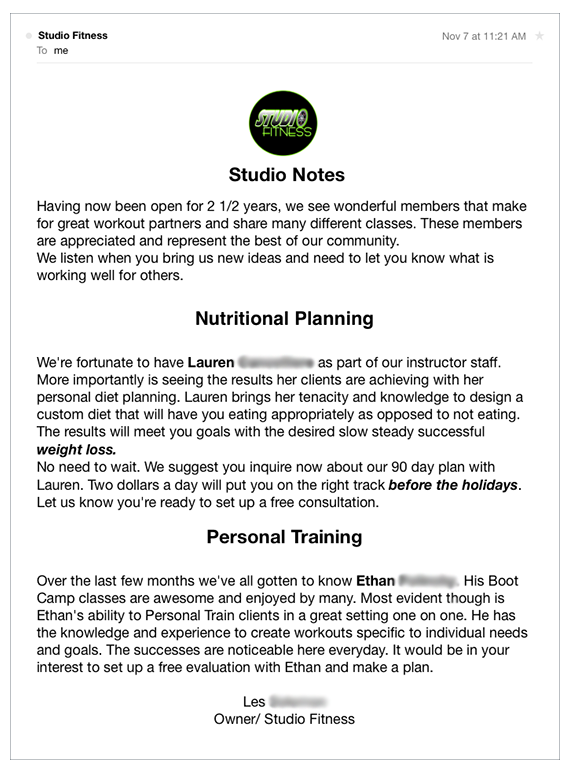
There is no link to the nutritionist or personal trainer they introduce us to, and while they encourage us to sign up for a plan, there is no link to help us do that either. Oh, and we can’t access the Studio Fitness website from this email. Since there could be any number of gyms named Studio Fitness, leaving subscribers to find their website on their own is probably not a great idea.
The solution: What do you want people to do when they read your email? Should they visit your website, sign up for a trial, take a survey? Your call to action needs to be strong and authoritative – people need to be told what to do! Make your call to action loud and clear.
The mistake: You’re inconsistent.
How would you feel if you received a weekly newsletter and then, without warning, weekly emails turned into 10 emails a day? You wouldn’t be very happy, would you? It sounds a little ridiculous, but it happens more often than you think. Readers tune out and unsubscribe when they don’t receive what they signed up for.
The solution: Deliver the emails you promised in your sign up form and stick to an editorial calendar if possible.
The mistake: Your follow up series is nonexistent.
Let’s say you have a customer who starts a free trial of your software service, but they never follow through and make a purchase. Sad story, right? It certainly will be if you don’t have a triggered-based follow up series in place.
The solution: While you can’t control a customer’s behavior, you can control how you react to it. If you set up a follow up email that will automatically send to that customer at the end of their free trial, you have a better shot at keeping them engaged. If they had a question about your service, the email could prompt them to contact you, giving you another opportunity to make the sale.
The mistake: Your subject lines are boring.
Look at the subject line below. What does it tell us about what lies within the email?

Absolutely nothing. It’s not creative or relevant to the content inside, so there’s nothing about it that would make someone feel compelled to open it. And see that preview text after the subject line? (“If you’re having trouble…”) That space could’ve been used to tease the email too.
The solution: You have about 35 characters to work with in your subject line, so make them count! Your subject line needs to grab attention and tell the reader something about the email itself, because that what will sell them on opening your email.
The mistake: You’re not using personalization.
What’s the best way to get someone’s attention? You address them by their name! It works the same way with email. If you’re not using personalization on your most important messages, you’re missing a real opportunity.
The solution: Just like adjusting your From address to your real name, using personalization in your emails is another way to make your business more human. Notice how the email below uses personalization and takes advantage of preview text.

The mistake: You’re sending to the wrong people.
If you own a burger joint in Philadelphia, you wouldn’t send newsletters to vegetarians in San Francisco, right? This is why segmenting and list management is key, especially for those with growing email lists.
The solution: Tell people exactly what they’re signing up for on your sign up form and stick to it. You can also use your form to segment people based on location, interests, or any other preference. If you only want to send emails to those who opened a particular message, you can segment based on open rates too. Once you’ve hit your sweet spot of segmentation, ask your readers for feedback so you can continue sending them content they want.
Chances are, you’re guilty of at least one of these mistakes. But don’t sweat it! You can put solutions to work by using an autoresponder like Aweber and readjust what you send to your readers.
What tips do you have for driving engagement in your emails? Share them in the comments section!
Source: http://blog.aweber.com/articles-tips/common-email-marketing-mistakes-why-your-emails-arent-getting-results.htm
What went wrong?
Whether your open rates are suffering or you’re not getting enough click-throughs, there are lots of common email marketing mistakes that even experienced marketers make. The good news is that they can be easily fixed to increase engagement.
The mistake: Your content is too self-promotional.
If you send an email announcing your new software update, who cares? But if you send an email announcing that it’s possible to cut video upload time in half because of your software update, people will pay attention. It’s all about showing the value of your services while promoting your business.
So, how can you do both?
The solution: First, identify your audience’s biggest problems. Let’s say you work with a recruiting agency. Your subscribers need resume help, so why not give them a checklist to help them fix common resume faux pas? Brainstorm content ideas based on real problems your customers are having, then show how your services can fix them. From there, you can create an editorial calendar for your email campaign that will help create focused, useful emails.
The mistake: Your readers think you’re a robot.
What does your From address say? Is it from your own name, your business’s name, or something else? If your open rates are suffering, it could be because your emails lack a personal touch. Your email’s content plays a key role here too. Are you speaking directly to your target audience, or are you using jargony, impersonal industry terms?
The solution: One easy way to make your brand more human is to personalize your From address – no one wants to talk to donotreply@email.com. To sound less robotic and more human, write in plain terms. For example, you wouldn’t described someone as economically marginalized, you would say they’re unemployed. Uncomplicated, easy-to-understand language wins over pretentious buzzwords any day.
The mistake: Your call to action isn’t very… actionable.
Take a look at this email from Studio Fitness.
There is no link to the nutritionist or personal trainer they introduce us to, and while they encourage us to sign up for a plan, there is no link to help us do that either. Oh, and we can’t access the Studio Fitness website from this email. Since there could be any number of gyms named Studio Fitness, leaving subscribers to find their website on their own is probably not a great idea.
The solution: What do you want people to do when they read your email? Should they visit your website, sign up for a trial, take a survey? Your call to action needs to be strong and authoritative – people need to be told what to do! Make your call to action loud and clear.
The mistake: You’re inconsistent.
How would you feel if you received a weekly newsletter and then, without warning, weekly emails turned into 10 emails a day? You wouldn’t be very happy, would you? It sounds a little ridiculous, but it happens more often than you think. Readers tune out and unsubscribe when they don’t receive what they signed up for.
The solution: Deliver the emails you promised in your sign up form and stick to an editorial calendar if possible.
The mistake: Your follow up series is nonexistent.
Let’s say you have a customer who starts a free trial of your software service, but they never follow through and make a purchase. Sad story, right? It certainly will be if you don’t have a triggered-based follow up series in place.
The solution: While you can’t control a customer’s behavior, you can control how you react to it. If you set up a follow up email that will automatically send to that customer at the end of their free trial, you have a better shot at keeping them engaged. If they had a question about your service, the email could prompt them to contact you, giving you another opportunity to make the sale.
The mistake: Your subject lines are boring.
Look at the subject line below. What does it tell us about what lies within the email?
Absolutely nothing. It’s not creative or relevant to the content inside, so there’s nothing about it that would make someone feel compelled to open it. And see that preview text after the subject line? (“If you’re having trouble…”) That space could’ve been used to tease the email too.
The solution: You have about 35 characters to work with in your subject line, so make them count! Your subject line needs to grab attention and tell the reader something about the email itself, because that what will sell them on opening your email.
The mistake: You’re not using personalization.
What’s the best way to get someone’s attention? You address them by their name! It works the same way with email. If you’re not using personalization on your most important messages, you’re missing a real opportunity.
The solution: Just like adjusting your From address to your real name, using personalization in your emails is another way to make your business more human. Notice how the email below uses personalization and takes advantage of preview text.
The mistake: You’re sending to the wrong people.
If you own a burger joint in Philadelphia, you wouldn’t send newsletters to vegetarians in San Francisco, right? This is why segmenting and list management is key, especially for those with growing email lists.
The solution: Tell people exactly what they’re signing up for on your sign up form and stick to it. You can also use your form to segment people based on location, interests, or any other preference. If you only want to send emails to those who opened a particular message, you can segment based on open rates too. Once you’ve hit your sweet spot of segmentation, ask your readers for feedback so you can continue sending them content they want.
Chances are, you’re guilty of at least one of these mistakes. But don’t sweat it! You can put solutions to work by using an autoresponder like Aweber and readjust what you send to your readers.
What tips do you have for driving engagement in your emails? Share them in the comments section!
Source: http://blog.aweber.com/articles-tips/common-email-marketing-mistakes-why-your-emails-arent-getting-results.htm
Tuesday, 9 December 2014
Surviving School Holidays When You Work From Home
Working from home is great in terms of flexibility, and once your little ones are at school, it can be a fantastic alternative to having to juggle childcare arrangements as well as your work load.
Of course that’s all well and good until the holidays roll round! Even the most organised work at home parent can be forgiven for a slight groan at the thought of entertaining the kids full time while still trying to keep their work life in order too. Don’t panic though, it can be done, and here are some top tips to help:
Plan Ahead! The more work that you can get off your plate ahead of the holidays, the better! Anything that can be done ahead of time, scheduled in advance or even postponed until the kids are back at school will make life easier. Pulling a few late nights before the holidays might not be fun at the time, but they’ll be worth the effort in the long run!
Prioritise: Be realistic about what really has to be done, and what can probably wait. Knowing that the important tasks are taken care of will help you take things easier while the kids are off.
Schedule time to work: If possible, schedule times throughout the holidays that you’ll be working – whether that’s an hour a day or a couple of days a week, and stick to them! Don’t be tempted to ‘pick at’ bits of work outside those hours – give yourself a break and enjoy the time with your family.
Ask for Help! See if a family member is free to take your tots out for a day – it’s amazing how much you can achieve if you know you have a dedicated block of uninterrupted time to use! Grandparents love to take the kids out, or why not come to an arrangement with your child’s best friend, where you each take all the kids for a day so that the other can get on with everything else?
Get the kids involved! Children love to be treated like grownups, so let them take on some new responsibilities during the holidays – for example, they could set the table for dinner while you take ten minutes to check your emails.
Have a back-up plan: Those wails of ‘I’m bored!’ can be an inevitable part of the holidays, so stock up on a few ‘emergency activities’ for the times you need to keep your little ones occupied without giving them your undivided attention – a jigsaw puzzle, a sticker book, even just good old fashioned colouring, can all provide you with a precious 20 minute window if something urgent crops up.
Outsource: Handing the reigns to someone else for a few days might sound scary, but so long as you use an experienced company, you can be confident your business will be in safe hands. Social Sparkle offer a wide range of support to small businesses – from keeping your Facebook page updated to adding content to your blog.
What are your top tips for working from home when the kids are on holiday?
Source: http://www.mumpreneursnetworkingclub.co.uk/articles/20140403
Of course that’s all well and good until the holidays roll round! Even the most organised work at home parent can be forgiven for a slight groan at the thought of entertaining the kids full time while still trying to keep their work life in order too. Don’t panic though, it can be done, and here are some top tips to help:
Plan Ahead! The more work that you can get off your plate ahead of the holidays, the better! Anything that can be done ahead of time, scheduled in advance or even postponed until the kids are back at school will make life easier. Pulling a few late nights before the holidays might not be fun at the time, but they’ll be worth the effort in the long run!
Prioritise: Be realistic about what really has to be done, and what can probably wait. Knowing that the important tasks are taken care of will help you take things easier while the kids are off.
Schedule time to work: If possible, schedule times throughout the holidays that you’ll be working – whether that’s an hour a day or a couple of days a week, and stick to them! Don’t be tempted to ‘pick at’ bits of work outside those hours – give yourself a break and enjoy the time with your family.
Ask for Help! See if a family member is free to take your tots out for a day – it’s amazing how much you can achieve if you know you have a dedicated block of uninterrupted time to use! Grandparents love to take the kids out, or why not come to an arrangement with your child’s best friend, where you each take all the kids for a day so that the other can get on with everything else?
Get the kids involved! Children love to be treated like grownups, so let them take on some new responsibilities during the holidays – for example, they could set the table for dinner while you take ten minutes to check your emails.
Have a back-up plan: Those wails of ‘I’m bored!’ can be an inevitable part of the holidays, so stock up on a few ‘emergency activities’ for the times you need to keep your little ones occupied without giving them your undivided attention – a jigsaw puzzle, a sticker book, even just good old fashioned colouring, can all provide you with a precious 20 minute window if something urgent crops up.
Outsource: Handing the reigns to someone else for a few days might sound scary, but so long as you use an experienced company, you can be confident your business will be in safe hands. Social Sparkle offer a wide range of support to small businesses – from keeping your Facebook page updated to adding content to your blog.
What are your top tips for working from home when the kids are on holiday?
Source: http://www.mumpreneursnetworkingclub.co.uk/articles/20140403
Monday, 8 December 2014
My top 11 blogging tips
Alright, so I’m taking a slightly different direction today. I was going through some emails this weekend, poring through questions from the best readers on the Internet (this would be you). I have quite the back log of fantastic reader questions and post suggestions, and I hope to tackle a number of them this fall.
Quite a few repeated themselves about the same subject — blogging. Apparently, some of you think I know how to blog daily while keeping a dust-free home and perfectly groomed children who love each other and never fight.
I have absolutely no idea how one does that. I’ll keep my eye out for the answer, but in the meantime, I I’ll compromise and answer the overarching blogging question, which basically asks, “How do I blog well?”
I don’t know everything about blogging. But I do know some things. Here are my best tips about blogging while still miraculously getting dinner on the table.
1. Decide your reasons.
Think through your purpose in blogging. Blogging for fun looks a bit different than blogging to promote your Etsy site, which also looks different than blogging to practice your writing skills and maybe land a book contract, which – guess what?, looks different than blogging to make a little side income with ad revenue.
You can have more than one reason, of course, so long as they don’t conflict. But if you’re blogging simply to share photos for the grandparents (a great reason, by the way), don’t be disappointed when the ad networks don’t come flooding your email inbox.
Likewise, if you’re blogging to earn revenue (and you therefore want to build an audience), don’t be frustrated when your readers move on when they haven’t heard from you in six weeks.
Blog consistently with your main purpose in doing so.
2. Flow with the seasons.
There are some seasons in life that are more conducive to more in-depth blogging. Enjoy those, and reap their benefits by reading and writing all you can about the topic. For me, I started Simple Mom when my second was a newborn. I nursed all day long, so during those long periods of sitting, I read and read and read some more about blogging.
I started with ProBlogger and went from there, in case you’re wondering.
It wasn’t long before Reed was walking all over the place and scooting the step stool up to the kitchen counter holding the knife block, so needless to say, I was up on my toes much more then. I didn’t read much on the subject of blogging any more.
Go with the season you’re in. Don’t fight it. Another season is probably just around the corner.
3. Marry and keep an amazing man.
Joking. Well, sort of. Honestly, one of the reasons I started Simple Mom — and why I can continue to keep it up — is because my husband Kyle is my most loyal reader and fan. He is a big reason I can write regularly throughout the week, and he sees himself just as much a part of the blog because he helps with the laundry and dishes and carpooling.
I am blessed in that we both work from home. We tag-team our approach to work and parenting, and every Sunday evening we dig up the weekly calendar to decide who works when.
I know not everyone can do this. But I add this to the list because I want you to know that he helps an enormous amount, so I definitely don’t “do it all.” Not by a long stretch.
4. Be you…
Don’t try to be Heather Armstrong, or Ree Drummond, or Ann Voskamp, or Amanda Soule, or Alli Worthington. Be you. Write like you. It’s way more fun. You’ll definitely stick with it longer, and people will enjoy reading you more.
5. …But keep your readers in mind.
This is particularly true if you’re writing with the purpose of generating a community or earning revenue in some form. Yes, in some way you’ll still write for you, but if you’ve created a place where people feel like they belong, like they’re in a community — it’s almost like they have part ownership.
That doesn’t mean you worry yourself to sleep making sure everyone likes you. You still write for you, and the things that interest you. But keep the readers in mind who are blessing you with their time and their eyes.
If they’ve expressed an interest in a topic, go with it.
And also — you can’t say thank you enough. Thank your readers all the time. I slacked off showing my gratitude the first half of this year, and it showed in my writing. Plus, I missed saying thank you, and it made blogging less fun.
Thank you, by the way.
6. Get to know people, and ask good questions.
I’ve rarely met an unfriendly blogger. I’ve met extremely busy bloggers, but I can’t imagine any blogger I’ve met who knows a thing or two honestly wants to withhold major blogging secrets or not reach out and say hello.
Don’t think of bloggers with big audiences as anyone different than you. If you have a good question, just ask. Get to the point, and don’t expect an answer right away, but don’t let intimidation or cynicism stop you from initiating a conversation.
Also, make friends. Blogging is much more fun when you make blogging friends. Email or tweet a blogger, and see if you hit it off.
A hint on this last tip: Reach out to a blogger that seems to have about the same size audience, or who writes about the same topic as you. That way, you can share ideas and experiences as you journey together. (But you never know, really — Alli and I are fantastic friends, yet our blogs could not be more different.)
7. Drink water, get exercise, and sleep.
Blogging is a sedentary activity, and if you’re not careful, you’ll spend hours and hours of your day not moving much. Move a little every day. Drink water constantly, and keep a cupful right by your laptop. And go to sleep. Shut off that computer and enjoy the three-dimensional world before hitting the pillow.
8. Organize yourself.
If you want to create a blog that posts regularly, has a specific niche, and fosters a community, then you’ve got to plan a bit in advance. Pencil in regular writing, editing, and networking times throughout your week.
Write an editorial calendar. Right now my posts for Simple Mom are more-or-less planned for the next two months, and I keep track of them on a separate calendar within my Google calendars.
Oh, and don’t leave your email client, Facebook, or Twitter open while you write and edit. You’ll never stay focused.
9. Use “use” instead of “utilize.”
Edit, edit, and then edit some more. For every hour I spend writing, I spend about three editing. Choose your words carefully. Spell correctly. Use adverbs where there should be adverbs; adjectives where there should be adjectives.
Get to the point — I’m regularly surprised how much deleting I do before I publish a post. I’ve already deleted paragraphs from this post, in fact.
Don’t use too many exclamation points, and don’t use emoticons — unless you’re blogging for yourself, or for fun. Or if this is your genuine style of writing (see point number four). Then go nuts.
And almost every time, “use” is more appropriate and more pleasant to the ears and eyes than “utilize.” I’m just saying.
10. Don’t forget about the kids.
Remember your priorities. What good is an enormously successful blog if your family is left in the dust? It’s a blessing if you can contribute to your family’s income through your blog, but not to the detriment of your relationships, well-being, and unity.
Close the laptop regularly, and give your kids quality face time. Go on dates with your spouse. Continually kindle your three-dimensional friends.
11. Keep it fun.
This last point is definitely not the least important. Because at the end of the day, if you don’t have a ball running your blog, then you’ll fizzle out, and it’ll show in your writing.
If you’ve noticed you’re no longer having fun, change it up. Take a little break (if your blog is more than just a hobby, re-run posts at least a year old, or find some guest posters). Try vlogging, or taking more photos.
Listen to music while you blog. I do. It makes it a lot more fun.
I could say a bit more about blogging, but I’ll stop for now. There’s already so much out there about the subject — if you’d like to learn more, I’d start with ProBlogger, Blog Coach, and Blogging Basics 101.
Really, at the end of the day, you’ve just got to be you. Your blog, your family, and your self will be all the better because of it.
Alright, fellow bloggers, now it’s your turn. What’s your best blogging tip?
Source
By: TSH
I love this post and it has been such an inspiration for me, thanks TSH!
Quite a few repeated themselves about the same subject — blogging. Apparently, some of you think I know how to blog daily while keeping a dust-free home and perfectly groomed children who love each other and never fight.
I have absolutely no idea how one does that. I’ll keep my eye out for the answer, but in the meantime, I I’ll compromise and answer the overarching blogging question, which basically asks, “How do I blog well?”
I don’t know everything about blogging. But I do know some things. Here are my best tips about blogging while still miraculously getting dinner on the table.
1. Decide your reasons.
Think through your purpose in blogging. Blogging for fun looks a bit different than blogging to promote your Etsy site, which also looks different than blogging to practice your writing skills and maybe land a book contract, which – guess what?, looks different than blogging to make a little side income with ad revenue.
You can have more than one reason, of course, so long as they don’t conflict. But if you’re blogging simply to share photos for the grandparents (a great reason, by the way), don’t be disappointed when the ad networks don’t come flooding your email inbox.
Likewise, if you’re blogging to earn revenue (and you therefore want to build an audience), don’t be frustrated when your readers move on when they haven’t heard from you in six weeks.
Blog consistently with your main purpose in doing so.
2. Flow with the seasons.
There are some seasons in life that are more conducive to more in-depth blogging. Enjoy those, and reap their benefits by reading and writing all you can about the topic. For me, I started Simple Mom when my second was a newborn. I nursed all day long, so during those long periods of sitting, I read and read and read some more about blogging.
I started with ProBlogger and went from there, in case you’re wondering.
It wasn’t long before Reed was walking all over the place and scooting the step stool up to the kitchen counter holding the knife block, so needless to say, I was up on my toes much more then. I didn’t read much on the subject of blogging any more.
Go with the season you’re in. Don’t fight it. Another season is probably just around the corner.
3. Marry and keep an amazing man.
Joking. Well, sort of. Honestly, one of the reasons I started Simple Mom — and why I can continue to keep it up — is because my husband Kyle is my most loyal reader and fan. He is a big reason I can write regularly throughout the week, and he sees himself just as much a part of the blog because he helps with the laundry and dishes and carpooling.
I am blessed in that we both work from home. We tag-team our approach to work and parenting, and every Sunday evening we dig up the weekly calendar to decide who works when.
I know not everyone can do this. But I add this to the list because I want you to know that he helps an enormous amount, so I definitely don’t “do it all.” Not by a long stretch.
4. Be you…
Don’t try to be Heather Armstrong, or Ree Drummond, or Ann Voskamp, or Amanda Soule, or Alli Worthington. Be you. Write like you. It’s way more fun. You’ll definitely stick with it longer, and people will enjoy reading you more.
5. …But keep your readers in mind.
This is particularly true if you’re writing with the purpose of generating a community or earning revenue in some form. Yes, in some way you’ll still write for you, but if you’ve created a place where people feel like they belong, like they’re in a community — it’s almost like they have part ownership.
That doesn’t mean you worry yourself to sleep making sure everyone likes you. You still write for you, and the things that interest you. But keep the readers in mind who are blessing you with their time and their eyes.
If they’ve expressed an interest in a topic, go with it.
And also — you can’t say thank you enough. Thank your readers all the time. I slacked off showing my gratitude the first half of this year, and it showed in my writing. Plus, I missed saying thank you, and it made blogging less fun.
Thank you, by the way.
6. Get to know people, and ask good questions.
I’ve rarely met an unfriendly blogger. I’ve met extremely busy bloggers, but I can’t imagine any blogger I’ve met who knows a thing or two honestly wants to withhold major blogging secrets or not reach out and say hello.
Don’t think of bloggers with big audiences as anyone different than you. If you have a good question, just ask. Get to the point, and don’t expect an answer right away, but don’t let intimidation or cynicism stop you from initiating a conversation.
Also, make friends. Blogging is much more fun when you make blogging friends. Email or tweet a blogger, and see if you hit it off.
A hint on this last tip: Reach out to a blogger that seems to have about the same size audience, or who writes about the same topic as you. That way, you can share ideas and experiences as you journey together. (But you never know, really — Alli and I are fantastic friends, yet our blogs could not be more different.)
7. Drink water, get exercise, and sleep.
Blogging is a sedentary activity, and if you’re not careful, you’ll spend hours and hours of your day not moving much. Move a little every day. Drink water constantly, and keep a cupful right by your laptop. And go to sleep. Shut off that computer and enjoy the three-dimensional world before hitting the pillow.
8. Organize yourself.
If you want to create a blog that posts regularly, has a specific niche, and fosters a community, then you’ve got to plan a bit in advance. Pencil in regular writing, editing, and networking times throughout your week.
Write an editorial calendar. Right now my posts for Simple Mom are more-or-less planned for the next two months, and I keep track of them on a separate calendar within my Google calendars.
Oh, and don’t leave your email client, Facebook, or Twitter open while you write and edit. You’ll never stay focused.
9. Use “use” instead of “utilize.”
Edit, edit, and then edit some more. For every hour I spend writing, I spend about three editing. Choose your words carefully. Spell correctly. Use adverbs where there should be adverbs; adjectives where there should be adjectives.
Get to the point — I’m regularly surprised how much deleting I do before I publish a post. I’ve already deleted paragraphs from this post, in fact.
Don’t use too many exclamation points, and don’t use emoticons — unless you’re blogging for yourself, or for fun. Or if this is your genuine style of writing (see point number four). Then go nuts.
And almost every time, “use” is more appropriate and more pleasant to the ears and eyes than “utilize.” I’m just saying.
10. Don’t forget about the kids.
Remember your priorities. What good is an enormously successful blog if your family is left in the dust? It’s a blessing if you can contribute to your family’s income through your blog, but not to the detriment of your relationships, well-being, and unity.
Close the laptop regularly, and give your kids quality face time. Go on dates with your spouse. Continually kindle your three-dimensional friends.
11. Keep it fun.
This last point is definitely not the least important. Because at the end of the day, if you don’t have a ball running your blog, then you’ll fizzle out, and it’ll show in your writing.
If you’ve noticed you’re no longer having fun, change it up. Take a little break (if your blog is more than just a hobby, re-run posts at least a year old, or find some guest posters). Try vlogging, or taking more photos.
Listen to music while you blog. I do. It makes it a lot more fun.
I could say a bit more about blogging, but I’ll stop for now. There’s already so much out there about the subject — if you’d like to learn more, I’d start with ProBlogger, Blog Coach, and Blogging Basics 101.
Really, at the end of the day, you’ve just got to be you. Your blog, your family, and your self will be all the better because of it.
Alright, fellow bloggers, now it’s your turn. What’s your best blogging tip?
Source
By: TSH
I love this post and it has been such an inspiration for me, thanks TSH!
Saturday, 6 December 2014
The State Of Digital Marketing In 2015
Planning ahead for 2015? Don't miss these key trends in digital marketing, as examined by columnist James Green.

The digital marketing industry is experiencing a major transformation.
The current state of digital is directly tied to data. Data are everywhere, informing marketers about audience interests, consumer intent, and device activity.
As mobile use continues to increase and media is progressively being bought programmatically, consumers expect a seamless and entertaining online experience.
With marketers and their agencies well underway with planning for the year ahead, here are a few trends that likely will be top of mind in 2015.
1. Big Data Will Become Bigger
Companies are sitting on massive amounts of analytics related to sales, purchase history, search activity, site interactions and more.
While this data is valuable, any single data point taken in isolation can give you a very warped view of the customer.
Linking data together and leveraging a historical trail of data points allows you to obtain bigger insights into what your customers are looking for and where they are going next.
The world of big data gives marketers the most complete obtainable customer profile, which informs audience strategies, smarter media buying and creative decisions.
Big data will only become bigger and bigger as data sources are combined.
unnamed
2. First- And Third-Party Data Will Be A Hot Topic
Within the world of big data is the combination of first and third party data sources. Brands will be retargeting customers based on their buying patterns, combining their own customer data with intent data from around the web.
Marketers want to know when their customers are in market for a good or service so that they can sell to them before they visit a website.
Incorporating data from social, location, search and site will improve the ability to attract customers at multiple stages of the consumer funnel, improving and optimizing your retargeting strategy for both prospecting and retention.
3. Automation Will Continue To Increase
Eventually, all media buying will become automated.
The swapping of insertion orders will be replaced by systems that seamlessly communicate with each other to reduce the duplication of work and improve accountability, measurability and efficiency.
The more interesting trend to watch will be how much media will switch to RTB. Over time, it’s likely that 100% of direct response advertising will be bought in real time; but how far up the funnel this trend will go remains to be seen.
There will always be a place for Super Bowl ads and other high-impact units on high-impact sites. However, these ads will be bought where there’s a large audience and will not be based on individuals, so they won’t be bought through RTB.
That said, over time, more and more advertising is going to be bought in real time, even TV.
4. Ad Fraud Will Still Be A Concern
Ad fraud won’t be much more than a blip on the road to RTB dominance. There are many companies and organizations fighting it.
Fraud, or suspicious activity as it’s sometimes euphemistically called, is simply a duplication of what happened to search at the turn of the century.
Search was easier to control because there was really only one provider (Google), and they fought it directly.
Now, fraud is recognized to be 5-10% of all search clicks. Display fraud is more complicated because of the large number of players in the space: publishers, ad servers, Supply Side Providers (SSPs), Demand Side Providers (DSPs), ad exchanges and other intermediaries.
As of now, there are a myriad of providers that can help, and only the reckless few don’t use these tools to avoid fraudulent activity.
Unfortunately, there will never be a real “crackdown” on fraudsters because these players are based in countries where these activities are not necessarily illegal. So, chasing them down seems unlikely to happen.
5. The Need For Personalized Advertising Will Grow
The opportunities for personalized advertising will continue to grow as the adoption of apps, location based advertising and dynamic creative optimization (DCO) increases.
There are so many data elements available to advertisers, enabling them to transform generic advertising into relevant marketing in real time, regardless of their device and location.
We will see this trend continue into 2015, as purchase, product level and search activity are used to predict consumer intent and therefore, inform which ad to show, and when, as well as what creative elements should be optimized within the ad itself.
In 2014 we witnessed new platforms, channels and technologies that led to major shifts in the industry and positioned data as the main ingredient for finding, reaching and engaging customers.
The biggest theme of 2015 will be “big data” as we see data sources coming together to create meaningful 360-degree customer views and actionable analytics that inform and even transform your marketing strategy.
Sourse: http://marketingland.com/state-digital-marketing-2015-109130
By James Green
The digital marketing industry is experiencing a major transformation.
The current state of digital is directly tied to data. Data are everywhere, informing marketers about audience interests, consumer intent, and device activity.
As mobile use continues to increase and media is progressively being bought programmatically, consumers expect a seamless and entertaining online experience.
With marketers and their agencies well underway with planning for the year ahead, here are a few trends that likely will be top of mind in 2015.
1. Big Data Will Become Bigger
Companies are sitting on massive amounts of analytics related to sales, purchase history, search activity, site interactions and more.
While this data is valuable, any single data point taken in isolation can give you a very warped view of the customer.
Linking data together and leveraging a historical trail of data points allows you to obtain bigger insights into what your customers are looking for and where they are going next.
The world of big data gives marketers the most complete obtainable customer profile, which informs audience strategies, smarter media buying and creative decisions.
Big data will only become bigger and bigger as data sources are combined.
unnamed
2. First- And Third-Party Data Will Be A Hot Topic
Within the world of big data is the combination of first and third party data sources. Brands will be retargeting customers based on their buying patterns, combining their own customer data with intent data from around the web.
Marketers want to know when their customers are in market for a good or service so that they can sell to them before they visit a website.
Incorporating data from social, location, search and site will improve the ability to attract customers at multiple stages of the consumer funnel, improving and optimizing your retargeting strategy for both prospecting and retention.
3. Automation Will Continue To Increase
Eventually, all media buying will become automated.
The swapping of insertion orders will be replaced by systems that seamlessly communicate with each other to reduce the duplication of work and improve accountability, measurability and efficiency.
The more interesting trend to watch will be how much media will switch to RTB. Over time, it’s likely that 100% of direct response advertising will be bought in real time; but how far up the funnel this trend will go remains to be seen.
There will always be a place for Super Bowl ads and other high-impact units on high-impact sites. However, these ads will be bought where there’s a large audience and will not be based on individuals, so they won’t be bought through RTB.
That said, over time, more and more advertising is going to be bought in real time, even TV.
4. Ad Fraud Will Still Be A Concern
Ad fraud won’t be much more than a blip on the road to RTB dominance. There are many companies and organizations fighting it.
Fraud, or suspicious activity as it’s sometimes euphemistically called, is simply a duplication of what happened to search at the turn of the century.
Search was easier to control because there was really only one provider (Google), and they fought it directly.
Now, fraud is recognized to be 5-10% of all search clicks. Display fraud is more complicated because of the large number of players in the space: publishers, ad servers, Supply Side Providers (SSPs), Demand Side Providers (DSPs), ad exchanges and other intermediaries.
As of now, there are a myriad of providers that can help, and only the reckless few don’t use these tools to avoid fraudulent activity.
Unfortunately, there will never be a real “crackdown” on fraudsters because these players are based in countries where these activities are not necessarily illegal. So, chasing them down seems unlikely to happen.
5. The Need For Personalized Advertising Will Grow
The opportunities for personalized advertising will continue to grow as the adoption of apps, location based advertising and dynamic creative optimization (DCO) increases.
There are so many data elements available to advertisers, enabling them to transform generic advertising into relevant marketing in real time, regardless of their device and location.
We will see this trend continue into 2015, as purchase, product level and search activity are used to predict consumer intent and therefore, inform which ad to show, and when, as well as what creative elements should be optimized within the ad itself.
In 2014 we witnessed new platforms, channels and technologies that led to major shifts in the industry and positioned data as the main ingredient for finding, reaching and engaging customers.
The biggest theme of 2015 will be “big data” as we see data sources coming together to create meaningful 360-degree customer views and actionable analytics that inform and even transform your marketing strategy.
Sourse: http://marketingland.com/state-digital-marketing-2015-109130
By James Green
Friday, 5 December 2014
Starting a Blog in 2015? Here are 5 Tips Pre-Blogging Tips
A new year is almost upon us. Wouldn’t it be fun to start a new blog in 2015? I agree! The first step of any new project is the planning stage. Unfortunately, many people (myself included!) have a tendency to forego this step and jump right in. Sometimes this works, but most of the time it just leads to a mess. I’ve been blogging, in some form of another, for over ten years, so take it from me: you need to think ahead. Here are five things to consider before you go any further in the starting-a-blog-process!
Don'ts rush it
If you’re like me, you come up with an idea and become completely and totally obsessed with it. When the idea of, “Hey, you know, I think I could start my own web design business and actually be successful,” struck me, I wanted nothing more than to jump right in, head over heels. And that’s awesome. But you have to give yourself time. You need time to research, time to develop your product/brand/idea, and time to understand if this is something you actually want to do or if it’s just a passing phase. I spent a good 2-3 months researching product need/pricing and developing my products before I ever launched Dinosaur Stew. The bottom line here is don’t act on impulse, because blogging is not an impulsive thing. It’s a huge commitment and, in order to be successful, you need to commit.
Know Why you're Blogging (and have realistic expectations)
Are you blogging for fun or because you think you’ll be able to make a quick buck off of it eventually? If you’re only blogging for fun, you don’t have to worry about much. However, if you’re looking to monetize your blog, you need to ensure you’re truly willing to put the work in to make your blog be the best it can be. Most importantly, have realistic expectations. You can start making money your first month of blogging, but–realistically-it likely isn’t going to be more than a couple dollars from Google AdSense advertising because you’ve convinced your best friend and your brother to visit your website every day and click your links. You can make income blogging, but it will take lots of dedication, hard work, and most of all–time!
Start writing posts. NOW
Before you start your blog, start writing blog posts. This will help you out in a number of ways. First, it’ll help you understand if you actually like blogging. Since writing blog posts, is, obviously, an integral part of blogging, if you hate the writing part, it’s best to find that out sooner than later. Secondly, it will help you understand if the scope of your blog is enough. For example, if you can only think of two posts to write, you might need to expand the topics that your blog will cover. Lastly, if you have a bunch of posts already written before your blog’s launch, you’ll be able to devote more time to promoting your blog, instead of having to spend all of your time coming up with more content.
Know your Schedule
For many, blogging can be (and is!) a full time job. Keeping up with a blog can be time consuming. Keeping up with a blog can feel like a chore. Can you keep up? Will you want to keep up? Will you still have time for you? Going back to the first tip, it’s easy to act on impulse, but you need to look ahead to the future. If, after eyeing up a calendar, you don’t think you’ll have time to commit to the upkeep of your blog at some point in the relatively close future, don’t waste the time or effort starting one! You can always start your blog at a later date but for now, don’t waste the energy when you could put it to use elsewhere!
Know Yourself
Is blogging going to help you or hurt you? Is this blog going to help you grow in some way? Even though you might be passionate about something, blogging about it might not be the right thing for you. I’m super passionate about cookies. And cake. And pie. And I know how to blog! I could be the next Averie Cooks! But I know that if I started a dessert recipe blog, I would be rewarded with Type 2 diabetes and an advertising deal for bariatric surgery, and that’s not what I want for myself. Make sure there’s something in it for you, beyond the odd change you get each day in advertising, to make it worthwhile.
Are you thinking of start a new blog soon? What do you think of these tips? If you’re already blogging, what would you tell new bloggers?
Source: http://dinosaurstew.com/starting-a-blog-in-2015-here-are-5-tips-pre-blogging-tips/
Don'ts rush it
If you’re like me, you come up with an idea and become completely and totally obsessed with it. When the idea of, “Hey, you know, I think I could start my own web design business and actually be successful,” struck me, I wanted nothing more than to jump right in, head over heels. And that’s awesome. But you have to give yourself time. You need time to research, time to develop your product/brand/idea, and time to understand if this is something you actually want to do or if it’s just a passing phase. I spent a good 2-3 months researching product need/pricing and developing my products before I ever launched Dinosaur Stew. The bottom line here is don’t act on impulse, because blogging is not an impulsive thing. It’s a huge commitment and, in order to be successful, you need to commit.
Know Why you're Blogging (and have realistic expectations)
Are you blogging for fun or because you think you’ll be able to make a quick buck off of it eventually? If you’re only blogging for fun, you don’t have to worry about much. However, if you’re looking to monetize your blog, you need to ensure you’re truly willing to put the work in to make your blog be the best it can be. Most importantly, have realistic expectations. You can start making money your first month of blogging, but–realistically-it likely isn’t going to be more than a couple dollars from Google AdSense advertising because you’ve convinced your best friend and your brother to visit your website every day and click your links. You can make income blogging, but it will take lots of dedication, hard work, and most of all–time!
Start writing posts. NOW
Before you start your blog, start writing blog posts. This will help you out in a number of ways. First, it’ll help you understand if you actually like blogging. Since writing blog posts, is, obviously, an integral part of blogging, if you hate the writing part, it’s best to find that out sooner than later. Secondly, it will help you understand if the scope of your blog is enough. For example, if you can only think of two posts to write, you might need to expand the topics that your blog will cover. Lastly, if you have a bunch of posts already written before your blog’s launch, you’ll be able to devote more time to promoting your blog, instead of having to spend all of your time coming up with more content.
Know your Schedule
For many, blogging can be (and is!) a full time job. Keeping up with a blog can be time consuming. Keeping up with a blog can feel like a chore. Can you keep up? Will you want to keep up? Will you still have time for you? Going back to the first tip, it’s easy to act on impulse, but you need to look ahead to the future. If, after eyeing up a calendar, you don’t think you’ll have time to commit to the upkeep of your blog at some point in the relatively close future, don’t waste the time or effort starting one! You can always start your blog at a later date but for now, don’t waste the energy when you could put it to use elsewhere!
Know Yourself
Is blogging going to help you or hurt you? Is this blog going to help you grow in some way? Even though you might be passionate about something, blogging about it might not be the right thing for you. I’m super passionate about cookies. And cake. And pie. And I know how to blog! I could be the next Averie Cooks! But I know that if I started a dessert recipe blog, I would be rewarded with Type 2 diabetes and an advertising deal for bariatric surgery, and that’s not what I want for myself. Make sure there’s something in it for you, beyond the odd change you get each day in advertising, to make it worthwhile.
Are you thinking of start a new blog soon? What do you think of these tips? If you’re already blogging, what would you tell new bloggers?
Source: http://dinosaurstew.com/starting-a-blog-in-2015-here-are-5-tips-pre-blogging-tips/
Subscribe to:
Posts (Atom)